# Release notes (/en/realtime-media/voice/reference/release-notes/web)
> For AI agents: see the complete documentation index at [llms.txt](/llms.txt).
Voice Calling 4.x is a JavaScript and TypeScript library loaded by an HTML web page. The SDK library uses APIs in the web browser to establish connections and control the communication, Broadcast Streaming and Interactive Live Streaming services.
### Compatibility [#compatibility]
See [Supported platforms](supported-platforms.md).
### Known issues [#known-issues-4]
The list of known issues page is continuously updated as the systems evolve. Agora suggests you regularly upgrade to the latest version of the SDK, which includes new features, bug fixes and improvements.
* **Desktop**
****Chrome****
* Starting from Chrome 117, the `getStats()` method is no longer supported in the SDK v4.9.3 and earlier versions. Calling this method will return all values as `0`. This caused by the fact that the old version of the `getStats()` WebRTC API will be removed from Chrome 117, as stated in the [Chrome official documentation](https://developer.chrome.com/blog/getstats-migration).
**Solution:** Upgrade to a higher version of the SDK.
* On all AMD-based and some Intel-based devices with the Windows operating system, if Chrome uses the H.264 codec, the video transmission bitrate may be lower than the set value.
**Solution:** To resolve this issue, you can set the browser to use the VP9 codec or try to disable hardware acceleration.
* Chrome 84 on macOS has a known issue: When using the H.264 codec, WebRTC can experience a sudden drop in the frame rate. For details, see the official Google bug reports: [Issue 1088650](https://bugs.chromium.org/p/chromium/issues/detail?id=1203206\&can=2\&q=webrtc%20drop%20component%3ABlink%3EWebRTC%3EVideo) and [Issue 12704](https://bugs.chromium.org/p/webrtc/issues/detail?id=12704#c3).
**Solution:** Agora recommends using VP9 instead of H.264 for Chrome 84 and later versions on macOS.
* Acoustic Echo Cancellation(AEC) fails to work on Chrome in certain use-cases.
**Cause:** If you apply extra processing (for example, spatial audio) to the received remote audio stream, AEC fails to get the AEC Reference signal. For details, see the Chrome [Issue 687574](https://bugs.chromium.org/p/chromium/issues/detail?id=687574).
**Solution:** Agora recommends that all users wear headphones instead of using speakers. To use speakers in this use-case, contact [support@agora.io](mailto\:support@agora.io).
* Chrome plans to deprecate and remove the Plan B dialect in WebRTC. For details, see the [Chrome feature description](https://www.chromestatus.com/feature/5823036655665152). If you use any of the following versions of Voice Calling, best practice is to upgrade to the latest version:
| Version | Impact |
| ------------ | ------------------------------------------------------------- |
| v4.0.0-4.0.1 | The `publish` and `subscribe` methods do not have any effect. |
****Safari****
* On Safari 17.2, the SDK cannot switch to the small stream properly.
* On Safari browsers of some Mac devices with Intel chips, calling `enableDualStream` to enable H.264-encoded dual-stream mode may result in system lag when the ratio of the small stream to the large stream resolution is below 1/4.
* On Safari 15.4, if you set the sample rate of the local audio track as 32,000 Hz, the local audio track ends (triggering the `AgoraRTCClient.on('track-ended'` event).
* If you use H.264 on Safari 15.1, setting [MediaStreamTrack.enabled](https://developer.mozilla.org/en-US/docs/Web/API/MediaStreamTrack/enabled) as `false` crashes the web tab.
* On Safari 14.0.1, the audio can experience stuttering.
* Safari 13 users may not be able to hear other users.
* Safari 12.1 or earlier only supports the H.264 codec.
* Safari 11 only supports video resolutions of 480P and higher.
* Safari does not support getting the output device information, so it does not support the `getPlayoutDevices` and `setAudioOutput` methods.
* On Safari, when calling APIs to get quality statistics, the values of some properties are 0. For example, when calling `getLocalAudioStats` to get the quality statistics of the local audio track, the value of `sendPacketsLost` is 0.
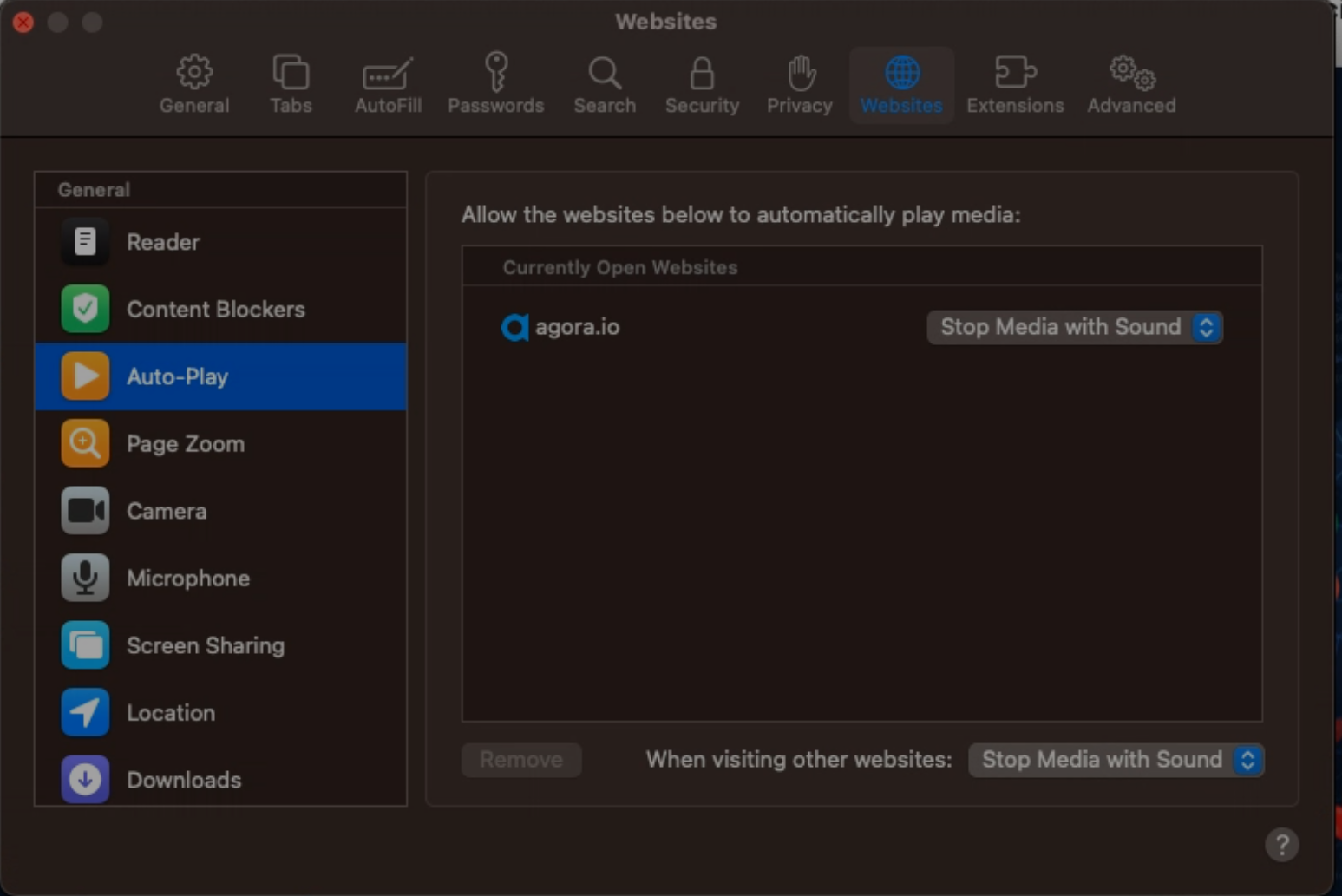
* If **Auto-Play** is not enabled on Safari (as the following figure shows), the stream playback has no audio. You have to call the `navigator.mediaDevices.getUserMedia` method to get the device permissions before playing a stream.
****Firefox****
**Firefox**
* Black screen issue on the receiver's side with Firefox version 138
**Issue description**: When users interact using real-time audio and video on Firefox version 138, the receiver may see a black screen instead of video.
**Root cause**: This issue is caused by a rollback in the Firefox browser. Version 138 introduced a temporary change that causes video stream decoding to fail. This is a compatibility issue introduced by the browser vendor. For details, see [Bugzilla 1965831](https://bugzilla.mozilla.org/show_bug.cgi?id=1965831).
**Workaround**: Agora has implemented a temporary fix through configuration delivery. In incognito or private browsing mode, this configuration may not take effect, and integration changes may be required. Contact [technical support](mailto\:support@agora.io) for assistance.
* The default setting for the minimum video bitrate in Web SDK does not take effect on Firefox.
* Sending SEI data in H.264 video streams is not supported on Firefox.
* On Firefox 98, when sending H.264 video from Windows devices, the keyframes cannot be received immediately after the video is subscribed, thus slowing down the rendering of the first video frame.
* When the Web SDK on Firefox communicates with the SDK on some devices, the video on Firefox is rotated.
* Firefox does not support changing the frame rate (30 fps by default).
* Firefox does not support setting the audio encoding rate.
* Setting the video profile on Firefox does not take effect on the following devices:
* MacBook Pro (13-inch, 2016, Two Thunderbolt 3 ports)
* Windows 10 (MI)
* On Macs with the Apple M1 chip, Firefox does not support H.264. For details, see the [Firefox documentation](https://bugzilla.mozilla.org/show_bug.cgi?id=1686470).
* Firefox does not support getting `CodecType`, `sendFrameRate` and `captureFrameRate`.
**Other restrictions on desktop**
* On Chrome 81 or later, Safari, and Firefox, device IDs are only available after the user has granted permission to use the media device. This restriction affects the `getMicrophones`, `getCameras`, and `getPlaybackDevices` methods.
* The `setPlaybackDevice` method is only supported on Chrome. Calling this method on other browsers throws the `NOT_SUPPORTED` error.
* The `setOptimizationMode` method and the `optimizationMode` parameter in `CameraVideoTrackInitConfig`, `ScreenVideoTrackInitConfig`, and `CustomVideoTrackInitConfig` are only supported on Chrome.
* **Mobile**
****iOS****
**iOS known issues**
iOS 16.0: The video is stretched after the screen changes to a certain orientation
**Impact**: All browsers and apps that use WKWebView on iOS 16.0, such as Safari and Chrome.
**Reason**: Due to the regression of the WebRTC module of WebKit on iOS 16.0, RTP streaming with coordination of video orientation (CVO) does not work properly, which causes the video to be stretched after rotation.
**Workaround**: Agora recommends that you add a prompt to remind users of this issue.
**iOS 15.1.x: The browser crashes when sending the H.264 video stream**
**Impact**: All browsers and apps that use WKWebView on iOS 15.1.x, such as Safari and Chrome.
**Details**: If you set `codec` as `'h264'` when calling `createClient`, the browsers on iOS 15.1.x crash after you send the video stream.
**Reason**: This issue happens due to the regression of the WebKit video encoder on iOS 15.1.x. For details, see [WebKit Bug 231505](https://bugs.webkit.org/show_bug.cgi?id=231505).
**Workaround**: Use the VP9 codec for video encoding.
```javascript
createClient({codec:'vp9', mode})
```
**iOS 15.x: The actual bitrate of sending the H.264 video stream is lower than expected**
**Impact**: Safari on iOS 15.x
**Reason**: The issue occurs because **WebRTC H264 LowLatency encoder** is enabled by default for Safari on iOS 15.x. For details, see [Webkit bug 238366](https://bugs.webkit.org/show_bug.cgi?id=238366).
**Workaround**: The following workarounds are available:
* Use the VP9 codec for video encoding. The sample code is as follows:
```javascript
createClient({codec:'vp9', mode})
```
* On the iOS device, go to **Settings** > **Safari** > **Advanced** > **Experimental Features**, and disable **WebRTC H264 LowLatency encoder**.
**iOS 15.0 to 15.3: Low audio volume**
**Impact**: All browsers and apps that use WKWebView on iOS 15.0 to 15.3, such as Safari and Chrome.
**Details**: On iOS 15.0 to 15.3, after the local user subscribes to the `RemoteAudioTrack` and plays it, sometimes the audio is routed to the earpiece instead of the speaker, and the volume that the local user hear may be very low.
**Reason**: This issue happens due to the regression of the WebKit audio module on iOS 15.0 to 15.3. For details, see [ WebKit Bug 230902](https://bugs.webkit.org/show_bug.cgi?id=230902).
**Workaround**: On iOS 15.0 to 15.3, use `WebAudio` to play the audio, and use `GainNode` to increase the audio volume level. Use the following workaround:
1. Upgrade to the Web SDK 4.9.0 or later versions.
2. Set the SDK private parameter `REMOTE_AUDIO_TRACK_USES_WEB_AUDIO` as `true`. The SDK uses `WebAudio` to play the remote audio stream. Sample code:
```javascript
function isIOS15(ua){
// Use UA to judge whether the iOS version is 15
}
if(isIOS15(navigator.userAgent)){
// If you are using Typescript, add the "@ts-ignore" tag before calling setParameter
// @ts-ignore
AgoraRTC.setParameter("REMOTE_AUDIO_TRACK_USES_WEB_AUDIO", true);
}
```
**iOS 15.x: The video playback goes black**
**Impact**: All browsers and apps that use WKWebView on iOS 15.x, such as Safari and Chrome.
**Details**: On iOS 15.x, if you play the video in DOM node and add some CSS properties (such as `transform` and `animation`) to the` video` element or its parent element, or if you change the CSS properties to redraw the video rendering area, sometimes the video goes black.
**Reason**: This issue happens due to the regression of the WebKit video renderer on iOS 15.x. For details, see [WebKit Bug 230902](https://bugs.webkit.org/show_bug.cgi?id=230902).
**Workaround**: Upgrade to the Web SDK v4.7.3 or later and minimize changes to the CSS properties of the `video` element and its parent elements.
**iOS 15.x: If a user wears a Bluetooth headset, the audio may be significantly distorted**
**Impact**: All browsers and apps that use WKWebView on iOS 15.x, such as Safari and Chrome.
**Reason**: This issue happens due to the regression of the WebKit audio playback module on iOS 15.x. For details, see [WebKit Bug 231422](https://bugs.webkit.org/show_bug.cgi?id=231422).
**Workaround**: Agora recommends that you add a prompt to remind users of possible audio distortion issues when they use a Bluetooth headset.
**Backgrounding the browser or app causes the audio streaming to be cut off.**
**Impact**:
* Safari on iOS 15.x.
* Browsers and apps that use WKWebView (such as Chrome) on iOS 14.4 to iOS 15.x.
**Reason**:
* For Safari: This happens primarily due to this WebKit [bug](https://bugs.webkit.org/show_bug.cgi?id=231105). After the browser switches to the background, the `AudioContext` of `WebAudio` stops processing audio.
* For browsers and apps using WKWebView: This happens because iOS `WKWebView` prohibits microphone usage while in the background. For details, see [Microphone gets muted in background](https://developer.apple.com/forums/thread/689182).
**Workaround**: Currently there is no workaround for browsers and apps using WKWebView. For Safari on iOS 15.x, you can follow these steps to avoid this issue:
1. Upgrade to the Web SDK v4.7.3 or later versions.
2. When calling `createMicrophoneAudioTrack`, set `bypassWebAudio` as `true`. The Web SDK directly publishes the local audio stream without processing it through `WebAudio`.
```javascript
const localAudioTrack = await AgoraRTC.createMicrophoneAudioTrack({bypassWebAudio: true});
```
> Note that this workaround has a side effect. After applying this workaround, the audio mixing function (`MixingAudioTrack`) in the SDK fails.
**iOS 15.x: Audio and video playback might not resume automatically after being interrupted by a system phone call, another real-time interaction app, Siri, or an alarm.**
**Impact**: All browsers and apps that use WKWebView on iOS 15.x, such as Safari and Chrome.
**Reason**: Such interruptions can cause the state of the `video` and `audio` elements to be `paused`. After the interruption finishes, the state cannot be automatically switched back to `playing`, and even calling `HTMLMediaElement.play` cannot resume the media playback. See the WebKit bug [232599](https://bugs.webkit.org/show_bug.cgi?id=232599) and [226698](https://bugs.webkit.org/show_bug.cgi?id=226698) for more details.
**Workaround**: Upgrade to the Web SDK v4.7.3 or later versions. The SDK attempts to resume media playback after the interruption. Agora recommends that you add a prompt that instructs users to refresh the page.
**iOS 15.x and 16.x: Certain iPad and iPhone models may experience noise issues after entering a channel.**
**Impact**: Chrome and Safari browsers on specific iPad and iPhone models with iOS 15.x and 16.x. Specific models include:
* iPad (5th Gen)
* iPad (6th Gen)
* iPad (7th Gen)
* iPad Pro (1st Gen)
* iPhone SE (1st Gen)
**Workaround**: Update to the latest iOS version.
**Other known issues**
* The volume of a remote user can change randomly on iOS 13 and 14.
* Switching between the front and rear cameras can momentarily rotate the video.
* The audio routing can change randomly. Sometimes, the audio is routed to the speakerphone when a headset is connected or to the earpiece when no headset is connected.
* If you call `getUserMedia` twice to get two tracks of the same media type, the first track goes muted or black.
* After a user switches to another app that uses the microphone or camera (such as Siri or Skype) and then switches back, the audio sampling or video capture fails.
**iOS known limitations**
**The `createScreenVideoTrack` method is not supported**
Reason: iOS Safari and WKWebView do not support the `mediaDevices.getDisplayMedia` method.
**The `setBeautyEffect` method is not supported**
Reason: WebGL is not well supported on iOS Safari and WKWebView, and the image enhancement algorithm can reduce the system performance below acceptable levels.
**`The IBufferSourceAudioTrack.seekAudioBuffer` method is not supported**
Reason: `WebAudio` on iOS does not support this method.
**Cannot send H.264 video streams with a resolution of 1080p or higher**
Reason: The Web SDK uses the H.264 Baseline Profile for negotiation, so encoding and sending a video stream with a resolution of 1080p or higher is not supported on iOS.
**When sending a low-quality stream on iOS Safari, you cannot set `LowStreamParameter.bitrate`, and the resolution of the low-quality stream must be proportional to the resolution of the high-quality stream.**
Reason: iOS Safari and WkWebView do not support setting the frame rate with the `RTCRTPSender.setParameters` method. After compressing the resolution with the `scaleResolutionDownBy` property, the resolution of the low-quality stream stays proportional to the resolution of the high-quality stream.
**The `encodeDelay` property is not supported**
Reason: The `encodeDelay` property cannot be calculated through the `getStats` method of WebRTC on iOS.
**Backgrounding the browser or app causes the user's video to display as a black screen**
Reason: iOS `AVCaptureSession` prohibits camera usage while in the background. For details, see [AVCaptureSessionInterruptionReason](https://developer.apple.com/documentation/avfoundation/avcapturesessioninterruptionreason/avcapturesessioninterruptionreasonvideodevicenotavailableinbackground?preferredLanguage=occ) or [Chromium issue 4294](https://bugs.chromium.org/p/webrtc/issues/detail?id=4294).
**Calling `RemoteAudioTrack.setVolume` has no effect on the playback volume of the remote audio**
Reason: iOS and iOS WebView do not support setting the volume of a media object through the `HTMLMediaElement.volume` property.
****Android****
**Android known issues**
Android 12: Video distortion on Chrome when hardware acceleration is enabled
**Impact**: The Chrome browser or Chromium kernel browser 97 or earlier on certain devices with Android 12, such as Pixel 3 and Pixel 4.
**Details**: If the Chrome browser on Android 12 enables the WebRTC `H264` or `VP9` hardware acceleration by default, video distortion can occur.
**Reason**: This issue happens due to the regression of the Chromium WebRTC video encoder. For details, see [Chromium issue 1237677](https://bugs.chromium.org/p/chromium/issues/detail?id=1237677).
**Workaround**: Chrome 97 fixed this issue. You can instruct users to upgrade to Chrome 97 or later versions.
**The bitrate when sending video on Android Chrome fails to reach the preset value.**
**Scope**: Certain Android devices, such as Xiaomi and OnePlus.
**Reason**: This is a hardware encoder issue. The bitrate fails to reach the preset value at a specific video encoding frame rate.
**Workaround**: In most cases, the bitrate is relatively lower when the frame rate is set as 15 fps. If you set the frame rate as 30 fps, the bitrate increases. So Agora recommends trying to set the frame rate as 30 fps when encountering a bitrate issue. However, setting the frame rate as fps may cause performance issues.
**The autoplay of inaudible media is blocked on WeChat**
**Impact**: The WeChat browser using Chromium 89 kernel
**Details**: The autoplay of inaudible media is blocked. Even after the user interacts with the webpage to resume the video playback, the autoplay block is still not removed.
**Reason**: This issue happens because the WeChat browser implements a custom autoplay policy.
**Workaround**: Follow these steps to avoid this issue:
1. Upgrade to the Web SDK v4.6.0 or later versions.
2. Listen to the `AgoraRTC.onAutoplayFailed` event. Instruct the user to click on the page to resume playback:
```javascript
AgoraRTC.onAutoplayFailed = ()=>{
document.alert('Please click the page to resume playback');
}
```
**If a local user wears a Bluetooth headset, after they start to send the audio, the remote audio is lost**
**Scope**: Certain Xiaomi and OnePlus devices
**Details**: If a local user wears a Bluetooth headset, when the Bluetooth headset starts capturing the audio, there is a possibility that the remote audio is lost.
**Reason**: It may be due to the audio issue on Chromium regarding the profile switch of the Bluetooth.
**Workaround**: Agora recommends that you add a prompt to remind users of possible audio-loss issues when they use a Bluetooth headset.
**When a local user is sending audio, switching the audio output device does not take effect**
**Scope**: Chromium-based browsers on Android devices
**Details**: When a local users is sending audio, if the user switches from using the speaker to using a Bluetooth headset, the remote audio still comes from the speaker.
**Reason**: The audio routing on Android devices is controlled by the Android operating system and cannot be fixed at Chromium's level. For details, see [Chromium issue 1317548](https://bugs.chromium.org/p/chromium/issues/detail?id=1317548\&q=bluetooth\&can=2).
**Issues specific to certain Android devices**
* On devices equipped with **MediaTek chips**, the Web SDK cannot encode and send video streams in H.264.
* On devices equipped with Huawei **HiSilicon Kirin** chips, if you use Chrome versions earlier than 88, the Web SDK cannot encode and send video streams in H.264.
* When receiving video streams on Chrome on **OnePlus 6**, if the screen turns off, the video can freeze.
* **Harmony OS** does not support sending the video stream of 180p.
**Other known issues**
* On some Android devices, the device labels might not be available.
* On some Android devices, tracks can end if the audio and video streams are interrupted by system phone calls or other audio or video calling apps. To resume the call, the Web SDK needs to re-capture the audio and video.
* On Android Chrome, the Web SDK cannot send high-quality and low-quality streams in H.264.
* On Android Chrome earlier than 90, the volume obtained by `getVolumeLevel` is 0, but the user can hear the audio.
* On Android system Webview versions from 55 to 75, the `decodeFrameRate` property stays 0.
* When running Android 11 on certain OPPO models, such as Reno4 and A11, users will experience black screens and no sound due to the lack of WebRTC support.
**Android known limitations**
**The `createScreenVideoTrack` method is not supported**
Reason: The `mediaDevices.getDisplayMedia` method is not implemented on mobile browsers and WkWebView.
**The `setBeautyEffect` method is not supported**
Reason: The image enhancement algorithm can reduce the system performance of mobile devices below acceptable levels.
### v4.24.5 [#v4245]
Released on June 24, 2026.
#### Upgrade considerations [#upgrade-considerations]
* **Domain allowlist change**
Starting with v4.24.5, the SDK domain allowlist is updated to:
```text
.agora.io
.edge.agora.io
.sd-rtn.com
.edge.sd-rtn.com
.rtnsvc.com
.edge.rtnsvc.com
.rtesvc.com
.edge.rtesvc.com
```
If you upgrade to v4.24.5, update your firewall allowlist so the SDK continues to work in restricted-network environments. See [Firewall requirements](/en/realtime-media/voice/reference/firewall).
#### New features [#new-features-37]
* **Background voice removal in AI Noise Suppression**
The AI Noise Suppression extension is enhanced to remove background human voices. In noisy environments or scenarios with multiple speakers, this capability further isolates the target speaker and improves audio capture. See [Extension release notes](#ai-noise-suppression).
#### Improvements [#improvements-40]
This release includes the following improvements:
* Optimized the signaling flow to improve session-setup efficiency and connection success rates in complex network environments.
* Optimized media-tracing links and jitter-buffer handling to reduce first-frame time and audio and video stuttering in certain scenarios.
* The audio subscription flow now uses a presubscribe model by default, improving subscription efficiency and playback stability. When full-link feedback and frame-rate-priority mode are enabled, you can now set a lower bound for resolution downgrade.
#### Fixed issues [#fixed-issues-4]
This release fixed the following issues:
* Connection setup could time out in some scenarios.
* The remote user received duplicate `user-joined` callbacks when a user with a string UID rejoined a channel immediately after leaving.
* Messages could not be received in some scenarios.
* On Safari 16.6, the local view could turn black or exit unexpectedly in some scenarios.
* Remote video could freeze briefly after the first `client.publish(video)` call.
* TypeScript type definition files were missing and some exported symbols were incorrect in the npm package.
### v4.24.4 [#v4244]
Released on May 27, 2026.
#### Improvements [#improvements-41]
This release includes internal optimizations for weak-network scenarios, improving the login success rate.
### v4.24.3 [#v4243]
Released on April 1, 2026.
#### New features [#new-features-38]
* **AI Noise Suppression extension upgrade**
The AI Noise Suppression extension ([agora-extension-ai-denoiser](https://www.npmjs.com/package/agora-extension-ai-denoiser)) is upgraded to v2.0.1. This version adds a low-latency mode and the ability to configure the log level of the WASM module. For details, see [Extension release notes](#ai-noise-suppression).
#### Improvements [#improvements-42]
This release includes the following improvements:
* Optimizes the interactive video experience in H.264 encoding scenarios.
* The [Super Clarity extension](#super-clarity-extension) is upgraded to v2.0.1, with sharpening algorithm improvements that provide better video experience in some scenarios.
### v4.24.2 [#v4242]
Released on December 12, 2025.
This release addresses a compatibility issue introduced in Chrome 143.
#### Issue description [#issue-description]
During a communication session between users A and B, if user A unsubscribes and stops publishing an audio stream and then tries to publish audio again, the SDK triggers the following error:
`Session error code: ERROR_CONTENT`
A breaking change in Chrome causes this issue and affects all versions of the RTC Web SDK. See the [Chromium bug report](https://issues.chromium.org/issues/467468926) for details.
#### Solution [#solution]
This version implements a compatibility fix that prevents the issue from interrupting republishing and subscription workflows. The fix remains in place until Chrome provides an official update.
The Agora R\&D team has reported the issue to the Chrome team and continues to monitor its progress.
### v4.24.1 [#v4241]
Released on November 26, 2025.
#### New Features [#new-features-39]
* **Pre-call network test**
Conducting a pre-call network test helps local users assess and predict the quality of their uplink network before starting a call. This version adds the [`startLastmileProbeTest`](https://api-ref.agora.io/en/video-sdk/web/4.x/interfaces/iagorartc.html#startlastmileprobetest) API, which returns information about packet loss, jitter, and round-trip time for both uplink and downlink before the call begins.
* **Dual-stream mode**
This version introduces the [`setDualStreamMode`](https://api-ref.agora.io/en/video-sdk/web/4.x/interfaces/iagorartcclient.html#setdualstreammode) method, which improves how you subscribe to dual video streams. By setting the `mode` parameter to `AUTO_SIMULCAST_MODE`, you enable adaptive low-stream mode on the sender side (low-stream is not sent by default). To send low streams, follow these steps:
* The host on the receiving side calls `setRemoteVideoStreamType` to initiate a low-stream request.
* The sender automatically switches to low-stream mode upon receiving the request.
Additionally, you can set the mode parameter to `DISABLE_SIMULCAST_STREAM` (never send low stream) or `ENABLE_SIMULCAST_STREAM` (always send low stream).
For the relationship between this method and the existing `enableDualStream` and `disableDualStream`, see the [API Reference](https://api-ref.agora.io/en/video-sdk/web/4.x/interfaces/iagorartcclient.html#setdualstreammode). To ensure clear integration logic, Agora recommends that you choose one set of APIs for integration. Agora plans to deprecate `enableDualStream` and `disableDualStream` in future versions.
* **Watermark extension (BETA)**
This version adds the Watermark extension [`agora-extension-video-watermark`](https://www.npmjs.com/package/agora-extension-video-watermark) v1.0.0, which enables you to add image watermarks to real-time interactive video streams through an extension.
The Watermark extension supports customizing the watermark's position, size, opacity, and other properties. It can be applied to both local and remote video tracks. For integration and usage steps, refer to Using the [Watermark extension guide](/en/realtime-media/video/build/apply-video-effects/watermark).
* **Other New Features**
Adds support for H.265 decoding. Refer to the [API Reference](https://api-ref.agora.io/en/video-sdk/web/4.x/globals.html#sdk_codec) for supported browser versions and usage restrictions.
#### Improvements [#improvements-43]
* **Expanded screen sharing capabilities**
This version further expands screen sharing capabilities. In the `createScreenVideoTrack` API, the following parameters are added to support audio sharing during screen sharing:
* `windowAudio` and `monitorTypeSurfaces` are added to [`ScreenVideoTrackInitConfig`](https://api-ref.agora.io/en/video-sdk/web/4.x/interfaces/screenvideotrackinitconfig.html) to control whether to allow sharing window audio and sharing the entire screen, respectively.
* `suppressLocalAudioPlayback` and `restrictOwnAudio` are added to `ScreenAudioTrackInitConfig` to control whether local audio playback and capture are allowed.
In screen sharing scenarios with co-hosting, Agora does not recommend sharing system or window audio, as it may cause echo. You can disable audio sharing by setting both `windowAudio` and `systemAudio` in `ScreenVideoTrackInitConfig` to `"exclude"`.
* **New release of the Super Clarity extension**
This version upgrades the algorithm of [`agora-extension-super-clarity`](https://www.npmjs.com/package/agora-extension-super-clarity), with improvements in reducing plugin size, enhancing video experience, and expanding browser compatibility. The new version of the plugin requires a browser that supports SIMD to run properly. For detailed changes and improvements, refer to the [Extension release notes](#super-clarity-extension).
#### Bug Fixes [#bug-fixes-3]
Fixes an issue on iOS where the system volume could not be set to `0` after destroying an audio stream.
### v4.24.0 [#v4240]
Released on August 6, 2025
#### New features [#new-features-40]
* **Fast first-frame rendering**
Adds a new `options` parameter to the [`join`](https://api-ref.agora.io/en/video-sdk/web/4.x/interfaces/iagorartcclient.html#join) method to configure channel media options. When you set `autoSubscribe` to `true` in [`IJoinOptions`](https://api-ref.agora.io/en/video-sdk/web/4.x/interfaces/ijoinoptions.html), the user automatically subscribes to the host’s media stream when joining the channel.
In real-time interactive scenarios such as one-on-one or one-to-many calls, this feature reduces the time to render the first frame and improves the overall interactive experience.
When automatic subscription to the host’s media stream is enabled, Agora delivers the media stream and starts billing for usage as soon as the user joins the channel.
#### Improvements [#improvements-44]
* **Transmission optimization in poor network conditions**
Optimizes the bandwidth estimation algorithm and implements audio-priority transmission. This reduces the risk of video stuttering under extremely poor network conditions and improves the smoothness of resolution switching, making transitions more seamless. The SDK also responds faster after network recovery.
* **New media connection strategy**
Introduces a new media connection strategy that improves the SDK’s reconnection and media login success rates under enterprise and restricted network environments.
* **Improved accuracy for network quality evaluation**
Enhances the algorithm for evaluating [`NetworkQuality`](https://api-ref.agora.io/en/video-sdk/web/4.x/interfaces/networkquality.html) by incorporating available bandwidth as a reference. This enables the SDK to more accurately reflect the impact of bandwidth-limited network conditions.
This improvement requires enabling a private parameter. Contact [support@agora.io](mailto\:support@agora.io) for details.
##### Other improvements [#other-improvements]
* Optimizes the default video bitrate under different encoding standards to allocate uplink bandwidth more efficiently and reduce stuttering in poor network conditions.
* Improves the fallback mechanism for devices that do not support AV1 decoding.
* Enhances the user experience in one-on-one calls in `rtc` mode when communicating between Web clients or between Web and Native clients.
#### Issues fixed [#issues-fixed-40]
This version fixes the following issues:
* Black screen on Firefox 138+ caused by a browser version rollback.
* Video stuttering caused by Safari 18.4 and 18.5.
* Encoding failure when the resolution was too low.
* Occasional black screen in scenarios using Plan-B.
### v4.23.4 [#v4234]
Released on June 5, 2025.
This release includes internal improvements. It fixes an issue where calling `setMute` or `setEnable` under certain conditions could result in no sound. If you are using SDK version 4.23.0 or later, upgrade to this release for a better user experience.
### v4.23.3 [#v4233]
Released on April 29, 2025.
This release updates the virtual background extension to [v2.1.0](https://www.npmjs.com/package/agora-extension-virtual-background), with the following changes:
* Optimizes memory and CPU usage.
* Fixes black screen issues at specific resolutions.
### v4.23.2 [#v4232]
Released on March 4, 2025.
This release includes the following improvements:
* Internal optimizations to support [Agora Conversational AI Engine](/en/ai).
* Enable audio metadata transmission
* Get presentation timestamp from the audio stream
For details on using these features, [submit a technical support ticket](https://agoraio.zendesk.com/hc/en-us).
* Further reduced package size.
### v4.23.1 [#v4231]
Released on January 17, 2025.
This release includes several internal improvements.
### v4.23.0 [#v4230]
Released on December 19, 2024.
#### Compatibility changes [#compatibility-changes-24]
This release modified the calculation of [`freezeRate`](https://api-ref.agora.io/en/video-sdk/web/4.x/interfaces/remotevideotrackstats.html#freezerate) in `RemoteVideoTrackStats`. The calculation is changed from the cumulative average freeze rate to the freeze rate in the last second. You can use this parameter to determine whether the video is experiencing a momentary freeze. To calculate the cumulative average freeze rate for the current session, use [`totalFreezeTime`](https://api-ref.agora.io/en/video-sdk/web/4.x/interfaces/remotevideotrackstats.html#totalfreezetime) or [`totalDuration`](https://api-ref.agora.io/en/video-sdk/web/4.x/interfaces/remotevideotrackstats.html#totalduration).
#### New features [#new-features-41]
1. **`PeerConnection` state callback for the local media**
To obtain the media connection state under poor network conditions, this release adds the [`peerconnection-state-change`](https://api-ref.agora.io/en/video-sdk/web/4.x/interfaces/iagorartcclient.html#event_peerconnection_state_change) event, which is used to obtain the connection state of WebRTC [RTCPeerConnection](https://developer.mozilla.org/en-US/docs/Web/API/RTCPeerConnection).
2. **Sharing the current tab by default**
To improve the ease of use of screen sharing, this release adds the [`preferCurrentTab`](https://api-ref.agora.io/en/video-sdk/web/4.x/interfaces/screenvideotrackinitconfig.html#prefercurrenttab) parameter in `ScreenVideoTrackInitConfig`, which supports setting sharing the current tab as default when creating a screen sharing track.
#### Improvements [#improvements-45]
1. **Improved media reconnection strategy**
This release improves the media reconnection strategy, which in turn increases the reconnection and media login success rate under poor network conditions. For enterprise networks with firewalls, the improvement is particularly noticeable. Contact [support@agora.io](mailto\:support@agora.io) to try this new strategy.
2. **Improved virtual background algorithm**
This release upgrades the [Virtual Background extension](https://www.npmjs.com/package/agora-extension-virtual-background/v/2.0.0) to version 2.0.0. The updated algorithm provides a more distinct face edge and clearer and more stable video images.
3. **Reduced package size**
To further reduce the package size, this release separates the Plan-B feature, which is compatible with WebRTC, from the ESM-bundle package into an independent service module. Users can integrate them manually based on actual needs. For details, see [Use tree shaking](../build/optimize-and-operate/app-size-optimization.mdx).
4. **Other improvements**
* Optimized login duration under complex network conditions.
* Optimized layer switching algorithm of VP9, which can reduce latency and improve video smoothness.
Safari does not support VP9 SVC.
#### Bug fixes [#bug-fixes-4]
This release fixes the following issues:
* Black screen might occur when calling `setMute` and `setEnable` under certain conditions.
* Occasional audio and video stream sending failures after network disconnection and reconnection.
* Users with the role of `audience` can send streams in a 128-person scene.
#### API changes [#api-changes-21]
**Added**
* `AgoraRTC.on("peer-connection-state-change")`
* `preferCurrentTab` in `ScreenVideoTrackInitConfig`
### v4.22.2 [#v4222]
v4.22.2 was released on 29 October 2024.
#### New features [#new-features-42]
**Screen sharing audio 3A processing**
Starting from v4.22.2, when calling the `createScreenVideoTrack` method to create a screen sharing video track, the `withAudio` parameter supports passing `ScreenAudioTrackInitConfig` to customize the initialization config of audio sharing. Depending on your use case, you can enable 3A processing (AGC, AEC, and ANS) as needed to optimize the quality of shared audio.
For details, see the [API documentation](https://api-ref.agora.io/en/voice-sdk/web/4.x/interfaces/iagorartc.html#createscreenvideotrack).
If your browser does not support audio sharing, passing `ScreenAudioTrackInitConfig` will only return the video track.
#### API changes [#api-changes-22]
This version introduces the following new APIs:
* The `withAudio` parameter in the `createScreenVideoTrack` method supports passing `ScreenAudioTrackInitConfig`.
### v4.22.1 [#v4221]
v4.22.1 was released on 23 September, 2024.
#### Improvements [#improvements-46]
This release includes several internal improvements.
### v4.22.0 [#v4220]
v4.22.0 was released on 16 August, 2024.
#### Compatibility changes [#compatibility-changes-25]
To further reduce the package size, this version splits the Channel Media Relay Service and the Live Streaming Service from the ESM-bundle format package into independent service modules. You can manually import these modules for integration based on your actual needs. See [Use tree shaking](../build/optimize-and-operate/app-size-optimization.mdx) for details on how to integrate.
#### New features [#new-features-43]
**Optimize channel preload**
When using the channel preload feature, Agora recommends sending the host's media stream immediately when calling the method to join the channel. This reduces the first frame rendering time. For details, see [Preload channels](/en/realtime-media/video/build/join-and-manage-channels/preload-channels). With this setting, users will start pulling streams as soon as they join the channel, which will generate charges. For details on how Agora charges for the services, see [Pricing](pricing.mdx).
**Support for AV1 encoding (Beta)**
The SDK supports the AV1 video encoding format. You can enable this encoding format by setting `ClientConfig.codec` to `av1`. Compared to H.264 at the same bitrate, AV1 offers over a 30% improvement in encoding efficiency and provides better video quality.
#### Improvements [#improvements-47]
This version includes the following improvements:
* Optimizes the SVC (Scalable Video Coding) capability for VP9 encoding and decoding, which further enhances the video quality and transmission efficiency.
* Improves VAD (Voice Activity Detection) with a new music detection feature, increasing the accuracy of voice detection.
#### Issues fixed [#issues-fixed-41]
This version fixes the following issues:
* The issue where Safari failed to retrieve `stats` in certain use-cases.
* The issue with inaccurate bitrate settings under poor network conditions in certain use-cases.
#### API changes [#api-changes-23]
This version introduces the following new APIs:
* `AgoraRTCClient.getRemoteAudioStats` adds the `receivePacketsDiscarded` return field.
* `ClientConfig.codec` adds the `av1` enumeration.
* The `AgoraRTC` module in the ESM-bundle adds the `use` method.
### v4.21.0 [#v4210]
v4.21.0 was released on June 3, 2024.
#### Compatibility changes [#compatibility-changes-26]
This release introduces the Video Quality Control (VQC) module. `ICameraVideoTrack` enables the `“motion”` mode by default to ensure the smoothness of the video under low bandwidth and high CPU usage to further improve the user experience. You can call the [setOptimizationMode](https://api-ref.agora.io/en/video-sdk/web/4.x/interfaces/ilocalvideotrack.html#setoptimizationmode) method to dynamically adjust the transmission mode of the video according to your needs.
#### New features [#new-features-44]
**Preload channels**
This release adds the [AgoraRTC.preload](https://api-ref.agora.io/en/video-sdk/web/4.x/interfaces/iagorartc.html#preload) method, which allows the user whose role is set to `audience` to preload channels before joining one. Calling the method can help shorten the time of joining a channel, thus reducing the time it takes for audience members to hear the host.
#### Improvements [#improvements-48]
This release includes the following improvements:
* Enhances the bandwidth estimation and congestion control algorithms for the sender in weak network conditions, effectively reducing the buffering rate of the sender under such conditions.
* Optimizes the SDK's browser compatibility detection scope to address the issue of inaccurate browser compatibility detection on certain devices.
* To enhance the user experience of browsers under Safari 17.4, the video quality adaptive algorithm has been added to improve the adaptability of video quality in the case of limited network bandwidth, to further ensure the smoothness of video streaming.
#### Issues fixed [#issues-fixed-42]
This release fixes the following issues:
* On some Android devices, the video playback status returned by `isPlaying` was inaccurate.
* On Safari mobile browsers, the resolution information of the local video track returned by the `getLocalVideoStats` method was inaccurate; the resolution set by `setLowStreamParameter` for the low stream resolution did not take effect.
#### API changes [#api-changes-24]
**Added**
* `AgoraRTC.preload`
### v4.20.2 [#v4202]
v4.20.2 was released on March 21, 2024.
#### Issues fixed [#issues-fixed-43]
This release fixes the issue where the browser would modify the captured video resolution when calling [createCustomVideoTrack](https://api-ref.agora.io/en/video-sdk/web/4.x/interfaces/iagorartc.html#createcustomvideotrack) in certain use-cases.
### v4.20.1 [#v4201]
v4.20.1 was released on February 28, 2024.
#### New features [#new-features-45]
This release adds the following new features:
**Send the SEI in the H.264 video streams**
This release introduces the `LocalVideoTrack.sendSeiData` method and the `RemoteVideoTrack.on("sei-received")` event to add and send the Supplemental Enhancement Information (SEI) within the H.264 video streams. The SEI data package has a maximum size of 1KB and encompasses dynamic facial capture data, virtual video information, and digital watermarking. To enable this feature, please contact technical support.
**Note:**
* This functionality is only supported on Chrome 87 or later, as well as Safari 15.4 or later.
* Due to the conflicts in certain browser core components, this feature is not available when [end-to-end media encryption (Beta)](../build/secure-and-protect-channels/media-stream-encryption.mdx) is enabled.
**Monitor the video states of receivers**
v4.20.1 introduces the `"video-state-changed"` event, which enables real-time monitoring of the video states of receivers, such as freezing and recovery, thereby facilitating prompt responses. For more information, see [API documentation](https://api-ref.agora.io/en/video-sdk/web/4.x/interfaces/iremotetrack.html#event_video_state_changed).
**Data Stream Encryption**
To enhance the security of data stream transmission, this version introduces a new `encryptDataStream` parameter in the `setEncryptionConfig` method for enabling data stream encryption. For more details, see [API documentation](https://api-ref.agora.io/en/video-sdk/web/4.x/interfaces/iagorartcclient.html#setencryptionconfig).
#### Improvements [#improvements-49]
This release adds the following improvements:
* Optimizes the audio reception experience on mobile devices, reducing issues such as electric noise or silence caused by browser defects in single audio stream use-cases.
* Enhances video bitrate settings by adding a default setting for the minimum video bitrate. If you don't specify a value for `bitrateMin` when calling `setEncoderConfiguration`, the SDK will automatically set an appropriate bitrate based on the resolution and frame rate settings. This default setting only applies to Chrome and Edge browsers.
#### Issues fixed [#issues-fixed-44]
This release fixes the following issue:
* In a single channel with 128 concurrent online hosts, if a user left the channel during network reconnection, it could result in the failure to subscribe to other users' audio streams for the local user.
#### API changes [#api-changes-25]
**Added**
* `LocalVideoTrack.sendSeiData`
* `RemoteVideoTrack.on("sei-received")`
* `RemoteVideoTrack.on("video-state-changed")`
* `encryptDataStream` parameter to `AgoraRTCClient.setEncryptionConfig`
### v4.20.0 [#v4200]
v4.20.0 was released on December 8, 2023.
#### Compatibility changes [#compatibility-changes-27]
Prior to v4.20.0, the `IRemoteAudioTrack.setPlaybackDevice` method could be invoked on Firefox, but an echo issue would occur due to a Firefox [bug](https://bugzilla.mozilla.org/show_bug.cgi?id=1849108). To improve the user experience, starting from v4.20.0, the SDK throws a `NOT_SUPPORTED` error when this method is called.
If you are using the `IRemoteAudioTrack.setPlaybackDevice` method, you need to make code modifications after upgrading to v4.20.0.
#### New features [#new-features-46]
On certain versions of iOS devices, the app call might not automatically resume after being interrupted by a WeChat call or system phone call. To address this issue, this release introduces the `"audio-context-state-changed"` event to monitor whether the app call has been interrupted, and the `resumeAudioContext` method to restore the app call.
For usage details, refer to the [API documentation](https://api-ref.agora.io/en/voice-sdk/web/4.x/interfaces/iagorartc.html#resumeaudiocontext).
#### Improvements [#improvements-50]
This release includes the following improvements:
* Reduces the time it takes to join a channel when the user ID is a string.
* Supports audio sharing on the ChromeOS platform when sharing the entire screen or a Chrome tab.
#### API changes [#api-changes-26]
**Added**
* `resumeAudioContext`
* `AgoraRTC.on("audio-context-state-changed")`
### v4.19.3 [#v4193]
v4.19.3 was released on November 2, 2023.
#### Issues fixed [#issues-fixed-45]
This release fixes a black screen issue when receiving H.264 encoded video streams on Safari prior to 16. Specifically, when a client using v4.19.2 SDK for Web made a video call on Safari prior to 16 to a client using the SDK for Android, iOS, Windows, or macOS, the web client displayed a black screen if the native client sent H.264 encoded video streams.
If you have integrated v4.19.2 of the SDK, Agora recommends upgrading to v4.19.3 as soon as possible.
### v4.19.2 [#v4192]
v4.19.2 was released on October 20, 2023.
#### Improvements [#improvements-51]
**VP9 codec (GA)**
This release advances VP9 from Beta to General Availability (GA) and introduces the following enhancements:
* Updated browser compatibility: VP9 now supports Safari 16.0 and later versions on both desktop and mobile platforms.
* Automatic fallback to VP8 for older browsers: If any user in a channel uses a browser version below the [specified compatibility threshold](#vp9-codec), all VP9-encoded video streams in that channel will automatically transition to VP8.
Test results show that VP9 provides twice the quality of VP8 at equivalent bitrates.
**Dynamic resolution adjustment on Safari**
Safari has a known issue where it does not automatically reduce video encoding resolution under poor network conditions or reduced video frame rates, potentially leading to blurry video. To ensure user experience, this release adds the `"720p_auto"` preset to the video encoder configurations. This preset guarantees automatic adjustment of the video encoding resolution on Safari.
After upgrading to this version, if you are using a 720p video profile, Agora recommends switching to the `"720p_auto"` preset and setting the encoding format to `"vp9"` for optimal results.
#### API changes [#api-changes-27]
**Added**
* `"720p_auto"` to `VideoEncoderConfigurationPreset`
### v4.19.1 [#v4191]
v4.19.1 was released on October 11, 2023.
#### Issues fixed [#issues-fixed-46]
This release fixes the issue that an error occurred when using Webpack 4.x to bundle your app after integrating the SDK.
### v4.19.0 [#v4190]
v4.19.0 was released on September 25, 2023.
After integrating this version of the SDK into your app, you might encounter an error if you use Webpack 4.x to bundle your app. To resolve this issue: - If you intend to use Webpack 4.x, upgrade the SDK to v4.19.1.
- If you prefer to continue using v4.19.0, Agora recommends bundling your app with Webpack 5.x or other tools such as Vite.
#### Compatibility changes [#compatibility-changes-28]
**Dynamic low-quality video profile adjustment**
Before 4.19.0, you had to call `setLowStreamParameter` before `publish` to set the video profile for the low-quality video stream. This meant that changing the profile after publishing required republishing, impacting the viewing experience.
As of this release, you can call `setLowStreamParameter` after `publish` to dynamically adjust the resolution, bitrate, and frame rate of the low-quality video stream. Agora recommends modifying your `setLowStreamParameter` calls as needed after upgrading to this release. For example, in use-cases such as live streaming and video conferences, as the number of hosts in the channel increases, you can dynamically adjust the video profile of the low-quality video stream to relieve bandwidth pressure.
#### New features [#new-features-47]
**Tree shaking support**
As of this release, the SDK supports [tree shaking](https://webpack.js.org/guides/tree-shaking/), which removes unused code during the build process, reducing your app's size after integrating the SDK. To use this feature, see [App size optimization](/en/api-reference/sdks).
**Dual display of video stream**
This release adds the `clone` method, allowing you to duplicate the current camera or screen sharing video track and customize display parameters. This can be useful in use-cases such as video conferencing and online education, where you want to display the same video stream with two sets of display parameters, including resolution, frame rate, and bitrate. For example, you can have one display set to high definition and the other to low definition.
**Switch between front and rear cameras**
To improve camera switching on mobile devices, this release adds the `facingMode` parameter to the `ICameraVideoTrack.setDevice` method. You can specify whether to use the front or rear camera on the mobile device.
See [`setDevice`](https://api-ref.agora.io/en/voice-sdk/web/4.x/interfaces/icameravideotrack.html#setdevice) for details.
**Third-party video moderation**
As of this release, the SDK supports integration with third-party video moderation services.
See `setImageModeration` in the [API Reference](https://api-ref.agora.io/en/voice-sdk/web/4.x/index.html) for details.
**Beta features**
End-to-end media encryption and Super Clarity extension are released in beta.
See [beta documentation](https://docs-beta.agora.io/en/realtime-media/video/reference/release-notes) for details.
#### Improvements [#improvements-52]
**Optimized automatic mode**
In the automatic mode, the SDK initially attempts a direct connection to Agora SDRTN®. If the attempt fails, the SDK automatically switches to TCP/TLS 443. To enhance the connection experience in restricted networks, this release optimizes the SDK's automatic mode, improving connection speed and stability. The optimized automatic mode no longer uses proxies, resulting in the deprecation of the `AgoraRTCClient.on("join-fallback-to-proxy")` callback.
**Other improvements**
This release also includes the following improvements:
* Reduces the time to first frame rendering. To enable this improvement, please [contact technical support](mailto\:support@agora.io).
* Adds token expiration as a reason for a user leaving a channel in the `AgoraRTCClient.on("connection-state-change")` callback for easier troubleshooting.
* Adds `sendJitterMs` and `sendRttMs` to local audio track information, reporting jitter (ms) and round-trip time (ms) for sent audio packets.
#### Issues fixed [#issues-fixed-47]
This release fixes the following issues:
* Under normal network conditions, the SDK occasionally misreported uplink network quality as `5` in the first few seconds after joining a channel.
* The local and remote audio and video packet loss rates reported by the SDK under the `currentPacketLossRate` attribute were inaccurate.
* On Windows devices using Chrome 115 browser, if the local user's screen sharing remained static without mouse movement, screen sharing stopped.
* During the procedure of subscribing to remote media streams, instances arose where the absence of audio was sporadically encountered by the local user when the remote user republished the audio stream. Likewise, when the remote user republished the video stream, occasional occurrences of a black screen were observed by the local user.
* Memory was not promptly released after calling `IBufferSourceAudioTrack.close`.
#### API changes [#api-changes-28]
**Added**
* `ICameraVideoTrack.clone` and `ILocalVideoTrack.clone`
* `facingMode` to the `setDevice` method
* `TOKEN_EXPIRE` to the `ConnectionDisconnectedReason` enum
* `setImageModeration`
* `AgoraRTCClient.on("image-moderation-connection-state-change")`
* `ImageModerationConfiguration`
* `ImageModerationConnectionState`
* `sendJitterMs` and `sendRttMs` to the `LocalAudioTrackStats` interface
* `sendJitterMs` and `sendRttMs` to the `LocalVideoTrackStats` interface
* `getRTCRtpTransceiver`
* `AgoraRTCClient.on("transceiver-updated")`
**Deprecated**
* `AgoraRTCClient.on("join-fallback-to-proxy")`
### v4.18.3 [#v4183]
v4.18.3 was released on September 20, 2023.
#### Issues fixed [#issues-fixed-48]
v4.18.3 fixes the following issue:
* The SDK failed to obtain audio and video statistics on Safari 17.
### v4.18.2 [#v4182]
v4.18.2 was released on July 11, 2023.
#### Issues fixed [#issues-fixed-49]
v4.18.2 fixes the following issues:
* In certain circumstances, Video SDK for Web triggered microphone and camera device permission prompts after it
finished loading.
### v4.18.1 [#v4181]
v4.18.1 was released on July 03, 2023.
#### Improvements [#improvements-53]
**Error handling support for event listeners**
As of this release, when an error occurs during the execution of the callback function assigned to the event listener (`listener`), the SDK does not interrupt normal operation. Instead, the SDK captures the exception and provide error information in the logs.
**Enhanced concurrency control for asynchronous methods**
This release optimizes concurrency control for asynchronous methods. When the following asynchronous methods are invoked concurrently, the SDK executes them in the order they were called, ensuring consistency:
* `join` and `leave`
* `publish` and `unpublish`
* `subscribe` and `unsubscribe`
Taking `publish` and `unpublish` as an example, if you call `unpublish` immediately after calling `publish`:
* In versions earlier than 4.18.1, `unpublish` might not take effect, which means the media track could remain published.
* As of version 4.18.1, the actual result is consistent with the order of these method calls, which means the media track is correctly unpublished.
#### Issues fixed [#issues-fixed-50]
This release fixed the issue that the following callbacks were not triggered when an external camera or microphone was initially connected to a device without any available cameras or microphones:
* `onCameraChanged` or `AgoraRTC.on("camera-changed")`
* `onMicrophoneChanged` or `AgoraRTC.on("microphone-changed")`
### v4.18.0 [#v4180]
v4.18.0 was released on June 12, 2023.
#### New features [#new-features-48]
**Variable playback speed for audio files**
To facilitate changing the playback speed of audio effect or music files, v4.18.0 modifies the `IBufferSourceAudioTrack` class as follows:
* Adds the `setAudioBufferPlaybackSpeed` method, which can be called before or after a user joins a channel.
* Adds the `playbackSpeed` property to retrieve the current playback speed.
**Custom signaling proxy**
v4.18.0 adds the `setProxyServer` method to allow customization of the signaling proxy server used by the SDK.
**Flexible event listening for AgoraRTC objects**
As of v4.18.0, the `IAgoraRTC` class inherits all methods from the `EventEmitter` class, providing a flexible way of listening to all events emitted by the `AgoraRTC` object.
Using `onCameraChanged` as an example:
```javascript
// Previous event listening (earlier than v4.18.0)
AgoraRTC.onCameraChanged = (info) => {
console.log("camera changed!", info.state, info.device);
};
// New event listening (v4.18.0 and later)
AgoraRTC.on("camera-changed", (info) => {
console.log("Camera changed!", info.state, info.device);
});
```
You can continue using the previous approach. However, for higher flexibility and extensibility, Agora recommends modifying the listening approach for the following events after upgrading the SDK:
* `onAutoplayFailed`
* `onCameraChanged`
* `onMicrophoneChanged`
* `onPlaybackDeviceChanged`
* `onSecurityPolicyViolation`
* `onAudioAutoplayFailed`: Deprecated, see `onAutoplayFailed` instead
Scalable Video Coding, access to encoded data, and enhanced connection experience in restricted networks are released in beta.
See [beta documentation](https://docs-beta.agora.io/en/realtime-media/video/reference/release-notes) for details.
#### Improvements [#improvements-54]
**Shorter time to join channel**
As of v4.18.0, the SDK enables WebSocket message compression by default, reducing the time to join a channel in poor network conditions.
**Other improvements**
v4.18.0 also includes the following improvements:
* Improves the retry mechanism by adding a 3s retry rule to switch a downgraded video resolution to a higher one. This prevents the video resolution from remaining low when the network conditions improve, resulting in a better user experience.
* Upgrades the Cloud Proxy service to enhance its stability in different network environments.
#### API changes [#api-changes-29]
**Added**
* `setProxyServer`
* `setAudioBufferPlaybackSpeed` method and `playbackSpeed` property to `IBufferSourceAudioTrack`
* The following methods inherited from the `EventEmitter` class to the `IAgoraRTC` class:
* `on`
* `off`
* `once`
* `getListeners`
* `removeAllListeners`
These methods support the following event names as parameters:
* `"camera-changed"`
* `"microphone-changed"`
* `"playback-device-changed"`
* `"autoplay-failed"`
* `"security-policy-violation"`
#### Issues fixed [#issues-fixed-51]
v4.18.0 fixes the following issues:
* Mobile devices experienced delays in receiving notifications for the [broadcaster leave channel event](../build/optimize-and-operate/receive-notifications.mdx).
* Users experienced a black screen while watching video streams encoded with H.264 in older browser versions.
* Memory usage increased when using the SDK with the Virtual Background or Image Enhancer extension.
* The SDK continued to use the expired token during reconnection attempts after generating a new token using the `renewToken` method.
### v4.17.2 [#v4172]
v4.17.2 was released on April 20, 2023.
#### Issues fixed [#issues-fixed-52]
This release fixes the issue where the `getCurrentFrameData` method returned abnormal data.
### v4.17.1 [#v4171]
v4.17.1 was released on April 19, 2023.
#### Compatibility changes [#compatibility-changes-29]
Chrome 107 prevents users from sharing the current tab by default. If you need to allow users to share the current tab on Chrome 107 and later versions, please upgrade your SDK to v4.17.1 or later as soon as possible.
To accommodate changes related to screen sharing in Chrome 107 (refer to [Chrome documentation](https://developer.chrome.com/docs/web-platform/screen-sharing-controls/)), this release introduces the following changes to the `config` parameter in the `createScreenVideoTrack` method:
* Deprecates the `screenSourceType` property. If you are using this property, replace it with the newly added `displaySurface` property after upgrading to this version.
* Adds new properties: `selfBrowserSurface`, `surfaceSwitching`, and `systemAudio`.
For detailed explanations of these properties, see [ScreenVideoTrackInitConfig](https://api-ref.agora.io/en/voice-sdk/web/4.x/interfaces/screenvideotrackinitconfig.html) in the API reference.
#### Improvements [#improvements-55]
**Improved flexibility in setting video profiles**
This release improves the flexibility in setting video profiles for different types of video tracks:
* You can now specify the resolution and the frame rate when calling `createCustomVideoTrack` to create a custom video track, by passing in values for the `width`, `height`, and `frameRate` parameters.
* After creating a screen track or a custom video track, you can dynamically adjust the video profile using `LocalVideoTrack.setEncoderConfiguration`. Please note that there is a known issue with calling this method on a screen track in certain versions of macOS Safari. [See issue details](/en/realtime-media/video/reference/common-problems).
For details, see more about [Configure video encoding](/en/realtime-media/broadcast-streaming/build/manage-video-and-streaming/configure-video-encoding).
**Other improvements**
This release also includes the following improvements:
* The time required to create tracks using `createMicrophoneAudioTrack` or `createMicrophoneAndCameraTracks` on Safari browsers is reduced.
* When you have two `AgoraRTCClient` objects created locally, you have the option to block certain callbacks from one `AgoraRTCClient` to another. These callbacks include those triggered when joining or leaving a channel, and publishing or unpublishing streams. For example, if you are using Client A for publishing a screen track and Client B for publishing a camera track, and you enable this feature to block callbacks, Client A and B will not receive the following callbacks from each other:
* `AgoraRTCClient.on("user-published")`
* `AgoraRTCClient.on("user-joined")`
* `AgoraRTCClient.on("user-unpublished")`
* `AgoraRTCClient.on("user-left")`
* `AgoraRTCClient.on("published-user-list")`
* `AgoraRTCClient.on("user-info-update")`
To enable this feature, contact technical support.
#### API changes [#api-changes-30]
**Added**
* `displaySurface` (replacement for `screenSourceType`), `selfBrowserSurface`, `surfaceSwitching`, and `systemAudio` in the `ScreenVideoTrackInitConfig` interface
* `width`, `height`, and `frameRate` in the `createCustomVideoTrack` method
* `LocalVideoTrack.setEncoderConfiguration`
**Deleted**
* `ILocalVideoTrack.setBeautyEffect`
### v4.17.0 [#v4170]
v4.17.0 was released on March 22, 2023.
#### New features [#new-features-49]
**Dynamic switching of local video streams**
This release adds the `ILocalVideoTrack.replaceTrack` method to increase the flexibility to switch local video tracks.
For example, to switch from one camera to another before v4.17.0, you needed to call `IAgoraRTCClient.unpublish` to
unpublish the current track and then call `IAgoraRTCClient.publish` to publish a new track.
As of v4.17.0, you can call `ILocalVideoTrack.replaceTrack` directly.
#### Improvements [#improvements-56]
**Optimized reconnection mechanism**
As of v4.17.0, the SDK defaults to showing the last video frame before disconnection during reconnection,
which prevents a black screen during the reconnection process. This optimization is not available on Safari due to Safari's limitations.
**Other improvements**
This release also includes the following improvements:
* The accuracy of SDK-related quality metrics on [Analytics](/en/realtime-media/agora-analytics/product-overview) is improved.
* The time required to join a channel is reduced. This optimization is not available on Firefox due to Firefox's limitations.
#### API changes [#api-changes-31]
**Added**
* `ILocalVideoTrack.replaceTrack`
**Deleted**
* `ILocalVideoTrack.setBeautyEffect`
#### Issues fixed [#issues-fixed-53]
On Safari on iOS 14.7 and later, performing subscribing and unsubscribing operations repeatedly to multiple audio streams could result in not hearing remote users.
### v4.16.1 [#v4161]
Voice Calling v4.16.1 was released on February 7, 2023.
#### Issues fixed [#issues-fixed-54]
This release fixes the following issue:
* When using Video SDK for Web v4.16.0, the video freeze rate showed in Agora Analytics is much higher than the correct value.
### v4.16.0 [#v4160]
Voice Calling v4.16.0 was released on January 5, 2023.
#### Improvements [#improvements-57]
This release adds the following enhancements:
**Compatibility for deprecated RTCMediaStreamTrackStats on Chrome**
Chrome plans to deprecate the stats dictionary `RTCMediaStreamTrackStats`.
See the service announcement on [discuss-webrtc@googlegrooups.com](https://groups.google.com/g/discuss-webrtc/c/9c8ZjberEcI).
This change affects the following media track statistics returned by the SDK:
| Statistics | Affected fields |
| :---------------------- | :------------------------------------------------------------------------------------------------------------------- |
| `LocalVideoTrackStats` | * `sendFrameRate`
* `sendResolutionHeight`
* `sendResolutionWidth` |
| `RemoteVideoTrackStats` | - `receiveFrameRate`
- `receiveResolutionHeight`
- `receiveResolutionWidth`
- `renderFrameRate`
- `receiveDelay` |
| `RemoteAudioTrackStats` | * `receiveDelay`
* `receiveLevel` |
To ensure the accuracy of these media track statistics on Chrome, please upgrade the SDK to v4.16.0 or later as soon as possible.
**Other improvements**
This version of the SDK also includes the following improvements:
* The cause of the [`HTMLMediaElement` error event](https://developer.mozilla.org/en-US/docs/Web/API/HTMLMediaElement/error_event)
is now recorded in the log.
* The size of the SDK package is reduced.
#### Issues fixed [#issues-fixed-55]
This release fixes the following issues:
* Media operations failed when the SDK was attempting to reconnect to the network.
* When relaying media streams across channels, [`ChannelMediaRelayConfiguration.addDestChannelInfo`](https://api-ref.agora.io/en/voice-sdk/web/4.x/interfaces/ichannelmediarelayconfiguration.html#adddestchannelinfo)
could not set `uid` to `0` to identify the relay stream in the destination channel.
* Some known issues on iOS 14.x.
### v4.15.1 [#v4151]
v4.15.1 was released on December 2, 2022.
#### Issues fixed [#issues-fixed-56]
This release fixes the following issue:
* No audio was received on iOS 13.7.
### v4.15.0 [#v4150]
v4.15.0 was released on October 31, 2022.
#### New features [#new-features-50]
The latest features in this release are:
##### Audio stream filter (Beta) [#audio-stream-filter-beta]
v4.15.0 introduces filtering audio streams based on volume. Once this function is enabled, Agora SDRTN® ranks all subscribed audio streams by volume. By default, the three audio streams with the highest volume are transported to others in the channel. To change the number of audio streams to be transported, contact [support@agora.io](mailto\:support@agora.io).
Agora enables channel hosts to control whether the audio streams being published are filtered based on volume. Streams that are not filtered bypass this filter mechanism and are transported directly to the receivers. In use-cases with a large number of publishers, enabling this function helps reduce the bandwidth and device system pressure for the receivers.
To enable this function, contact [support@agora.io](mailto\:support@agora.io).
##### VP9 codec [#vp9-codec]
Video SDK for Web v4.15.0 adds support for the VP9 codec in the following browsers:
| | Supported browsers① |
| ------- | ---------------------------------------------------------------------------------------------------------------- |
| Desktop | * Chrome 65 or later
* Firefox 69 or later
* Edge 79 or later
* Safari 16 or later |
| Android | - Chrome 68 or later
- Wechat v8.0.6 or later
- Other apps that use WKWebView: WebView v65.0.3325.109 or later |
| iOS | Safari 16 or later |
① To ensure the best user experience, best practice is to use the latest version of the browsers listed above.
To start a call using the VP9 codec, apps you connect to built using for Android, iOS, Windows, or macOS must use Video SDK v4.0.1 or greater.
##### CSP violation callback [#csp-violation-callback]
v4.15.0 adds the `AgoraRTC.onSecurityPolicyViolation` callback. When Agora fails to load a resource or send a request due to Content Security Policy(CSP) violations, the Video SDK triggers this callback. When you receive this callback, modify your CSP configuration to ensure that you can access Agora-related services.
#### Improvements [#improvements-58]
The SDK has the following improvements:
* The accuracy of network quality reported by `AgoraRTCClient.on("network-quality")` in certain use-cases has increased.
* Resumption of audio or video streams when the user switches between Wi-Fi networks is faster.
#### API changes [#api-changes-32]
**Added**
* `IAgoraRTC.onSecurityPolicyViolation`
#### Compatibility changes [#compatibility-changes-30]
Cloud Proxy default mode has changed. In Video SDK for Web v4.15.0, the `mode` parameter in `startProxyServer` defaults to `3`. This represents the Force UDP cloud proxy mode. In this mode, Video SDK always transmits data over UDP. For details, see [Restricted network connection with Cloud Proxy](../build/manage-connection-and-quality/cloud-proxy.mdx).
### v4.14.2 [#v4142]
v4.14.2 was released on October 27, 2022.
#### Issues fixed [#issues-fixed-57]
This release fixes the following issue:
* When using WeChat browsers on iOS 14.x, no audio is received from the first channel the user subscribes to.
### v4.14.1 [#v4141]
v4.14.1 was released on October 24, 2022.
#### Issues fixed [#issues-fixed-58]
This release fixes the following issues:
* On Electron v17.x, screen sharing did not work properly. To solve this issue, add the following code in the main process:
```javascript
const { ipcMain, desktopCapturer } = require("electron");
ipcMain.handle("DESKTOP_CAPTURER_GET_SOURCES", (event, opts) => desktopCapturer.getSources(opts));
```
* On desktop Safari, if autoplay was blocked for all videos, they kept trying to replay resulting in video freeze.
* On mobile browsers, the video freeze rate calculated by the SDK was higher than the actual value when the browser was running in the background.
* In Android WebView, the default poster (a gray play button) of the video element showed before video playback.
* Media stream relay failed after the SDK resumed connection to the network.
* During a media stream relay, the SDK continued to send heartbeats after the user left the source channel.
### v4.14.0 [#v4140]
v4.14.0 was released on August 31, 2022.
#### Compatibility changes [#compatibility-changes-31]
**getVolumeLevel accuracy improvement**
As of v4.14.0, the SDK calibrates the calculation of the volume returned in `getVolumeLevel`. The volume range is still \[0,1], where 1 represents the highest audio level. If your business use-case depends on the volume returned in `getVolumeLevel` (for example, a speaker icon shows according to the volume), ensure that you check the returned volume after upgrading to v4.14.0.
#### Issues fixed [#issues-fixed-59]
This release fixes the following issue:
* The received Opus stereo audio had no stereo effect.
* On versions earlier than Chrome 76, the `decodeFrameRate` returned by the `getRemoteVideoStats` method was 0.
* On WeChat browsers running on iOS 14.1 and 14.2, the first subscribed audio stream was silent.
* After calling `LocalVideoTrack.setBeautyEffect` to enable image enhancement, calling `LocalVideoTrack.unpipe` caused an error.
* On Windows Chrome 103 and later versions, enabling the dual-stream mode did not take effect in certain use-cases.
### v4.13.0 [#v4130]
v4.13.0 was released on July 25, 2022.
#### New features [#new-features-51]
#### Improvements [#improvements-59]
**AI Noise Suppression and virtual background**
The AI Noise Suppression extension and virtual background extension are converted from beta release to official release. To experience the AI Noise Suppression or virtual background extension, contact [support@agora.io](mailto\:support@agora.io).
**Callback for token expiration**
v4.13.0 improved the logic of triggering the callback for token expiration. If a token expires when the user's device is in sleep mode or disconnected from network, the SDK triggers the `token-privilege-did-expire` event when the device resumes operation and attempts to reconnect to the SDK.
#### API changes [#api-changes-33]
**Added**
* `RemoteAudioTrack.pipe`
* `RemoteAudioTrack.unpipe`
### v4.12.2 [#v4122]
v4.12.2 was released on July 7, 2022. This release improved the automatic mode for SDK connectivity (In this mode, the SDK first attempts a direct connection to Agora SDRTN®; if the attempt fails, the SDK automatically switches to TCP/TLS 443).
### v4.12.1 [#v4121]
v4.12.1 was released on June 27, 2022. This release fixed the following issues:
* Subscribing to remote streams occasionally failed after disconnection.
### v4.12.0 [#v4120]
v4.12.0 was released on June 15, 2022.
#### Improvements [#improvements-60]
**Media processing extensions**
Media processing extensions have the following changes:
* The [Image Enhancement Extension (Beta)](https://www.npmjs.com/package/agora-extension-beauty-effect) is released. This extension incorporates and upgrades the built-in image enhancement feature (enabled by [setBeautyEffect](https://api-ref.agora.io/en/video-sdk/web/4.x/interfaces/ilocalvideotrack.html#setbeautyeffect))) of the Agora Web SDK 4.x. You can adjust parameters including the contrast, brightness, and smoothness levels, in order to touch up the image for effects such as skin lightening and skin smoothing. For details, see [Use the Image Enhancement Extension](/en/realtime-media/marketplace/build/add-video-and-ar-effects/banuba).
#### Issues fixed [#issues-fixed-60]
v4.12.0 fixed the issue that when dual-stream mode was enabled on Safari, calling methods such as `Track.setEnabled(false)` and `Track.close()` could not turn off the camera indicator light.
### v4.11.1 [#v4111]
v4.11.1 was released on May 9, 2022. This release fixed the following issues:
* Subscribing to audio streams might cause no sound on Firefox.
* Compatibility issues occurred in Safari on iOS 12 and in the WeChat built-in browser on iOS 13.
### v4.11.0 [#v4110]
v4.11.0 was released on April 1, 2022.
#### Compatibility changes [#compatibility-changes-32]
As of v4.11.0, the SDK adopts an automatic mode by default to ensure connectivity. In this mode, the SDK first attempts a direct connection to Agora SDRTN®; if the attempt fails, the SDK automatically switches to TCP/TLS 443. You can listen for such auto-switch events through `client.on("join-fallback-to-proxy")`.
#### Improvements [#improvements-61]
**Channel capacity improvement**
As of v4.11.0, a single channel can support up to 128 concurrent online hosts, who can publish media streams at the same time. The number of audience members in a channel is unlimited. Each host or audience member can subscribe to a maximum of 50 hosts at the same time.
To experience this improvement, contact [support@agora.io](mailto\:support@agora.io).
#### Fixed issues [#fixed-issues-5]
v4.11.0 fixed the following issues:
* Angular’s dependency zone.js caused an error when `Promise.finally` was called in the SDK.
* On Chrome, AEC could not be enabled when sending stereo sound.
* On Chrome 100, the SDK reported inaccurate statistics for the decoding frame rate and sending frame rate.
* When dual-stream mode was enabled, calling `unpublish` without parameters caused the method call to fail.
### v4.10.2 [#v4102]
v4.10.2 was released on March 24, 2022. This release fixed the issue that calling `join` in certain use-cases might cause proxy exceptions.
### v4.10.1 [#v4101]
v4.10.1 was released on March 17, 2022 and added the dependency of TypeScript type definitions for Agora Extension `agora-rte-extension` in `package.json`. If you use TypeScript for type checking, Agora suggests that you update TypeScript to v4.3.2 or later.
### v4.10.0 [#v4100]
v4.10.0 was released on March 11, 2022.
#### New features [#new-features-52]
#### API changes [#api-changes-34]
**Added**
* `AgoraRTC.registerExtensions`
* `LocalTrack.pipe`
* `LocalTrack.unpipe`
* `LocalTrack.processorDestination`
### v4.9.4 [#v494]
v4.9.4 was released on March 16, 2022 and fixed the failure to access localStorage when loading the SDK in an iFrame in Chrome Incognito mode.
### v4.9.3 [#v493]
v4.9.3 was released on March 3, 2022. This release fixed several internal issues.
### v4.9.1 [#v491]
v4.9.1 was released on February 24, 2022. This release fixed several internal issues.
### v4.9.0 [#v490]
v4.9.0 was released on February 17, 2022.
#### New features [#new-features-53]
**Cloud Proxy Force TCP mode**
v4.9.0 adds Force TCP mode for the Agora Cloud Proxy service. In this mode, the SDK always transmits data over TLS 443. To use this mode, set `mode` as 5 when calling `startProxyServer`.
#### Improvements [#improvements-62]
* Improves the accuracy of the `client.on("is-using-cloud-proxy")` event.
#### Issues fixed [#issues-fixed-61]
v4.9.0 fixed the following issues:
* When using v4.8.0 together with Angular and zone.js, users might fail to join a channel because zone.js modified the promise object.
* Several known issues on iOS.
#### API changes [#api-changes-35]
**Added**
* `client.on("join-fallback-to-proxy")`
### v4.8.2 [#v482]
### v4.8.1 [#v481]
v4.8.1 was released on January 6, 2022. This release fixed an internal issue.
### v4.8.0 [#v480]
v4.8.0 was released on December 29, 2021.
#### New features [#new-features-54]
#### Improvements [#improvements-63]
v4.8.0 made some internal improvements.
#### Issues fixed [#issues-fixed-62]
v4.8.0 fixed the following issues:
* When receiving streams on iOS Safari as an audience member, the host’s voice could be heard, but the volume returned by the `client.on("volume-indicator")` event was 0.
* When sending streams on iOS Safari, if you first call `setDevice` and then `setEncoderConfiguration`, the SDK returns an error.
#### API changes [#api-changes-36]
### v4.7.3 [#v473]
v4.7.3 was released on November 17, 2021. This release avoided the issue that on the Safari browser in iOS 15.1, after a call was interrupted, the Voice Calling failed to resume playing the remote media.
### v4.7.2 [#v472]
v4.7.2 was released on October 14, 2021, with the following changes:
* Fixed the issue that calling `AgoraRTC.checkSystemRequirements()` on the Edge browser only returned `false`.
### v4.7.1 [#v471]
v4.7.1 was released on September 13, 2021. This release fixed some issues on Safari 11 and iPad Chrome.
### v4.7.0 [#v470]
v4.7.0 was released on September 1, 2021.
#### Compatibility changes [#compatibility-changes-33]
As of v4.7.0, if you enable media stream encryption, the SDK automatically disables encryption and resets the encryption configurations after a user leaves the channel. To re-enable the encryption, call `setEncryptionConfig` before the user joins the channel again.
#### Improvements [#improvements-64]
This release makes the following improvements:
* Optimizes the end-user experience of the Voice Calling on the mobile browser.
* Improves the accuracy of the volume obtained by `getVolumeLevel`.
* Adds the support of enabling dual-stream mode on Safari.
#### Issues fixed [#issues-fixed-63]
This release fixed the following issues:
* After calling `LocalAudioTrack.setVolume` to adjust the local volume, the local user could not perceive the volume change.
* When the log level was set to none, the SDK nevertheless output the initialization logs.
* The promise returned by `LocalAudioTrack.setDevice` could get stuck in a pending state.
### v4.6.3 [#v463-1]
v4.6.3 was released on August 10, 2021. This release fixed an occasional issue: After the user closes a tab or browser on the local client, the remote client does not receive the `user-left` event immediately.
### v4.6.2 [#v462-3]
v4.6.2 was released on July 30, 2021. This release fixed the issue that the SDK did not destroy all the media players created during a call or live streaming. Chrome 92 introduced a limit on the number of media players that can be created in a particular tab: 75 for the desktop. After you play tracks several times, the undestroyed media players in the SDK might cause the playback failure in the tab.
### v4.6.1 [#v461-1]
v4.6.1 was released on July 21, 2021. This release fixed an internal error.
### v4.6.0 [#v460-3]
v4.6.0 was released on July 16, 2021.
#### New features [#new-features-55]
**Interactive Live Streaming Standard**
As of v4.6.0, the Voice Calling supports Interactive Live Streaming Standard. The major difference between Agora Interactive Live Streaming Standard and Agora Live Interactive Streaming Premium is the latency level on the audience’s client:
* Interactive Live Streaming Premium: Ultra-low latency (400 ms to 800 ms) from the host’s client to an audience member’s client.
* Interactive Live Streaming Standard: Low latency (1500 ms to 2000 ms) from the host’s client to an audience member’s client.
The charges for Standard and Premium are different. For details, see the [product overview](../product-overview.md) and [pricing](pricing.mdx) of Interactive Live Streaming Standard.
You can set the latency level of the audience role in the following two ways:
* When calling `createClient` to create a client object, set the `role` parameter as `"audience"` and the `level` parameter in `clientRoleOptions` as `1`.
* When calling the `setClientRole` method, set the `role` parameter as `"audience"` and the level parameter in `clientRoleOptions` as `1`.
**The mute states of local tracks**
v4.6.0 adds the `localTrack.setMuted` method to stop sending the media data of local tracks. The differences between this method and `localTrack.setEnabled` are as follows:
* Calling `setEnabled(true)` takes longer to resume sending the media data than by than calling `setMuted(false)`.
#### Improvements [#improvements-65]
**Dealing with autoplay blocking**
On most web browsers, inaudible media are not affected by autoplay blocking. However, on iOS Safari with low power mode enabled, or on other iOS in-app browsers that implement a custom autoplay policy, such as the WeChat browser, the autoplay of inaudible media is blocked.
#### Issues fixed [#issues-fixed-64]
v4.6.0 fixes the following issues:
* The method call of `localAudioTrack.setVolume` did not take effect immediately.
* Using multiple clients on one web page caused unexpected issues.
* The SDK did not check whether the App ID was a string of 1 to 256 bytes in size.
#### API changes [#api-changes-37]
**Added**
* `localTrack.setMuted`
* `onAutoplayFailed`
* `clientRoleOptions` in `ClientConfig`
* `options` in the `setClientRole` method
**Deprecated**
* `onAudioAutoplayFailed`
### v4.5.0 [#v450-3]
v4.5.0 was released on May 25, 2021.
#### New features [#new-features-56]
**AEC (Acoustic Echo Canceller) for the audio played on the local client**
In a use-case where multiple users play a media file at the same time, such as watching a movie together, if the user A plays the media file through [HTMLMediaElement](https://developer.mozilla.org/en-US/docs/Web/API/HTMLMediaElement) on Chrome with a speaker, the SDK captures the audio played by a speaker together with the voice of the user A. The other users can hear the audio sent by the user A and the audio played locally, which sounds like an echo. To deal with this echo issue, v4.5.0 adds the `processExternalMediaAEC` method. You can call `processExternalMediaAEC` and pass in the `HTMLMediaElement` to enable the AEC for the audio played on the local client.
#### Improvements [#improvements-66]
**Channel encryption**
To strengthen the security of the key, v4.5.0 adds two encryption modes, `"aes-128-gcm2"` and `"aes-256-gcm2"`, which use the PBKDF2 (Password-Based Key Derivation Function 2). When calling `setEncryptionConfig` and setting the encryption mode as `"aes-128-gcm2"` or `"aes-256-gcm2"`, you need to set `secret` and `salt`. For how to generate and set `secret` and `salt`, see [Secure channel encryption](../build/secure-and-protect-channels/media-stream-encryption.mdx).
**Restrict media zones**
As of v4.5.0, when calling `setArea` to specify the media zone for connection, you can use the `areaCode` parameter to specify a large zone and use the `excludedArea` parameter to specify a small zone. The region for connection is the large zone excluding the small zone. You can only specify the large zone as `"GLOBAL"`. For details, see [Restrict media zones](/en/realtime-media/video/build/manage-connection-and-quality/geofencing).
#### Issues fixed [#issues-fixed-65]
v4.5.0 fixes the following issues:
* The `OptimizationMode` setting did not take effect.
* On iOS, when the Voice Calling captures media, noises might occur on the local client.
* On Chrome, after you called `remoteAudioTrack.setVolume` to adjust the volume, if the playback was paused and then resumed, the volume changed back to the original one.
* On Chrome, the `LocalAudioTrack.setVolume` method did not take effect.
#### API changes [#api-changes-38]
**Added**
* `processExternalMediaAEC`
* `clientRoleOptions` in `ClientConfig`
* `options` in the `setClientRole` method
* `salt` in the `setEncryptionConfig` method
* `"aes-128-gcm"` and `"aes-256-gcm"` in `EncryptionMode`
* `excludedArea` in the `setArea` method
### v4.4.0 [#v440-3]
v4.4.0 was released on April 2, 2021.
#### Compatibility changes [#compatibility-changes-34]
**Firewall domain whitelist**
As of v4.4.0, the destination domains required for your firewall whitelist changes to:
.agora.io
.edge.agora.io
.sd-rtn.com
.edge.sd-rtn.com
If you upgrade the SDK to v4.4.0, update your firewall domain whitelist to ensure you can use Agora products in environments with restricted network access.
#### Improvements [#improvements-67]
**AES-GCM encryption mode**
In use-cases requiring high security, to ensure the confidentiality, integrity and authenticity of data, and to improve the computational efficiency of data encryption, v4.4.0 adds the following encryption modes in `EncryptionMode`:
* `"aes-128-xts"`: 128-bit AES encryption, GCM mode.
* `"aes-256-gcm"`: 256-bit AES encryption, GCM mode.
Once you enable the built-in encryption, all users in the same channel must use the same encryption mode and key, including the server-side users, such as the Agora recording service.
**Cloud proxy**
**Error code**
If you start media capturing after disabling the media capture device on Windows, the error thrown by the SDK changes from `UNEXPECTED_ERROR` to `NOT_READABLE`.
#### Issues fixed [#issues-fixed-66]
v4.4.0 fixes the following issues:
* The SDK did not trigger the `"first-frame-decoded"` event for a remote audio track.
* The return value of `AgoraRTC.checkSystemRequirement` was inaccurate.
* When the network had multiple IP addresses, the cloud proxy service did not take effect.
#### API changes [#api-changes-39]
**Added**
* `client.on("is-using-cloud-proxy")`
* `"aes-128-gcm"` and `"aes-256-gcm"` in `EncryptionMode`
### v4.3.0 [#v430-3]
v4.3.0 was released on January 26, 2021.
#### New features [#new-features-57]
**Cloud proxy**
This release optimizes the Agora cloud proxy architecture and enhances the connectivity of the Voice Calling in environments with restricted network access. The optimized Agora cloud proxy service also supports regional connection.
You can contact (mailto:support\@agora.io) to apply for using the optimized Agora cloud proxy service and set the `mode` parameter as `3` when calling `startProxyServer`. For details, see [Cloud proxy service](../build/manage-connection-and-quality/cloud-proxy.mdx).
### v4.2.1 [#v421-3]
v4.2.1 was released on December 23, 2020. This release fixed the incorrect error that the SDK throws when you pass an illegal parameter in the client.publish method.
### v4.2.0 [#v420-3]
v4.2.0 was released on December 1, 2020.
#### New features [#new-features-58]
**Regional connection**
This release adds the `AgoraRTC.setArea` method for specifying the region for connection. After specifying the region, the SDK connects to the Agora servers within that region. The following regions are supported:
* China
* North America
* Europe
* Asia, excluding Mainland China
* Japan
* India
* Global
This advanced feature applies to use-cases that have regional restrictions.
**Network quality of remote users**
This release adds the `AgoraRTCClient.getRemoteNetworkQuality` method for getting the uplink and downlink network quality of all the remote users to whom the local user subscribes.
**Cloud proxy**
This release changes the `mode` parameter of the `AgoraRTCClient.startProxyServer` method from `boolean` to `number`.
#### Improvements [#improvements-68]
* After you call `AgoraRTCClient.setEncryptionConfig` to enable the built-in encryption, when the user uses a weak secret, the SDK outputs a warning message to the Web Console and prompts the user to use a strong secret. A strong secret must contain at least eight characters and be a combination of uppercase and lowercase letters, numbers, and special characters.
#### Issues fixed [#issues-fixed-67]
* After an audience member tried to publish a local track in live mode but failed, the audience member could not publish this track even after switching the role to host.
* After dual-stream mode was enabled, a bug during the disconnection would occasionally cause publishing to fail after reconnection.
* Due to Safari’s limited support for WebAudio, the audio of `BufferSourceAudioTrack` could be distorted.
* When the SDK gained device permission for the first time, it did not trigger the media device change events (`onMicrophoneChanged`, `onCameraChanged`, or `onPlaybackDeviceChanged`). The SDK only triggered these events for a subsequent device change.
#### API changes [#api-changes-40]
**Added**
* `AgoraRTC.setArea`
* `AgoraRTCClient.getRemoteNetworkQuality`
**Changed**
* Changed the type of the `mode` parameter in `AgoraRTCClient.startProxyServer` from `boolean` to `number`
### v4.1.1 [#v411-3]
v4.1.1 was released on October 27, 2020. This release fixed the following issues:
* Improved the accuracy of the `event_network_quality` event.
* After calling `unsubscribe` to unsubscribing from an unpublished track of a remote user, the subsequent subscribing and unsubscribing operations failed to take effect.
### v4.1.0 [#v410-3]
v4.1.0 was released on September 4, 2020.
#### New features [#new-features-59]
**Audio playback device management**
v4.1.0 adds the following APIs to manage audio playback devices:
* `setPlaybackDevice`: Sets the audio playback device, for example, the speaker. This method supports Chrome only.
* `getPlaybackDevices`: Retrieves the audio playback devices available.
* `onPlaybackDeviceChanged`: Occurs when an audio playback device is added or removed.
#### Improvements [#improvements-69]
* Fully supports Chromium-based versions of Microsoft Edge (versions 80 and later).
* Improves the accuracy of the `network-quality` event.
* Supports sharing audio when sharing Chrome tabs on macOS.
#### Issues fixed [#issues-fixed-68]
* Occasional failure of reconnection after enabling dual-stream mode.
* Occasional failure to call `setEnabled` after leaving the channel.
* Failure to push streams to CDN with transcoding and without transcoding at the same time.
* Occasional failure to automatically re-subscribe to the remote streams after disconnection, indicated by the `UNEXPECTED_RESPONSE: ERR_SUBSCRIBE_REQUEST_INVALID` error.
* Failure to join different channels with the same UID in one browser tab.
* Occasional misreport on connection states due to frequent channel join and leave.
#### API changes [#api-changes-41]
**Added**
* `AgoraRTC.getPlaybackDevices`
* `LocalAudioTrack.setPlaybackDevice`
* `RemoteAudioTrack.setPlaybackDevice`
* `AgoraRTC.onPlaybackDeviceChanged`
* `Client.getLocalAudioStats`
* `Client.getRemoteAudioStats`
**Deprecated**
### v4.0.1 [#v401-3]
v4.0.1 was released on July 18, 2020. This release fixed the following issues:
* Failure to publish local tracks on Chrome 70.
* Publish operation may not be aborted when leaving the channel.
### v4.0.0 [#v400-3]
v4.0.0 was released on July 15, 2020.
#### Compatibility changes [#compatibility-changes-35]
v4.0.0 deletes the `LocalTrack.setMute` method and adds the `LocalTrack.setEnabled` method for enabling or disabling a local track. The advantages of this change are as follows:
* Eliminates the concept of "mute" to avoid confusion between mute states and publishing states.
* In versions earlier than v4.0.0, the SDK triggers the `Client.on("user-mute-updated")` callback when the remote user calls `setMute` to change the mute state.
* As of v4.0.0, the SDK triggers the existing `Client.on("user-unpublished")` or `Client.on("user-published")` callbacks when the remote user calls `setEnabled` to enable or disable a track.
> The `setEnabled` method changes media input behaviors, so it is an asynchronous operation and returns the result through the `Promise` object.
#### New features [#new-features-60]
#### Improvements [#improvements-70]
* The `Client.subscribe` method.
* The `Client.on("user-published")` and `Client.on("user-unpublished")` callbacks.
#### Issues fixed [#issues-fixed-69]
v4.0.0 fixed the following issues:
* After the local user called `unpublish`, the SDK triggerred the `Client.on("user-left")` callback on the remote side.
* Occasional publishing failure when calling `publish` and `unpublish` frequently.
* The `Client.on("network-quality")` callback was inaccurate.
#### API changes [#api-changes-42]
**Added**
* The `Client.localTracks` interface
* The `LocalTrack.setEnabled` method
**Updated**
* Removes the value of `"all"` from the mediaType parameter in `Client.subscribe`.
* The `mediaType` parameter in the `Client.on("user-published")` and `Client.on("user-unpublished")` callbacks does report `"all"`
**Deprecated**
* The `LocalAudioTrackStats.muteState` property
* The `RemoteAudioTrackStats.muteState` property
**Deleted**
* The `Client.on("user-mute-updated")` callback
* The `LocalTrack.setMute` method
* The `AgoraRTCRemoteUser.audioMuted` property
* The `LocalTrack.getUserId` method
## AI Noise Suppression [#ai-noise-suppression]
Agora charges additionally for this extension. See [Pricing](/en/realtime-media/video/reference/pricing).
### v2.0.2 [#v202]
Released on June 24, 2026.
#### New features [#new-features-61]
* Added background voice removal.
* Suitable for noisy environments or scenarios with multiple speakers to further highlight the target voice and improve audio capture.
### v2.0.1 [#v201]
Released on April 1, 2026.
#### Compatibility changes [#compatibility-changes-36]
This version no longer supports calling the `disable` method before `pipe` to disable the processor. Ensure that you call `pipe` before invoking `disable`.
#### New features [#new-features-62]
* Added the `setLogLevel` method to the `IAIDenoiserExtension` interface class to set the log level for the plugin and WASM module.
* Added the `setLatency` method to the `IAIDenoiserProcessor` interface class to configure latency for noise reduction processing.
#### Improvements [#improvements-71]
* Updated the noise reduction algorithm for improved noise suppression, voice fidelity, and overall robustness.
* Significantly improved voice fidelity after AI noise suppression in scenarios with sampling rates of 16 kHz and above.
* Optimized CPU resource allocation strategy to enhance runtime efficiency.
#### API changes [#api-changes-43]
The implementation of callbacks has been revised in this version. The original callbacks `onloaderror`, `onoverload`, `ondump`, and `ondumpend` are deprecated. Use the `on` method with event names `"pipeerror"`, `"overload"`, `"dump"`, or `"dumpend"` to listen for the corresponding events instead.
### v1.1.0 [#v110]
#### Improvement [#improvement]
This release improves the calculation performance of the AI-powered noise suppression algorithm.
#### New features [#new-features-63]
This release adds the following APIs and parameters:
* **APIs**:
* `checkCompatibility`: Checks whether the AI Noise Suppression extension is supported on the current browser.
* `setMode`: Sets the noise suppression mode as AI noise suppression or stationary noise suppression.
* `setLevel`: Sets the AI noise suppression level.
* **Parameters**:
* `elapsedTime` in `onoverload`: Reports the time in ms that the extension needs to process one audio frame.
For API details, see [AI Noise Suppression](/en/realtime-media/video/build/enhance-the-audio-experience/ai-noise-suppression).
#### Compatibility changes [#compatibility-changes-37]
This release brings the following changes:
* AI Noise Suppression supports Agora Video SDK for Web v4.15.0 or later.
* The extension has Wasm dependencies only. Because JS dependencies are removed, you need to publish the Wasm files located in the `node_modules/agora-extension-ai-denoiser/external` directory again. If you have enabled the Content Security Policy (CSP), you need to modify the CSP configuration. See [AI Noise Suppression](/en/realtime-media/interactive-live-streaming/build/apply-effects-and-enhancements/ai-noise-suppression) for details.
* The audio data is dumped in PCM format instead of WAV format.
* To adjust the intensity of noise suppression, best practice is to call `setLevel`.
### v1.0.0 [#v100]
First release.
## Noise suppression for use cases involving AI [#noise-suppression-for-use-cases-involving-ai]
### v1.0.0-beta2 [#v100-beta2]
[`agora-conversational-ai-denoiser`](https://www.npmjs.com/package/agora-conversational-ai-denoiser) v1.0.0-beta2 was released on March 5, 2025, to enhance the user experience in applications powered by [Agora Conversational AI Engine](/en/ai).
The `agora-conversational-ai-denoiser` plugin has high CPU usage. Agora recommend using it only for AI-related use cases.
#### Key features: [#key-features]
* Significantly improved voice protection, especially for singing.
* Reduced risk of audio capture and playback stuttering during operation.
* When AI noise suppression is enabled, the default maximum AGC gain is reduced from 24dB to 12dB.
## Virtual background [#virtual-background]
### Key Features [#key-features-1]
* Seamless Integration.
* Integrate directly through an HTML `