# Voice Activity Detection (Beta) (/en/realtime-media/voice/build/enhance-the-audio-experience/voice-activity-detection)
> For AI agents: see the complete documentation index at [llms.txt](/llms.txt).
This feature is supported only on Web.
The Voice Activity Detection (VAD) plugin analyzes audio streams in real-time to detect the probability of human voice and background music. This enables you to implement features like automatic muting during silence, smart audio recording, noise suppression, and adaptive audio processing. The extension is compatible with Web SDK v4.15.0 and above.
<_PlatformTabsGroup groupMode="structured" canonicalPlatform="web" platforms="["web"]" showTabs="false">
<_PlatformPanel platform="web">
<_PlatformProcessedMarker groupMode="structured" canonicalPlatform="web" platform="web" />
## Understand the tech [#understand-the-tech]
The Agora Web SDK processes media through the following pipeline:
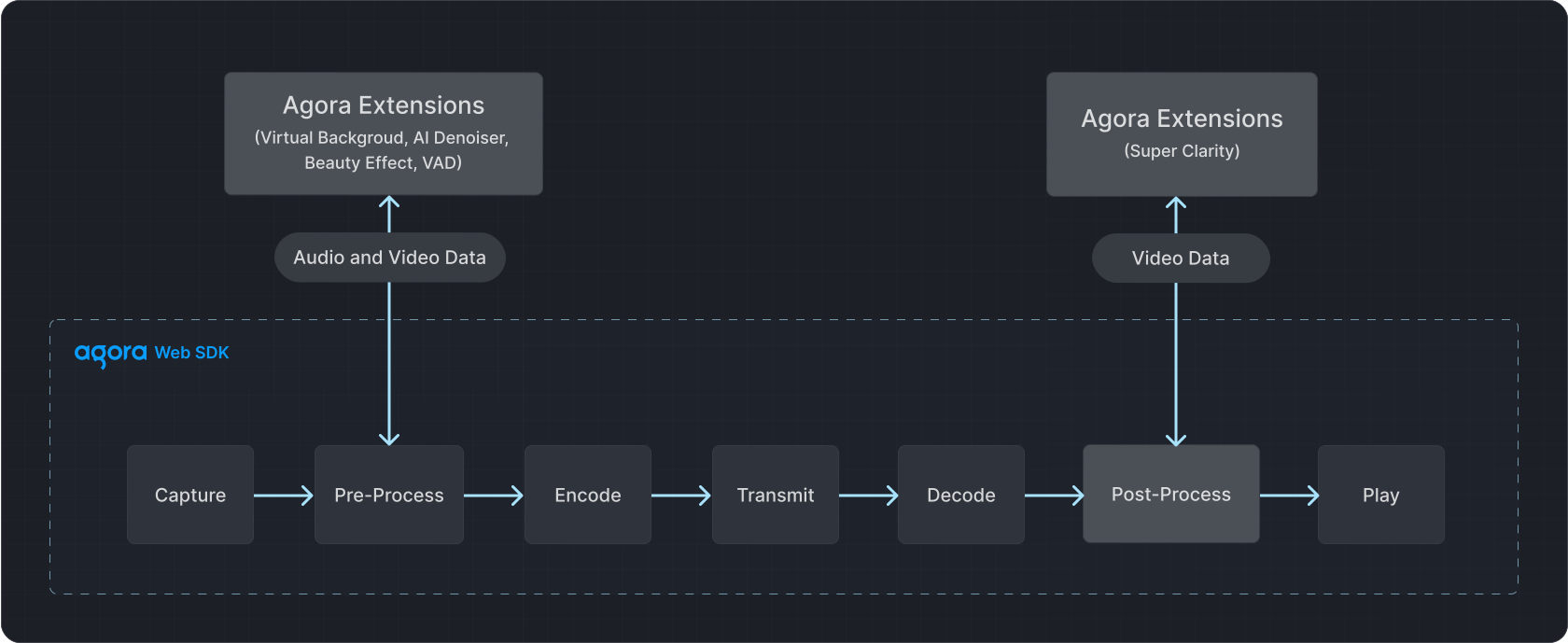
The VAD plugin operates during the preprocessing stage, analyzing audio data in real-time to detect voice activity and background music.
## Prerequisites [#prerequisites]
Before you begin, make sure:
* Your project integrates the [SDK quickstart](../index.mdx) using Web SDK v4.15.0 or later.
* You are using a supported browser:
* **Desktop**: Latest Chrome (recommended), Edge, or Firefox
* **Safari**: 14.1+ (supported but not recommended due to performance issues)
* Your system meets performance requirements:
* **Single plugin**: Standard hardware is sufficient
* **Multiple plugins**: Use an Intel Core i5 (4-core) or equivalent for best performance
* **High system load**: Running multiple plugins with heavy CPU usage may cause audio/video to freeze
## Implement the logic [#implement-the-logic]
This section shows you how to integrate and use the VAD extension in your project.
Follow these steps to install, configure, and use the VAD plugin in your project:
1. Install the [VAD plugin](https://www.npmjs.com/package/agora-extension-vad) from npm.
1. Run the following command to install the VAD plugin:
```shell
npm install agora-extension-vad
```
2. Import the VAD module in your JavaScript or TypeScript file:
```ts
import { VADExtension } from "agora-extension-vad";
```
2. Deploy Wasm files
The VAD plugin requires WebAssembly files to function. Make these files accessible to your web application:
1. Copy the Wasm files from `node_modules/agora-extension-vad/wasm/` to your application's public assets folder, such as `public/wasm/` or `static/wasm/`. When you create the `VADExtension` object, specify this path so the plugin can load these files.
Sample file structure:
```
your-project/
├── public/
│ └── wasm/ // Copy Wasm files here
│ ├── file1.wasm
│ └── file2.wasm
└── src/
└── app.js
```
* **HTTPS required**: Serve Wasm files over HTTPS in production.
* **CORS configuration**: If you host Wasm files on a different domain than your app, enable CORS for that domain.
* **Same-origin recommended**: For simplicity, host Wasm files on the same domain as your application.
2. Configure Content Security Policy (if applicable)
If your application uses CSP headers, add the following permissions:
* For Chrome 97+, Edge 97+, and modern browsers:
```html
```
* For older browsers (Chrome versions earlier than 97, Edge versions earlier than 97):
```html
```
3. Register the plugin
Call the [`AgoraRTC.registerExtensions`](https://api-ref.agora.io/en/video-sdk/web/4.x/interfaces/iagorartc.html#registerextensions) method and pass the created `VADExtension` instance to register the VAD plugin. You can also listen for events when the Wasm file fails to load.
Agora recommends that you create only one instance of `VADExtension`.
```ts
import AgoraRTC from "agora-rtc-sdk-ng";
import { VADExtension } from "agora-extension-vad";
// Create the VADExtension instance with the public path where the Wasm files are located
// Don't include a trailing slash in the path
const extension = new VADExtension({ assetsPath: "./wasm" });
// Check compatibility
if (!extension.checkCompatibility()) {
console.warn("VAD plugin is not supported");
return;
}
// Listen for Wasm file loading failures
extension.onloaderror = (error) => {
// Handle VAD loading errors
console.error("VAD plugin failed to load:", error);
};
// Register the plugin
AgoraRTC.registerExtensions([extension]);
```
4. Enable the plugin
To enable the VAD plugin:
1. Call the `createProcessor` method to create an instance of `IVADProcessor`. You can set the plugin to be enabled or disabled by default. If you don't specify a state, the plugin uses the last known state.
```ts
// Create an IVADProcessor instance
const processor = extension.createProcessor();
// Enable the plugin by default
// await processor.enable();
// Disable the plugin by default
// await processor.disable();
// Optional: Listen for processor overload events
processor.on("overload", async () => {
console.log("Processor overload detected");
// Choose to disable the plugin
// await processor.disable();
// Or continue processing audio despite the overload
});
```
2. Inject the plugin into the audio processing pipeline by calling the SDK's [`pipe`](https://api-ref.agora.io/en/video-sdk/web/4.x/interfaces/imicrophoneaudiotrack.html#pipe) method and specify the `processorDestination` property.
```ts
// Create an audio track
const audioTrack = await AgoraRTC.createMicrophoneAudioTrack();
// Inject the plugin into the audio processing pipeline
audioTrack.pipe(processor).pipe(audioTrack.processorDestination);
```
3. If the plugin is not enabled by default, call the `enable` method to enable the plugin.
```ts
await processor.enable();
```
5. Get detection results
After you enable the plugin, listen to the `result` event to get the detection results and process them as needed.
```ts
// Listen to the detection results of the VAD plugin
processor.on("result", handleResult);
function handleResult(result) {
// Output voiceProb, which indicates the probability that someone is speaking
console.info("voiceProb: ", result.voiceProb);
// Output musicProb, which indicates the probability that music is playing
console.info("musicProb: ", result.musicProb);
}
```
`voiceProb` and `musicProb` are floating-point numbers from 0 to 1 that represent the probability that someone is speaking and that music is playing.
6. Disable the plugin
When you no longer need the VAD plugin, call the `disable` method to disable the plugin.
```ts
await processor.disable();
```
## Reference [#reference]
This section contains content that completes the information in this page, or points you to documentation that explains other aspects to this product.
### API reference [#api-reference]
This section provides the API reference for the Voice Activity Detection extension.
#### `IVADExtension` [#ivadextension]
##### `checkCompatibility` [#checkcompatibility]
Checks whether the current browser supports the VAD plugin. The result returned by this method is for reference only.
```typescript
checkCompatibility(): boolean;
```
##### `createProcessor` [#createprocessor]
Creates an `IVADProcessor` instance.
```typescript
createProcessor(): IVADProcessor;
```
##### `onloaderror` [#onloaderror]
Callback for Wasm dependency file loading failures.
```typescript
onloaderror?: (error: Error) => void;
```
#### `IVADProcessor` [#ivadprocessor]
##### `kind` [#kind]
Processor type. Returns either `video` or `audio`.
```typescript
get kind(): 'video' | 'audio';
```
##### `enabled` [#enabled]
Indicates whether the plugin is enabled.
```typescript
get enabled(): boolean;
```
##### `enable` [#enable]
Enables the VAD function.
```typescript
enable(): void | Promise;
```
##### `disable` [#disable]
Disables the VAD function.
```typescript
disable(): void | Promise;
```
##### `on` [#on]
Listens for processor overload events.
```typescript
on("overload", callback: () => void): void;
```
#### Type definitions [#type-definitions]
##### `VADExtensionOptions` [#vadextensionoptions]
```typescript
export interface VADExtensionOptions {
assetsPath: string;
}
```
**Parameters:**
* `assetsPath`: The URL path of the Wasm files that the VAD plugin depends on. Don't end the path with a slash, for example `"./external"`.
The plugin assembles the full path to the Wasm files from the `assetsPath`. If the path is incorrect and the Wasm files fail to load, you receive an `onloaderror` callback.
<_PlatformProcessedMarker close="true" />