# Quickstart (/en/realtime-media/video/get-started-sdk/flutter)
> For AI agents: see the complete documentation index at [llms.txt](/llms.txt).
This page provides a step-by-step guide on how to create a basic Video Calling app using the Agora Video SDK.
## Understand the tech [#understand-the-tech-6]
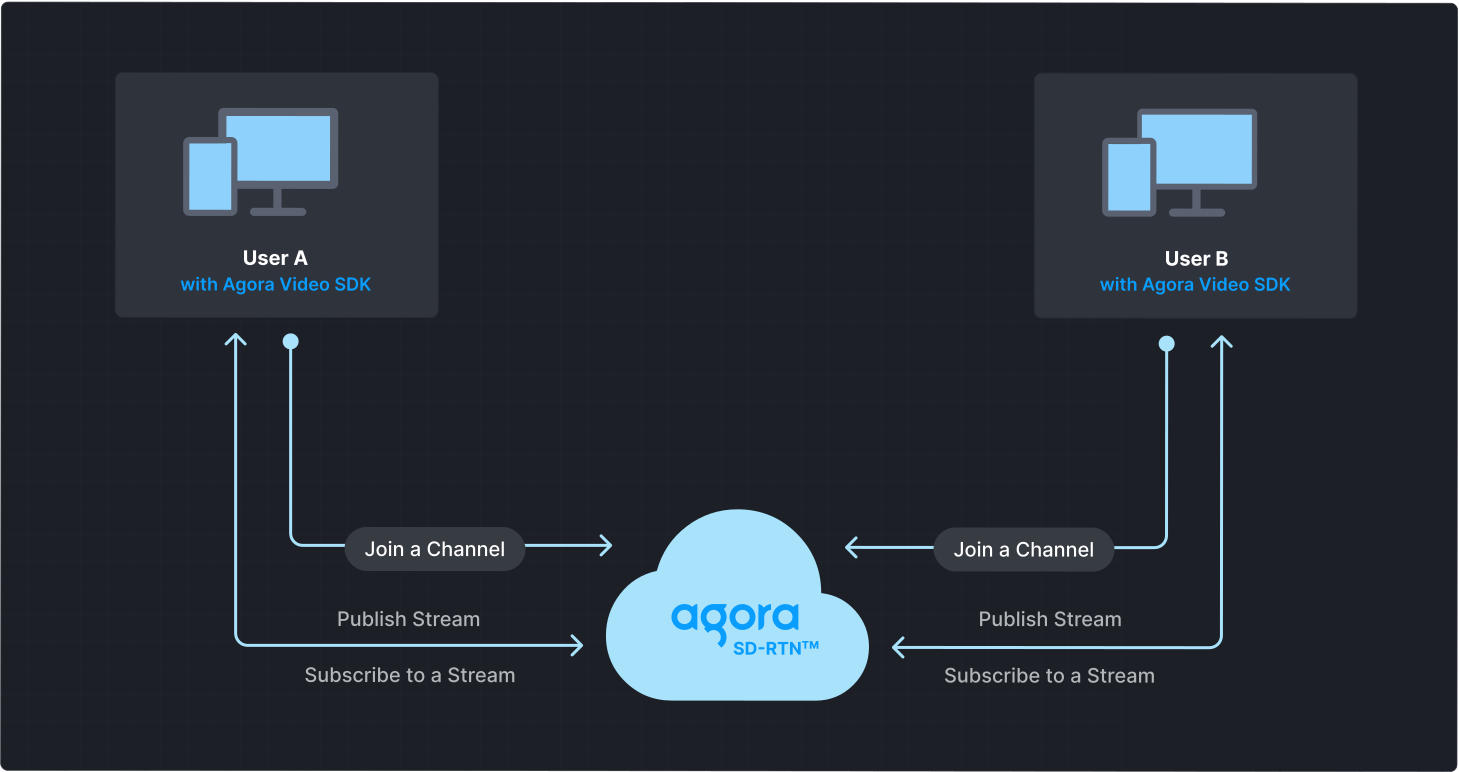
To start a Video Calling session, implement the following steps in your app:
* **Initialize the engine**: Before calling other APIs, create and initialize an engine instance.
* **Join a channel**: Call methods to create and join a channel.
* **Send and receive audio and video**: All users can publish streams to the channel and subscribe to audio and video streams published by other users in the channel.
## Prerequisites [#prerequisites-6]
* A camera and a microphone.
* A valid Agora account and project. See [Agora account management](/en/realtime-media/video/manage-agora-account) for details.
* [Flutter](https://docs.flutter.dev/get-started/install) 2.10.5 or higher with Dart 2.14.0 or higher.
* [Android Studio](https://developer.android.com/studio), IntelliJ, VS Code, or another IDE that supports Flutter. See [Set up an editor](https://docs.flutter.dev/get-started/editor).
* Prepare your development and testing environment according to your [target platform](/en/realtime-media/video/reference/supported-platforms).
Run `flutter doctor` to confirm that your development environment is set up correctly for Flutter development.
## Set up your project [#set-up-your-project-6]
Create a new project
Add to an existing project
From the Terminal, run the following commands to create a new project named `agora_project`, or follow the [steps for your IDE](https://docs.flutter.dev/get-started/test-drive?tab=vscode#choose-your-ide):
```bash
flutter create agora_project
cd agora_project
```
To add Video Calling to your existing project:
1. Open your Flutter project and navigate to the `lib` folder.
2. Add a new file to the `lib` folder and name it `agora_logic.dart`.
### Install the SDK [#install-the-sdk-6]
Install the Agora Video SDK and other dependencies.
1. Add the [latest version](https://pub.dev/packages/agora_rtc_engine) of Agora Video SDK to your Flutter project:
```bash
flutter pub add agora_rtc_engine
```
2. Add the permission processing package:
```bash
flutter pub add permission_handler
```
The `dependencies` in your `pubspec.yaml` file should look like the following:
```yaml
dependencies:
flutter:
sdk: flutter
agora_rtc_engine: ^6.5.0 # Agora Flutter SDK, please use the latest version
permission_handler: ^11.3.1 # Package for managing runtime permissions
cupertino_icons: ^1.0.8
```
3. Install the dependencies.
Execute the following command in the project path:
```bash
flutter pub get
```
## Implement Video Calling [#implement-video-calling-6]
This section guides you through the implementation of basic real-time audio and video interaction in your app.
The following figure illustrates the essential steps:
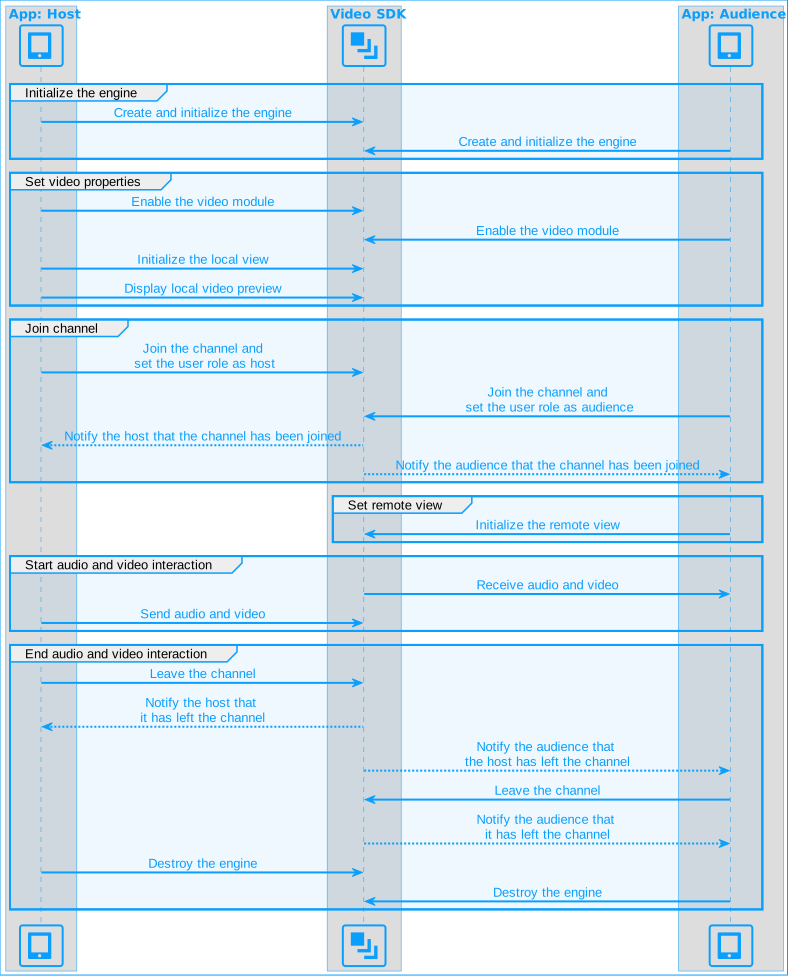
This guide includes [complete sample code](#complete-sample-code) that demonstrates implementing basic real-time interaction. To understand the core API calls in the sample code, review the following implementation steps.
### Import packages [#import-packages]
Import the following packages in your dart file.
```dart
import 'dart:async';
import 'package:agora_rtc_engine/agora_rtc_engine.dart';
import 'package:flutter/material.dart';
import 'package:permission_handler/permission_handler.dart';
```
### Initialize the engine [#initialize-the-engine-5]
For real-time communication, initialize an `RtcEngine` instance. Use `RtcEngineContext` to specify the [App ID](/en/realtime-media/video/manage-agora-account#get-the-app-id), and other configuration parameters. In your dart file, add the following code:
```dart
// Set up the Agora RTC engine instance
Future _initializeAgoraVoiceSDK() async {
_engine = createAgoraRtcEngine();
await _engine.initialize(const RtcEngineContext(
appId: "<-- Insert app Id -->",
channelProfile: ChannelProfileType.channelProfileCommunication,
));
}
```
### Join a channel [#join-a-channel-6]
To join a channel, call `joinChannel` with the following parameters:
* **Channel name**: The name of the channel to join. Clients that pass the same channel name join the same channel. If a channel with the specified name does not exist, it is created when the first user joins.
* **Authentication token**: A dynamic key that authenticates a user when the client joins a channel. In a production environment, you obtain a token from a [token server](/en/realtime-media/video/build/authenticate-users/deploy-token-server) in your security infrastructure. For the purpose of this guide [Generate a temporary token](/en/realtime-media/video/manage-agora-account#generate-temporary-tokens).
* **User ID**: A 32-bit signed integer that identifies a user in the channel. You can specify a unique user ID for each user yourself. If you set the user ID to `0` when joining a channel, the SDK generates a random number for the user ID and returns the value in the `onJoinChannelSuccess` callback.
* **Channel media options**: Configure `ChannelMediaOptions` to define publishing and subscription settings, optimize performance for your specific use-case, and set optional parameters.
For Video Calling, set the `clientRoleType` to `clientRoleBroadcaster`.
```dart
// Join a channel
Future _joinChannel() async {
await _engine.joinChannel(
token: token,
channelId: channel,
options: const ChannelMediaOptions(
autoSubscribeVideo: true, // Automatically subscribe to all video streams
autoSubscribeAudio: true, // Automatically subscribe to all audio streams
publishCameraTrack: true, // Publish camera-captured video
publishMicrophoneTrack: true, // Publish microphone-captured audio
// Use clientRoleBroadcaster to act as a host or clientRoleAudience for audience
clientRoleType: ClientRoleType.clientRoleBroadcaster,
),
uid: 0,
);
}
```
### Subscribe to Video SDK events [#subscribe-to-video-sdk-events-4]
The SDK provides the `RtcEngineEventHandler` for subscribing to channel events. To use it, pass an instance of `RtcEngineEventHandler` to `registerEventHandler` and implement the event methods you want to handle.
Call `registerEventHandler` to bind the event handler to the SDK.
```dart
// Register an event handler for Agora RTC
void _setupEventHandlers() {
_engine.registerEventHandler(
RtcEngineEventHandler(
onJoinChannelSuccess: (RtcConnection connection, int elapsed) {
debugPrint("Local user ${connection.localUid} joined");
setState(() => _localUserJoined = true);
},
onUserJoined: (RtcConnection connection, int remoteUid, int elapsed) {
debugPrint("Remote user $remoteUid joined");
setState(() => _remoteUid = remoteUid);
},
onUserOffline: (RtcConnection connection, int remoteUid, UserOfflineReasonType reason) {
debugPrint("Remote user $remoteUid left");
setState(() => _remoteUid = null);
},
),
);
}
```
When a remote user joins the channel, the `onUserJoined` callback is triggered. Use the remote user's `uid` returned in the callback, to create an `AgoraVideoView` control for displaying the video stream from the remote user.
To ensure that you receive all Video SDK events, register the event handler before joining a channel.
### Display the local video [#display-the-local-video-6]
To display the local video, enable the video module by calling `enableVideo`, then start the local video preview with `startPreview`.
```dart
Future _setupLocalVideo() async {
// The video module and preview are disabled by default.
await _engine.enableVideo();
await _engine.startPreview();
}
```
To render the local video, add the following widget inside your UI’s widget tree, such as in the build method of your `StatefulWidget`:
```dart
// Displays the local user's video view using the Agora engine.
Widget _localVideo() {
return AgoraVideoView(
controller: VideoViewController(
rtcEngine: _engine, // Uses the Agora engine instance
canvas: const VideoCanvas(
uid: 0, // Specifies the local user
renderMode: RenderModeType.renderModeHidden, // Sets the video rendering mode
),
),
);
}
```
### Display remote video [#display-remote-video-6]
To render a remote video, add the following widget inside your UI’s widget tree, such as in the build method of your `StatefulWidget`:
```dart
// If a remote user has joined, render their video, else display a waiting message
Widget _remoteVideo() {
if (_remoteUid != null) {
return AgoraVideoView(
controller: VideoViewController.remote(
rtcEngine: _engine, // Uses the Agora engine instance
canvas: VideoCanvas(uid: _remoteUid), // Binds the remote user's video
connection: const RtcConnection(channelId: channel), // Specifies the channel
),
);
} else {
return const Text(
'Waiting for remote user to join...',
textAlign: TextAlign.center,
);
}
}
```
### Handle permissions [#handle-permissions-4]
Request microphone and camera permissions for Video Calling.
```dart
Future _requestPermissions() async {
await [Permission.microphone, Permission.camera].request();
}
```
Information
If your target platform is iOS or macOS, add the microphone and camera permission declarations required for real-time interaction to [`Info.plist`](https://help.apple.com/xcode/mac/current/#/dev3f399a2a6).
| **Device** | **Key** | **Value** |
| :--------- | :------------------------------------- | :-------------- |
| Microphone | Privacy - Microphone Usage Description | for audio calls |
| Camera | Privacy - Camera Usage Description | for video calls |
### Start and close the app [#start-and-close-the-app-4]
To start Video Calling, request microphone and camera permissions, initialize the Agora SDK instance, set up event handlers, join a channel, and display the local video.
```dart
await _requestPermissions();
await _initializeAgoraVideoSDK();
await _setupLocalVideo();
_setupEventHandlers();
await _joinChannel();
```
To stop Video Calling, leave the channel and release the engine instance.
```dart
// Leaves the channel and releases resources
Future _cleanupAgoraEngine() async {
await _engine.leaveChannel();
await _engine.release();
}
```
Warning
After you call `release`, you no longer have access to the methods and callbacks of the SDK. To use Video Calling features again, create a new engine instance.
### Complete sample code [#complete-sample-code-6]
A complete code sample demonstrating the basic process of real-time interaction is provided for your reference. To use the sample code, copy the following code to replace the entire contents of the `.dart` file in your project.
```dart
import 'dart:async';
import 'package:agora_rtc_engine/agora_rtc_engine.dart';
import 'package:flutter/material.dart';
import 'package:permission_handler/permission_handler.dart';
void main() => runApp(const MyApp());
// Fill in the app ID obtained from Agora Console
const appId = "<-- Insert app Id -->";
// Fill in the temporary token generated from Agora Console
const token = "<-- Insert token -->";
// Fill in the channel name you used to generate the token
const channel = "<-- Insert channel name -->";
// Main App Widget
class MyApp extends StatelessWidget {
const MyApp({Key? key}) : super(key: key);
@override
Widget build(BuildContext context) {
return const MaterialApp(
home: MainScreen(),
);
}
}
// Video Call Screen Widget
class MainScreen extends StatefulWidget {
const MainScreen({Key? key}) : super(key: key);
@override
_MainScreenScreenState createState() => _MainScreenScreenState();
}
class _MainScreenScreenState extends State {
int? _remoteUid; // Stores remote user ID
bool _localUserJoined = false; // Indicates if local user has joined the channel
late RtcEngine _engine; // Stores Agora RTC Engine instance
@override
void initState() {
super.initState();
_startVideoCalling();
}
// Initializes Agora SDK
Future _startVideoCalling() async {
await _requestPermissions();
await _initializeAgoraVideoSDK();
await _setupLocalVideo();
_setupEventHandlers();
await _joinChannel();
}
// Requests microphone and camera permissions
Future _requestPermissions() async {
await [Permission.microphone, Permission.camera].request();
}
// Set up the Agora RTC engine instance
Future _initializeAgoraVideoSDK() async {
_engine = createAgoraRtcEngine();
await _engine.initialize(const RtcEngineContext(
appId: appId,
channelProfile: ChannelProfileType.channelProfileCommunication,
));
}
// Enables and starts local video preview
Future _setupLocalVideo() async {
await _engine.enableVideo();
await _engine.startPreview();
}
// Register an event handler for Agora RTC
void _setupEventHandlers() {
_engine.registerEventHandler(
RtcEngineEventHandler(
onJoinChannelSuccess: (RtcConnection connection, int elapsed) {
debugPrint("Local user ${connection.localUid} joined");
setState(() => _localUserJoined = true);
},
onUserJoined: (RtcConnection connection, int remoteUid, int elapsed) {
debugPrint("Remote user $remoteUid joined");
setState(() => _remoteUid = remoteUid);
},
onUserOffline: (RtcConnection connection, int remoteUid, UserOfflineReasonType reason) {
debugPrint("Remote user $remoteUid left");
setState(() => _remoteUid = null);
},
),
);
}
// Join a channel
Future _joinChannel() async {
await _engine.joinChannel(
token: token,
channelId: channel,
options: const ChannelMediaOptions(
autoSubscribeVideo: true,
autoSubscribeAudio: true,
publishCameraTrack: true,
publishMicrophoneTrack: true,
clientRoleType: ClientRoleType.clientRoleBroadcaster,
),
uid: 0,
);
}
@override
void dispose() {
_cleanupAgoraEngine();
super.dispose();
}
// Leaves the channel and releases resources
Future _cleanupAgoraEngine() async {
await _engine.leaveChannel();
await _engine.release();
}
@override
Widget build(BuildContext context) {
return Scaffold(
appBar: AppBar(title: const Text('Agora Video Calling')),
body: Stack(
children: [
Center(child: _remoteVideo()),
Align(
alignment: Alignment.topLeft,
child: SizedBox(
width: 100,
height: 150,
child: Center(
child: _localUserJoined
? _localVideo()
: const CircularProgressIndicator(),
),
),
),
],
),
);
}
// Displays remote video view
Widget _localVideo() {
return AgoraVideoView(
controller: VideoViewController(
rtcEngine: _engine,
canvas: const VideoCanvas(
uid: 0,
renderMode: RenderModeType.renderModeHidden,
),
),
);
}
// Displays remote video view
Widget _remoteVideo() {
if (_remoteUid != null) {
return AgoraVideoView(
controller: VideoViewController.remote(
rtcEngine: _engine,
canvas: VideoCanvas(uid: _remoteUid),
connection: const RtcConnection(channelId: channel),
),
);
} else {
return const Text(
'Waiting for remote user to join...',
textAlign: TextAlign.center,
);
}
}
}
```
Information
In the `appId` and `token` fields, enter the corresponding values you obtained from Agora Console. Use the same `channel` name you filled in when generating the temporary token.
### Create a user interface [#create-a-user-interface-6]
To connect the sample code to your existing UI, ensure that your widget tree includes the `_remoteVideo` and `_localVideo` widgets used to [Display the local video](#display-the-local-video) and [Display remote video](#display-remote-video).
Alternatively, use the following sample code to generate a basic user interface:
### Sample code to create the user interface [#sample-code-to-create-the-user-interface-5]
```dart
// Build UI to display local video and remote video
@override
Widget build(BuildContext context) {
return Scaffold(
appBar: AppBar(title: const Text('Agora Video Call')),
body: Stack(
children: [
Center(child: _remoteVideo()),
Align(
alignment: Alignment.topLeft,
child: SizedBox(
width: 100,
height: 150,
child: Center(
child: _localUserJoined
? _localVideo()
: const CircularProgressIndicator(),
),
),
),
],
),
);
}
```
## Test the sample code [#test-the-sample-code-6]
Take the following steps to test the sample code:
1. In `main.dart` update the values for `appId`, and `token` with values from Agora Console. Fill in the same `channel` name you used to generate the token.
2. Connect a target device to your development computer.
3. Open Terminal and execute the following command in the project folder to run the sample project:
```bash
flutter run
```
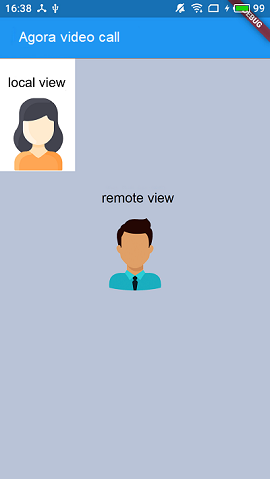
4. Launch the App, grant microphone and camera permissions. If you set the user role to host, you see yourself in the local view.
5. On a second target device, repeat the previous steps to install and launch the client. Alternatively, use the [Web demo](https://webdemo.agora.io/basicVideoCall/index.html) to join the same channel and test the following use-cases:
* If users on both devices join the channel as hosts, they can see and hear each other.
* If one user joins as host and the other as audience, the host can see themselves in the local video window; the audience can see the host in the remote video window and hear the host.
On an Android device, the app UI appears similar to the following:
## Reference [#reference-6]
This section contains content that completes the information on this page, or points you to documentation that explains other aspects of this product.
* If a firewall is deployed in your network environment, refer to [Connect with Cloud Proxy](/en/realtime-media/video/build/manage-connection-and-quality/cloud-proxy) to use Agora services normally.
### Next steps [#next-steps-6]
After implementing the quickstart sample, read the following documents to learn more:
* To ensure communication security in a test or production environment, best practice is to obtain and use a token from an authentication server. For details, see [Secure authentication with tokens](/en/realtime-media/video/build/authenticate-users/authentication-workflow).
### Sample project [#sample-project-6]
Agora provides open source sample projects on [GitHub](https://github.com/AgoraIO-Extensions/Agora-Flutter-SDK/tree/main/example/lib/examples) for your reference. Download or view [join\_channel\_video.dart](https://github.com/AgoraIO-Extensions/Agora-Flutter-SDK/tree/main/example/lib/examples/basic/join_channel_video) for a more detailed example.
### API reference [#api-reference-6]
* [`enableVideo`](https://api-ref.agora.io/en/video-sdk/flutter/6.x/API/class_irtcengine.html#api_irtcengine_enablevideo)
* [`registerEventHandler`](https://api-ref.agora.io/en/video-sdk/flutter/6.x/API/class_irtcengine.html#api_irtcengine_addhandler)
* [`setClientRole`](https://api-ref.agora.io/en/video-sdk/flutter/6.x/API/class_irtcengine.html#api_irtcengine_setclientrole2)
* [`setChannelProfile`](https://api-ref.agora.io/en/video-sdk/flutter/6.x/API/class_irtcengine.html#api_irtcengine_setchannelprofile)
* [`startPreview`](https://api-ref.agora.io/en/video-sdk/flutter/6.x/API/class_irtcengine.html#api_irtcengine_startpreview2)
* [`AgoraVideoView`](https://api-ref.agora.io/en/video-sdk/flutter/6.x/API/class_agoravideoview.html)
* [`joinChannel`](https://api-ref.agora.io/en/video-sdk/flutter/6.x/API/class_irtcengine.html#api_irtcengine_joinchannel2)
* [`leaveChannel`](https://api-ref.agora.io/en/video-sdk/flutter/6.x/API/class_irtcengine.html#api_irtcengine_leavechannel2)
### Frequently asked questions [#frequently-asked-questions-6]
* [How can I fix black screen issues?](/en/api-reference/faq/quality/video_blank#black-screen-on-the-local-side)
* [Why can't I turn on the camera?](/en/api-reference/faq/quality/video_camera)
* [How can I listen for audience joining or leaving a channel?](/en/api-reference/faq/integration/audience_event)
* [How can I solve channel-related issues?](/en/api-reference/faq/integration/channel)
* [How can I set the log file?](/en/api-reference/faq/integration/set_log_file)
### See also [#see-also-6]
* [SDK error codes](/en/realtime-media/video/reference/error-codes)
* [Connection status management](/en/realtime-media/video/build/manage-connection-and-quality/connection-status-management)