# Optimize video experience in multi-host scenarios (/en/realtime-media/video/build/manage-connection-and-quality/optimize-multihost-video/flutter)
> For AI agents: see the complete documentation index at [llms.txt](/llms.txt).
In multi-host streaming scenarios where 4 or more hosts stream videos simultaneously, users with the audience role face the following challenges:
* **Device performance and bandwidth pressure**: Subscribing to multiple video streams can put significant pressure on device performance and downstream bandwidth, especially for mid-to-low-end devices. Audience members might experience lag or frame drops, leading to a suboptimal viewing experience.
* **Flexible layout needs**: A custom video layout is often required, allowing viewers to adjust the position of each host's video to suit their individual preferences.
* **Window switching and zooming**: With multiple hosts, the video size of each host may be limited. Flexible switching and resizing allow for a more personalized viewing experience.
Agora offers a video experience optimization solution for multi-host video scenarios through a client-customized composite layout, designed to enhance user experience by focusing on smooth, personalized viewing.
This solution is ideal for scenarios such as:
* Team battle PK
* Multi-person conference
* Online education for large classes
## Understand the tech [#understand-the-tech-2]
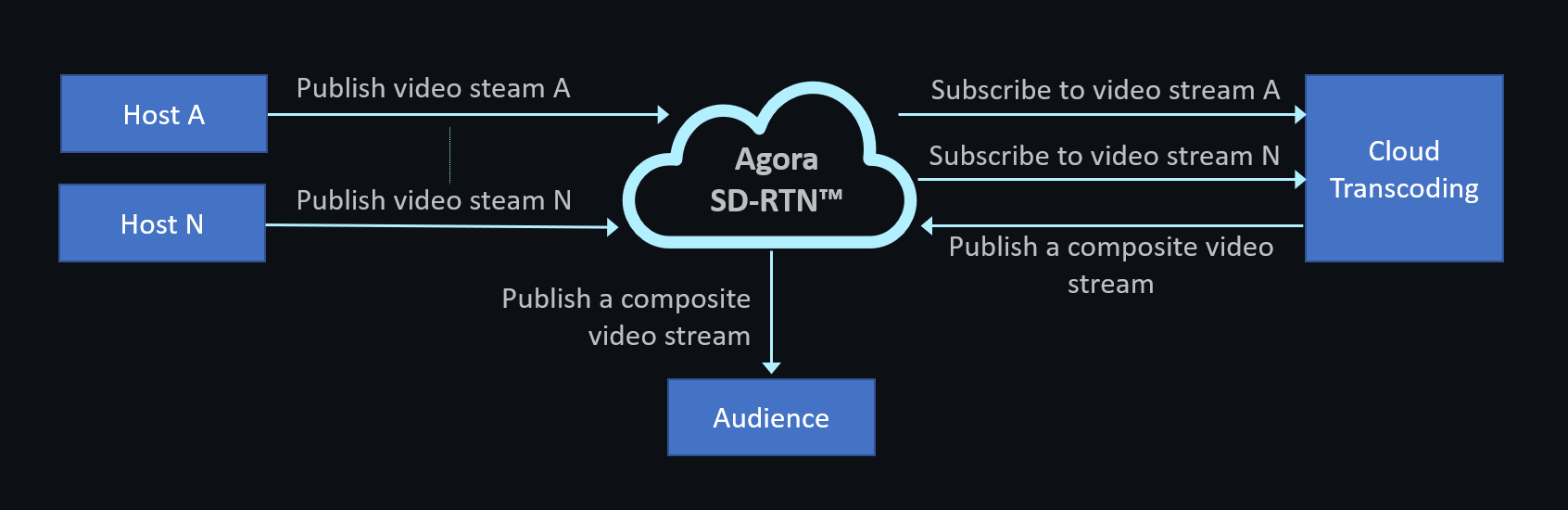
The following figure shows how the client-customized composite layout is used in conjunction with the Cloud Transcoding service:
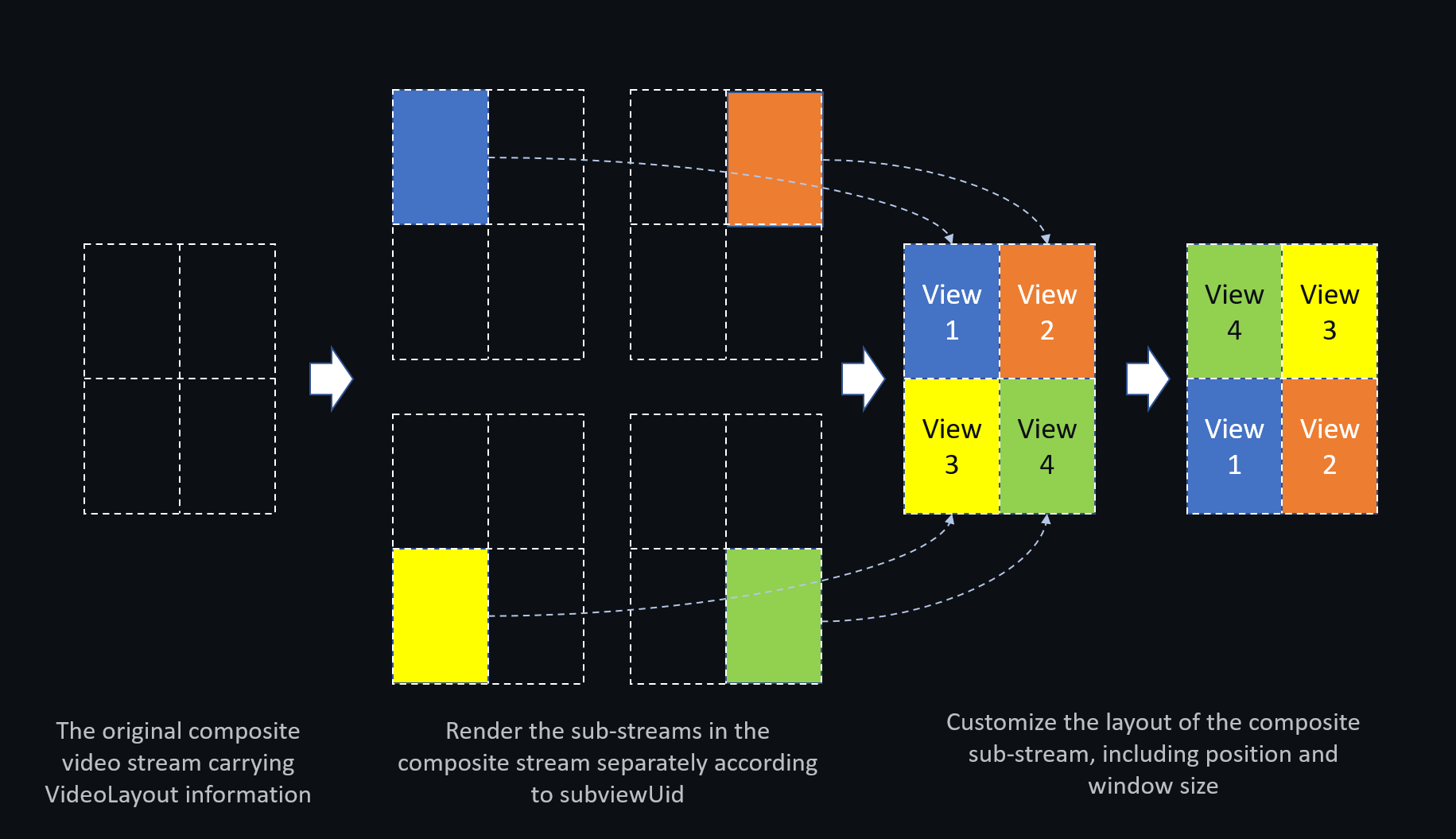
After the audience receives the transcoded composite video stream, the custom composite layout is implemented locally as follows:
## Prerequisites [#prerequisites-2]
Make sure you have:
* Implemented basic real-time audio and video functionality with SDK version 4.5 or later. See the [SDK quickstart](/en/realtime-media/video/get-started-sdk).
* Implemented [Cloud Transcoding](/en/realtime-media/transcoding) to forward composite video to other channels. Make sure you set the following parameters when you configure transcoding:
```json
"outputs": [
{
"seiOption": {
"source": {
"agora": {
"uidvideoLayout": true
}
},
"sink": {
"type": 100
}
}
}
]
```
## Implementation [#implementation-2]
This section explains how to implement a client-customized composite layout, with the API call sequence illustrated in the diagram.
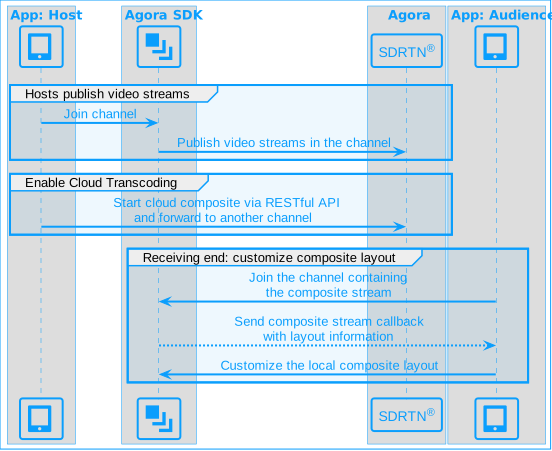
To implement a client-customized composite layout for the audience, follow these steps:
1. Call `joinChannelEx` to join the channel where the composite stream is located.
2. Register an `RtcEngineEventHandler` and listen for the `onTranscodedStreamLayoutInfo` callback triggered by the SDK. Use it to obtain the following information about the composite video stream:
* The width and height of the composite stream, and the user ID of the user publishing it.
* The user ID of each host publishing a sub-stream within the composite stream.
* The x and y coordinates of each sub-stream on the composite canvas.
* The width and height of each sub-stream.
* The rendering state of each sub-stream on the composite canvas:
* Normal rendering
* Displayed as a placeholder
* Displayed as a black image
3. For each sub-stream in the layout list, create an `AgoraVideoView` widget using `VideoViewController.remote` and configure the `VideoCanvas` with the following key parameters:
* `sourceType`: Set to `VideoSourceType.videoSourceTranscoded`, indicating the video source is a transcoded composite stream.
* `uid`: The user ID of the user forwarding the composite stream to the current channel, obtained from the `onTranscodedStreamLayoutInfo` callback.
* `subviewUid`: The user ID corresponding to a specific sub-stream within the composite stream.
* `renderMode`: Set to `RenderModeType.renderModeFit`.
- When `subviewUid` is not `0`, the default value of `setupMode` is `VideoViewSetupMode.videoViewSetupReplace` (add a view).
- If `subviewUid` is set, the setting of `cropArea` does not take effect.
The following sample code demonstrates this in a multi-channel scenario. The usage in a single-channel scenario is similar.
```dart
// Register the event handler
_engine.registerEventHandler(
RtcEngineEventHandler(
onTranscodedStreamLayoutInfo: (RtcConnection connection, int uid,
int width, int height, int layoutCount, List layoutlist) {
setState(() {
_compositeUid = uid;
_layoutList = layoutlist;
});
},
),
);
// Join the channel containing the composite stream
await _engine.joinChannelEx(
token: token,
connection: RtcConnection(channelId: compositeChannelId, localUid: localUid),
options: const ChannelMediaOptions(
autoSubscribeVideo: true,
autoSubscribeAudio: true,
clientRoleType: ClientRoleType.clientRoleAudience,
),
);
// Build AgoraVideoView widgets for each sub-stream
Widget _buildSubStreamViews() {
if (_layoutList == null || _compositeUid == null) {
return const SizedBox.shrink();
}
return Stack(
children: _layoutList!.map((layout) {
return AgoraVideoView(
controller: VideoViewController.remote(
rtcEngine: _engine,
canvas: VideoCanvas(
// User ID of the user forwarding the composite stream
uid: _compositeUid,
// User ID corresponding to a specific sub-stream
subviewUid: layout.uid,
sourceType: VideoSourceType.videoSourceTranscoded,
renderMode: RenderModeType.renderModeFit,
),
connection: RtcConnection(channelId: compositeChannelId),
),
);
}).toList(),
);
}
// To remove a specific sub-stream view, rebuild the widget tree
// without that sub-stream's AgoraVideoView, or use setupMode:
VideoCanvas(
uid: _compositeUid,
subviewUid: layout.uid,
setupMode: VideoViewSetupMode.videoViewSetupRemove,
)
```
4. When the layout of the composite stream changes, the `onTranscodedStreamLayoutInfo` callback fires again. Each time it fires, update your widget state with the new layout list and rebuild the `AgoraVideoView` widgets to reflect the updated layout.
Layout changes can occur in the following situations:
* The coordinates of a sub-stream on the composite canvas change.
* The width or height of the composite stream or a sub-stream changes.
* The state of a sub-stream changes. When the host publishing a sub-stream leaves the channel, the `videoState` parameter for that sub-stream changes from `0` (normal) to `1` (no video available). Remove the corresponding `AgoraVideoView` from the widget tree to stop rendering that host's video.
5. Listen for the `onUserOffline` callback. When the user forwarding the composite stream leaves the channel, clear the layout list and stop rendering the composite stream.
Note
* Client-customized composite layout is currently supported on mobile platforms only.
* If a watermark is applied to the composite stream, the watermark renders within its designated region and may appear split across sub-stream boundaries.
## Reference [#reference-2]
This section contains content that completes the information on this page, or points you to documentation that explains other aspects of this product.
### API reference [#api-reference-2]
* [`onTranscodedStreamLayoutInfo`](https://api-ref.agora.io/en/video-sdk/flutter/6.x/API/class_irtcengineeventhandler.html#callback_irtcengineeventhandler_ontranscodedstreamlayoutinfo)
* [`setupRemoteVideo`](https://api-ref.agora.io/en/video-sdk/flutter/6.x/API/class_irtcengine.html#api_irtcengine_setupremotevideo)
* [`setupRemoteVideoEx`](https://api-ref.agora.io/en/video-sdk/flutter/6.x/API/class_irtcengineex.html#api_irtcengineex_setupremotevideoex)