# Raw video processing (/en/realtime-media/video/build/capture-and-render-video/raw-video-processing)
> For AI agents: see the complete documentation index at [llms.txt](/llms.txt).
In certain use-cases, it is necessary to process raw video captured through the camera to achieve desired functionality or enhance the user experience. Video SDK provides the capability to pre-process and post-process the captured video data, allowing you to implement custom playback effects.
<_PlatformTabsGroup groupMode="structured" canonicalPlatform="web" platforms="["android","ios","macos","windows","unity","web","unreal"]" showTabs="true">
<_PlatformPanel platform="android">
<_PlatformProcessedMarker groupMode="structured" canonicalPlatform="web" platform="android" />
## Understand the tech [#understand-the-tech]
Video SDK enables you to pre-process the captured video frames before sending the data to the encoder or perform post-processing on the received video frames after sending the data to the decoder.
The following figure shows the video data processing flow in the SDK video module.
**Process raw video**
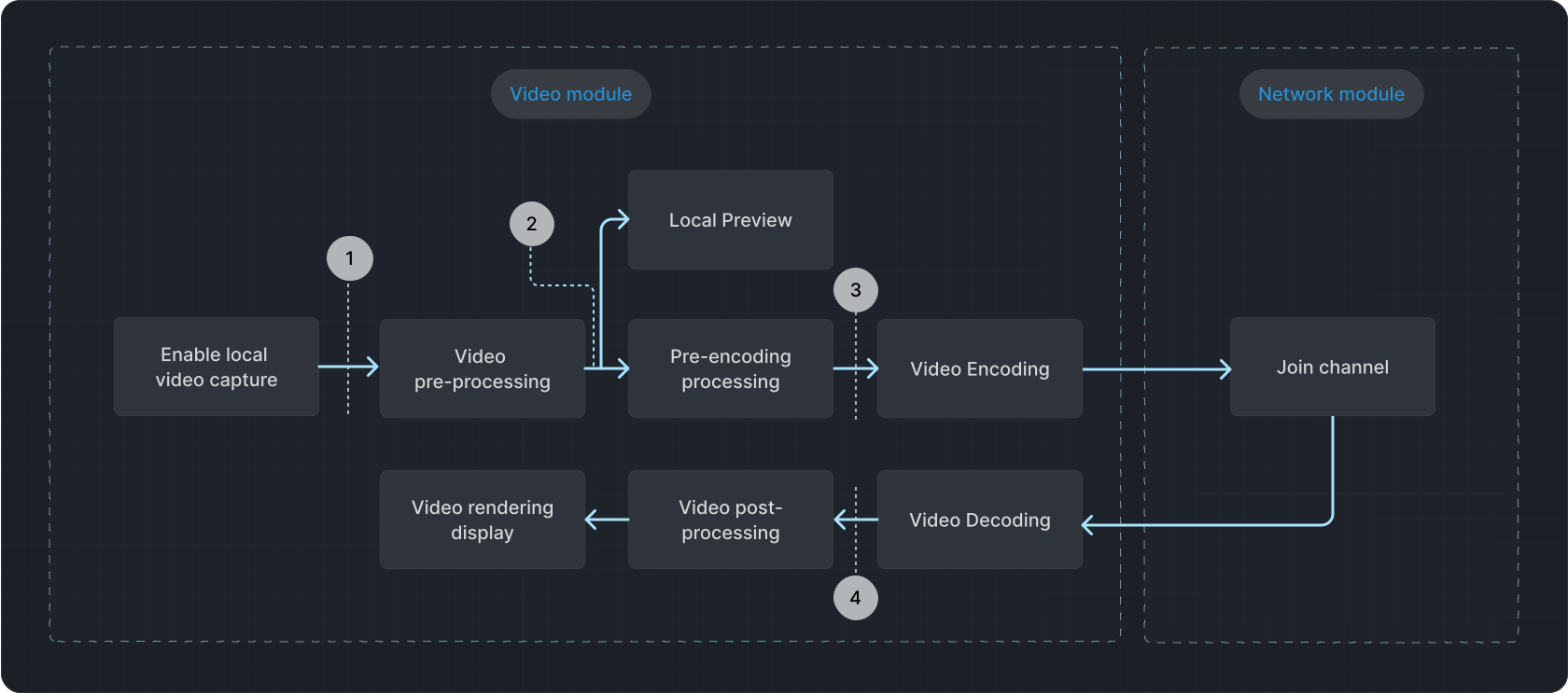
* Position (2) corresponds to the `onCaptureVideoFrame` callback.
* Position (3) corresponds to the `onPreEncodeVideoFrame` callback.
* Position (4) corresponds to the`onRenderVideoFrame` callback.
## Prerequisites [#prerequisites]
Ensure that you have implemented the [SDK quickstart](/en/realtime-media/video/get-started-sdk) in your project.
## Implement raw video processing [#implement-raw-video-processing]
To implement raw video data functionality in your project, refer to the following steps:
1. Before joining the channel, create an `IVideoFrameObserver` object and register the video observer by calling the `registerVideoFrameObserver` method.
Java
Kotlin
```java
int ret = engine.registerVideoFrameObserver(iVideoFrameObserver);
```
```kotlin
val ret = engine.registerVideoFrameObserver(iVideoFrameObserver)
```
2. Implement the `onCaptureVideoFrame` and `onRenderVideoFrame` callbacks. After obtaining the video data, process it according to your specific use-case.
Java
Kotlin
```java
private final IVideoFrameObserver iVideoFrameObserver = new IVideoFrameObserver() {
@Override
public boolean onCaptureVideoFrame(VideoFrame videoFrame) {
Log.i(TAG, "OnEncodedVideoImageReceived" + Thread.currentThread().getName());
if (isSnapshot) {
isSnapshot = false;
// Get the image bitmap
VideoFrame.Buffer buffer = videoFrame.getBuffer();
VideoFrame.I420Buffer i420Buffer = buffer.toI420();
int width = i420Buffer.getWidth();
int height = i420Buffer.getHeight();
ByteBuffer bufferY = i420Buffer.getDataY();
ByteBuffer bufferU = i420Buffer.getDataU();
ByteBuffer bufferV = i420Buffer.getDataV();
byte[] i420 = YUVUtils.toWrappedI420(bufferY, bufferU, bufferV, width, height);
Bitmap bitmap = YUVUtils.NV21ToBitmap(getContext(),
YUVUtils.I420ToNV21(i420, width, height),
width,
height);
Matrix matrix = new Matrix();
matrix.setRotate(270);
// Rotate around the center
Bitmap newBitmap = Bitmap.createBitmap(bitmap, 0, 0, width, height, matrix, false);
// Save to file
saveBitmap2Gallery(newBitmap);
bitmap.recycle();
i420Buffer.release();
}
return false;
}
@Override
public boolean onScreenCaptureVideoFrame(VideoFrame videoFrame) {
return false;
}
@Override
public boolean onMediaPlayerVideoFrame(VideoFrame videoFrame, int i) {
return false;
}
@Override
public boolean onRenderVideoFrame(String s, int i, VideoFrame videoFrame) {
return false;
}
@Override
public int getVideoFrameProcessMode() {
return 0;
}
@Override
public int getVideoFormatPreference() {
return 1;
}
@Override
public int getRotationApplied() {
return 0;
}
@Override
public boolean getMirrorApplied() {
return false;
}
};
```
```kotlin
private val iVideoFrameObserver = object : IVideoFrameObserver {
override fun onCaptureVideoFrame(videoFrame: VideoFrame): Boolean {
Log.i(TAG, "OnEncodedVideoImageReceived${Thread.currentThread().name}")
if (isSnapshot) {
isSnapshot = false
// Get the image bitmap
val buffer = videoFrame.buffer
val i420Buffer = buffer.toI420()
val width = i420Buffer.width
val height = i420Buffer.height
val bufferY = i420Buffer.dataY
val bufferU = i420Buffer.dataU
val bufferV = i420Buffer.dataV
val i420 = YUVUtils.toWrappedI420(bufferY, bufferU, bufferV, width, height)
val bitmap = YUVUtils.NV21ToBitmap(
context = context,
nv21Data = YUVUtils.I420ToNV21(i420, width, height),
width = width,
height = height
)
val matrix = Matrix().apply { setRotate(270f) }
// Rotate around the center
val newBitmap = Bitmap.createBitmap(bitmap, 0, 0, width, height, matrix, false)
// Save to file
saveBitmap2Gallery(newBitmap)
bitmap.recycle()
i420Buffer.release()
}
return false
}
override fun onScreenCaptureVideoFrame(videoFrame: VideoFrame): Boolean {
return false
}
override fun onMediaPlayerVideoFrame(videoFrame: VideoFrame, i: Int): Boolean {
return false
}
override fun onRenderVideoFrame(s: String, i: Int, videoFrame: VideoFrame): Boolean {
return false
}
override fun getVideoFrameProcessMode(): Int {
return 0
}
override fun getVideoFormatPreference(): Int {
return 1
}
override fun getRotationApplied(): Int {
return 0
}
override fun getMirrorApplied(): Boolean {
return false
}
}
```
When modifying parameters in a `VideoFrame`, ensure that the updated parameters match the actual video frame in the buffer. Mismatches may cause issues like unexpected rotation, distortion, or other visual problems in the local preview and the remote video.
## Reference [#reference]
This section contains content that completes the information on this page, or points you to documentation that explains other aspects to this product.
### Sample project [#sample-project]
Agora provides an open source sample project [ProcessRawData](https://github.com/AgoraIO/API-Examples/blob/main/Android/APIExample/app/src/main/java/io/agora/api/example/examples/advanced/ProcessRawData.java) on GitHub. Download it or view the source code for a more detailed example.
### API reference [#api-reference]
* [`registerVideoFrameObserver`](https://api-ref.agora.io/en/video-sdk/android/4.x/API/class_irtcengine.html#api_imediaengine_registervideoframeobserver)
* [`registerVideoEncodedFrameObserver`](https://api-ref.agora.io/en/video-sdk/android/4.x/API/class_irtcengine.html#api_imediaengine_registervideoencodedframeobserver)
* [`onCaptureVideoFrame`](https://api-ref.agora.io/en/video-sdk/android/4.x/API/class_ivideoframeobserver.html#callback_ivideoframeobserver_oncapturevideoframe)
* [`onRenderVideoFrame`](https://api-ref.agora.io/en/video-sdk/android/4.x/API/class_ivideoframeobserver.html#callback_ivideoframeobserver_onrendervideoframe)
* [`getVideoFrameProcessMode`](https://api-ref.agora.io/en/video-sdk/android/4.x/API/class_ivideoframeobserver.html#callback_ivideoframeobserver_getvideoframeprocessmode)
* [`onEncodedVideoFrameReceived`](https://api-ref.agora.io/en/video-sdk/android/4.x/API/class_ivideoencodedframeobserver.html#callback_ivideoencodedframeobserver_onencodedvideoframereceived)
<_PlatformProcessedMarker close="true" />
<_PlatformPanel platform="ios">
<_PlatformProcessedMarker groupMode="structured" canonicalPlatform="web" platform="ios" />
## Understand the tech [#understand-the-tech-1]
Video SDK enables you to pre-process the captured video frames before sending the data to the encoder or perform post-processing on the received video frames after sending the data to the decoder.
The following figure shows the video data processing flow in the SDK video module.
**Process raw video**

* Position (2) corresponds to the `onCaptureVideoFrame` callback.
* Position (3) corresponds to the `onPreEncodeVideoFrame` callback.
* Position (4) corresponds to the`onRenderVideoFrame` callback.
## Prerequisites [#prerequisites-1]
Ensure that you have implemented the [SDK quickstart](/en/realtime-media/video/get-started-sdk) in your project.
## Implement raw video processing [#implement-raw-video-processing-1]
To implement raw video data functionality in your project, refer to the following steps:
1. Before joining the channel, call `setVideoFrameDelegate` to register the video observer object.
2. Implement the `onCaptureVideoFrame` and `onRenderVideoFrame` callbacks to handle the capture and rendering of video frames.
When modifying parameters in a `videoFrame`, ensure that the updated parameters match the actual video frame in the buffer. Failure to do so may result in unexpected rotation or distortion in both the local preview and the remote video.
```swift
class RawVideoDataMain: BaseViewController {
var localVideo = Bundle.loadVideoView(type: .local, audioOnly: false)
var remoteVideo = Bundle.loadVideoView(type: .remote, audioOnly: false)
@IBOutlet weak var container: AGEVideoContainer!
// Define agoraKit variable
var agoraKit: AgoraRtcEngineKit!
// ...
// Initialize agoraKit and register the corresponding callbacks
agoraKit = AgoraRtcEngineKit.sharedEngine(with: config, delegate: self)
// Call setVideoFrameDelegate to register the video observer object
agoraKit.setVideoFrameDelegate (self)
// ...
// Implement the AgoraVideoFrameDelegate protocol extension in the current class
extension RawVideoDataMain: AgoraVideoFrameDelegate {
// Implement the onCaptureVideoFrame callback
func onCaptureVideoFrame(_ videoFrame: AgoraOutputVideoFrame) -> Bool {
return true
}
// Implement the onScreenCaptureVideoFrame callback
func onScreenCaptureVideoFrame(_ videoFrame: AgoraOutputVideoFrame) -> Bool {
return true
}
// Implement the onRenderVideoFrame callback
func onRenderVideoFrame(_ videoFrame: AgoraOutputVideoFrame, uid: UInt, channelId: String) -> Bool {
return true
}
}
}
```
## Reference [#reference-1]
This section contains content that completes the information on this page, or points you to documentation that explains other aspects to this product.
### Sample project [#sample-project-1]
Agora provides an open source sample project [RawVideoData](https://github.com/AgoraIO/API-Examples/tree/main/iOS/APIExample/APIExample/Examples/Advanced/RawVideoData) on GitHub. Download it or view the source code for a more detailed example.
### API reference [#api-reference-1]
* [`setVideoFrameDelegate(_:)`](https://api-ref.agora.io/en/video-sdk/ios/4.x/documentation/agorartckit/agorartcenginekit/setvideoframedelegate\(_:\))
* [`onRenderVideoFrame(_:uid:channelId:)`](https://api-ref.agora.io/en/video-sdk/ios/4.x/documentation/agorartckit/agoravideoframedelegate/onrendervideoframe\(_\:uid\:channelid:\))
* [`onCapture(_:sourceType:)`](https://api-ref.agora.io/en/video-sdk/ios/4.x/documentation/agorartckit/agoravideoframedelegate/oncapture\(_\:sourcetype:\))
<_PlatformProcessedMarker close="true" />
<_PlatformPanel platform="macos">
<_PlatformProcessedMarker groupMode="structured" canonicalPlatform="web" platform="macos" />
## Understand the tech [#understand-the-tech-2]
Video SDK enables you to pre-process the captured video frames before sending the data to the encoder or perform post-processing on the received video frames after sending the data to the decoder.
The following figure shows the video data processing flow in the SDK video module.
**Process raw video**

* Position (2) corresponds to the `onCaptureVideoFrame` callback.
* Position (3) corresponds to the `onPreEncodeVideoFrame` callback.
* Position (4) corresponds to the`onRenderVideoFrame` callback.
## Prerequisites [#prerequisites-2]
Ensure that you have implemented the [SDK quickstart](/en/realtime-media/video/get-started-sdk) in your project.
## Implement raw video processing [#implement-raw-video-processing-2]
To implement raw video data functionality in your project, refer to the following steps:
1. Before joining the channel, call `setVideoFrameDelegate` to register the video observer object.
2. Implement the `onCaptureVideoFrame` and `onRenderVideoFrame` callbacks to handle the capture and rendering of video frames.
When modifying parameters in a `videoFrame`, ensure that the updated parameters match the actual video frame in the buffer. Failure to do so may result in unexpected rotation or distortion in both the local preview and the remote video.
```swift
class RawVideoDataMain: BaseViewController {
var localVideo = Bundle.loadVideoView(type: .local, audioOnly: false)
var remoteVideo = Bundle.loadVideoView(type: .remote, audioOnly: false)
@IBOutlet weak var container: AGEVideoContainer!
// Define agoraKit variable
var agoraKit: AgoraRtcEngineKit!
// ...
// Initialize agoraKit and register the corresponding callbacks
agoraKit = AgoraRtcEngineKit.sharedEngine(with: config, delegate: self)
// Call setVideoFrameDelegate to register the video observer object
agoraKit.setVideoFrameDelegate (self)
// ...
// Implement the AgoraVideoFrameDelegate protocol extension in the current class
extension RawVideoDataMain: AgoraVideoFrameDelegate {
// Implement the onCaptureVideoFrame callback
func onCaptureVideoFrame(_ videoFrame: AgoraOutputVideoFrame) -> Bool {
return true
}
// Implement the onScreenCaptureVideoFrame callback
func onScreenCaptureVideoFrame(_ videoFrame: AgoraOutputVideoFrame) -> Bool {
return true
}
// Implement the onRenderVideoFrame callback
func onRenderVideoFrame(_ videoFrame: AgoraOutputVideoFrame, uid: UInt, channelId: String) -> Bool {
return true
}
}
}
```
## Reference [#reference-2]
This section contains content that completes the information on this page, or points you to documentation that explains other aspects to this product.
### Sample project [#sample-project-2]
Agora provides an open source sample project [RawVideoData](https://github.com/AgoraIO/API-Examples/tree/main/macOS/APIExample/Examples/Advanced/RawVideoData) on GitHub. Download it or view the source code for a more detailed example.
### API reference [#api-reference-2]
* [`setVideoFrameDelegate(_:)`](https://api-ref.agora.io/en/video-sdk/macos/4.x/documentation/agorartckit/agorartcenginekit/setvideoframedelegate\(_:\))
* [`onRenderVideoFrame(_:uid:channelId:)`](https://api-ref.agora.io/en/video-sdk/macos/4.x/documentation/agorartckit/agoravideoframedelegate/onrendervideoframe\(_\:uid\:channelid:\))
* [`onCapture(_:sourceType:)`](https://api-ref.agora.io/en/video-sdk/macos/4.x/documentation/agorartckit/agoravideoframedelegate/oncapture\(_\:sourcetype:\))
<_PlatformProcessedMarker close="true" />
<_PlatformPanel platform="windows">
<_PlatformProcessedMarker groupMode="structured" canonicalPlatform="web" platform="windows" />
## Understand the tech [#understand-the-tech-3]
Video SDK enables you to pre-process the captured video frames before sending the data to the encoder or perform post-processing on the received video frames after sending the data to the decoder.
The following figure shows the video data processing flow in the SDK video module.
**Process raw video**

* Position (2) corresponds to the `onCaptureVideoFrame` callback.
* Position (3) corresponds to the `onPreEncodeVideoFrame` callback.
* Position (4) corresponds to the`onRenderVideoFrame` callback.
## Prerequisites [#prerequisites-3]
Ensure that you have implemented the [SDK quickstart](/en/realtime-media/video/get-started-sdk) in your project.
## Implement raw video processing [#implement-raw-video-processing-3]
To implement raw video data functionality in your project, refer to the following steps:
1. Before joining the channel, create an instance of `IVideoFrameObserver` and call `registerVideoFrameObserver` to register the video observer.
When modifying parameters in a `VideoFrame`, ensure that the updated parameters match the actual video frame in the buffer. Failure to do so may result in unexpected rotation or distortion in both the local preview and the remote video.
```cpp
// Register or unregister the video observer
BOOL CGrayVideoProcFrameObserver::RegisterVideoFrameObserver(
BOOL bEnable, IVideoFrameObserver *videoFrameObserver) {
// Create an AutoPtr instance using IMediaEngine as a template for IMediaEngine
agora::util::AutoPtr mediaEngine;
// Use the queryInterface method through AutoPtr instance to get a pointer to IMediaEngine instance
// Access the IMediaEngine instance pointer through the arrow operator of AutoPtr instance
// Call registerVideoFrameObserver through IMediaEngine instance using AutoPtr instance
mediaEngine.queryInterface(m_rtcEngine, AGORA_IID_MEDIA_ENGINE);
int nRet = 0;
agora::base::AParameter apm(*m_rtcEngine);
if (mediaEngine.get() == NULL) return FALSE;
if (bEnable) {
// Register the video frame observer
nRet = mediaEngine->registerVideoFrameObserver(videoFrameObserver);
} else {
// Unregister the video observer
nRet = mediaEngine->registerVideoFrameObserver(nullptr);
}
return nRet == 0 ? TRUE : FALSE;
}
```
2. Obtain video data through the `onCaptureVideoFrame` and `onRenderVideoFrame` callbacks and process the video frames according to your requirements.
```cpp
// Process locally captured raw video data from the camera, perform grayscale processing, and then send it back to the SDK
bool CGrayVideoProcFrameObserver::onCaptureVideoFrame(VideoFrame &videoFrame) {
// Calculate the size of the video frame
int nSize = videoFrame.height * videoFrame.width;
// Apply grayscale processing to the U and V components of the video frame
memset(videoFrame.uBuffer, 128, nSize / 4);
memset(videoFrame.vBuffer, 128, nSize / 4);
// Return true to indicate successful processing
return true;
}
// Process raw video data received from a remote user
bool CGrayVideoProcFrameObserver::onRenderVideoFrame(const char *channelId,
rtc::uid_t remoteUid,
VideoFrame &videoFrame) {
// Return true to indicate that the received video frame is processed successfully
return true;
}
// Apply an average filter to the locally captured raw video data
bool CAverageFilterVideoProcFrameObserver::onCaptureVideoFrame(
VideoFrame &videoFrame) {
// Static variables to control the step size and direction of the average filter
static int step = 1;
static bool flag = true;
// Update the step size based on the flag
if (flag) {
step += 2;
} else {
step -= 2;
}
// Adjust step size and direction based on certain conditions
if (step >= 151) {
flag = false;
step -= 4;
} else if (step <= 0) {
flag = true;
step += 4;
}
// Apply average filtering to the Y, U, and V components of the video frame
AverageFiltering((unsigned char *)videoFrame.yBuffer, videoFrame.width,
videoFrame.height, step);
AverageFiltering((unsigned char *)videoFrame.uBuffer, videoFrame.width / 2,
videoFrame.height / 2, step);
AverageFiltering((unsigned char *)videoFrame.vBuffer, videoFrame.width / 2,
videoFrame.height / 2, step);
// Return true to indicate successful processing
return true;
}
// Process the locally captured raw video data from screen capture
bool CGrayVideoProcFrameObserver::onScreenCaptureVideoFrame(
VideoFrame &videoFrame) {
// Return true to indicate that the screen-captured video frame is processed successfully
return true;
}
```
## Reference [#reference-3]
This section contains content that completes the information on this page, or points you to documentation that explains other aspects to this product.
### Sample project [#sample-project-3]
Agora provides an open source sample project [OriginalVideo](https://github.com/AgoraIO/API-Examples/tree/main/windows/APIExample/APIExample/Advanced/OriginalVideo) on GitHub. Download it or view the source code for a more detailed example.
### API reference [#api-reference-3]
* [`registerVideoFrameObserver`](https://api-ref.agora.io/en/video-sdk/cpp/4.x/API/class_irtcengine.html#api_imediaengine_registervideoframeobserver)
* [`registerVideoEncodedFrameObserver`](https://api-ref.agora.io/en/video-sdk/cpp/4.x/API/class_irtcengine.html#api_imediaengine_registervideoencodedframeobserver)
* [`onCaptureVideoFrame`](https://api-ref.agora.io/en/video-sdk/cpp/4.x/API/class_ivideoframeobserver.html#callback_ivideoframeobserver_oncapturevideoframe)
* [`onRenderVideoFrame`](https://api-ref.agora.io/en/video-sdk/cpp/4.x/API/class_ivideoframeobserver.html#callback_ivideoframeobserver_onrendervideoframe)
* [`getVideoFrameProcessMode`](https://api-ref.agora.io/en/video-sdk/cpp/4.x/API/class_ivideoframeobserver.html#callback_ivideoframeobserver_getvideoframeprocessmode)
* [`onEncodedVideoFrameReceived`](https://api-ref.agora.io/en/video-sdk/cpp/4.x/API/class_ivideoencodedframeobserver.html#callback_ivideoencodedframeobserver_onencodedvideoframereceived)
<_PlatformProcessedMarker close="true" />
<_PlatformPanel platform="unity">
<_PlatformProcessedMarker groupMode="structured" canonicalPlatform="web" platform="unity" />
## Understand the tech [#understand-the-tech-4]
Video SDK enables you to pre-process the captured video frames before sending the data to the encoder or perform post-processing on the received video frames after sending the data to the decoder.
The following figure shows the video data processing flow in the SDK video module.
**Process raw video**

* Position (2) corresponds to the `onCaptureVideoFrame` callback.
* Position (3) corresponds to the `onPreEncodeVideoFrame` callback.
* Position (4) corresponds to the`onRenderVideoFrame` callback.
## Prerequisites [#prerequisites-4]
Ensure that you have implemented the [SDK quickstart](/en/realtime-media/video/get-started-sdk) in your project.
## Implement raw video processing [#implement-raw-video-processing-4]
To implement raw video data functionality in your project, refer to the following steps:
1. Before joining the channel, create an `IVideoFrameObserver` object and register the video observer by calling the `RegisterVideoFrameObserver` method. To apply pre-processed video data, set the `formatPreference` to `FRAME_TYPE_YUV420` and the `mode` to `INTPTR`.
```csharp
// Register the video observer
RtcEngine.RegisterVideoFrameObserver(
new VideoFrameObserver(this),
VIDEO_OBSERVER_FRAME_TYPE.FRAME_TYPE_YUV420,
VIDEO_MODULE_POSITION.POSITION_POST_CAPTURER |
VIDEO_MODULE_POSITION.POSITION_PRE_RENDERER |
VIDEO_MODULE_POSITION.POSITION_PRE_ENCODER,
OBSERVER_MODE.INTPTR
);
```
2. After obtaining video data via the `OnCaptureVideoFrame` and `OnRenderVideoFrame` callbacks, process it according to your requirements.
```csharp
class VideoFrr : IVideoFrameObserver {
// Get the original video data captured by the local camera
public override bool OnCaptureVideoFrame(VIDEO_SOURCE_TYPE sourceType, VideoFrame videoFrame) {
ProcessVideoFrame(videoFrame);
return true;
}
// Get the video data sent by the remote user
public override bool OnRenderVideoFrame(string channelId, uint remoteUid, VideoFrame videoFrame) {
ProcessVideoFrame(videoFrame);
return true;
}
public void ProcessVideoFrame(VideoFrame videoFrame) {
int yBufferLength = videoFrame.yStride * videoFrame.height;
int uBufferLength = videoFrame.uStride * videoFrame.height / 2;
int vBufferLength = videoFrame.vStride * videoFrame.height / 2;
byte[] bytes = new byte[uBufferLength];
for (int i = 0; i < uBufferLength; i++) {
bytes[i] = 128;
}
System.Runtime.InteropServices.Marshal.Copy(bytes, 0, videoFrame.uBufferPtr, uBufferLength);
System.Runtime.InteropServices.Marshal.Copy(bytes, 0, videoFrame.vBufferPtr, vBufferLength);
}
}
```
When modifying parameters in `videoFrame`, ensure that the updated values are consistent with the actual video frames in the buffer. Mismatches may cause issues like unexpected rotation, distortion, or other visual problems in the local preview and the remote video.
## Reference [#reference-4]
This section contains content that completes the information on this page, or points you to documentation that explains other aspects to this product.
### Sample project [#sample-project-4]
Agora provides an open source sample project [ProcessRawData](https://github.com/AgoraIO-Extensions/Agora-Unity-Quickstart/blob/main/API-Example-Unity/Assets/API-Example/Examples/Advanced/ProcessVideoRawData/ProcessVideoRawData.cs) on GitHub. Download it or view the source code for a more detailed example.
### API reference [#api-reference-4]
* [`RegisterVideoFrameObserver`](https://api-ref.agora.io/en/video-sdk/unity/4.x/API/class_irtcengine.html#api_imediaengine_registervideoframeobserver)
* [`RegisterVideoEncodedFrameObserver`](https://api-ref.agora.io/en/video-sdk/unity/4.x/API/class_irtcengine.html#api_imediaengine_registervideoencodedframeobserver)
* [`OnCaptureVideoFrame`](https://api-ref.agora.io/en/video-sdk/unity/4.x/API/class_ivideoframeobserver.html#callback_ivideoframeobserver_oncapturevideoframe)
* [`OnRenderVideoFrame`](https://api-ref.agora.io/en/video-sdk/unity/4.x/API/class_ivideoframeobserver.html#callback_ivideoframeobserver_onrendervideoframe)
<_PlatformProcessedMarker close="true" />
<_PlatformPanel platform="web">
<_PlatformProcessedMarker groupMode="structured" canonicalPlatform="web" platform="web" />
## Understand the tech [#understand-the-tech-5]
Video SDK allows you to process video frames using the [Canvas API](https://developer.mozilla.org/en-US/docs/Web/API/Canvas_API/Manipulating_video_using_canvas#manipulating_the_video_frame_data). Use the API to modify video frames before publishing to the channel.
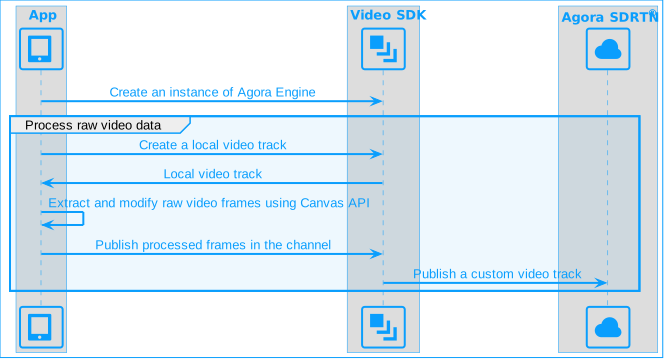
This guide explains how to extract video frames from the local video track, modify them, and publish the processed frames to the channel.
The following figure shows the video data processing flow in the SDK video module.
**Process raw video**
## Prerequisites [#prerequisites-5]
Ensure that you have implemented the [SDK quickstart](/en/realtime-media/video/get-started-sdk) in your project.
## Implement raw video processing [#implement-raw-video-processing-5]
To implement raw video data functionality in your project, refer to the following steps:
1. Extract video frames:
1. Create a local video track to capture the raw video stream from the camera.
2. Assign the local video stream to a hidden `