# Use tokens (/en/realtime-media/video/build/authenticate-users/authentication-workflow/web)
> For AI agents: see the complete documentation index at [llms.txt](/llms.txt).
To protect your business, it is best practice to authenticate every client that joins a channel. This guide explains how to fetch an authentication token from your token server, use it to join a channel, and renew the token when it expires.
## Understand the tech [#understand-the-tech]
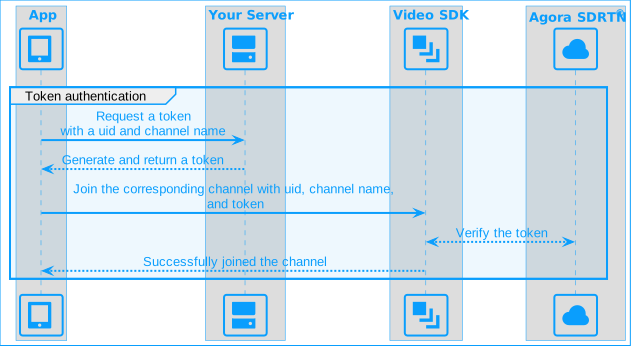
When a user attempts to connect to an Agora channel, your app retrieves a token from the token server in your security infrastructure. Your app then sends this token to Agora SDRTN® for authentication. Agora SDRTN® reads the information stored in the token to validate the request.
The following figure shows the call flow you implement to create step-up-authentication with Agora Video Calling:
## Prerequisites [#prerequisites]
Before starting, ensure that you have:
* Implemented the [Quickstart](/en/realtime-media/video/get-started-sdk) in your project.
* Deployed a token server using either of the following guides:
* [Deploy a token server](/en/realtime-media/video/build/authenticate-users/deploy-token-server)
* [Deploy a middleware server](/en/realtime-media/video/build/authenticate-users/middleware-token-server)
## Implement basic authentication [#implement-basic-authentication]
This section shows you how to implement basic authentication by acquiring a token and using it to join a channel.
### Use a token to join a channel [#use-a-token-to-join-a-channel-9]
This section shows you how to integrate token authentication in your app.
1. Open the [Quickstart](/en/realtime-media/video/get-started-sdk) project you created earlier.
2. In `index.html`, include an HTTP client library such as `axios` for sending token requests to the authentication server.
```html
Token demo
Token demo
```
3. Add a `fetchToken` method to retrieve a token from your token server to join a channel.
```js
// Retrieve a token from your token server
function fetchToken(uid, channelName, tokenRole) {
return new Promise(function (resolve) {
axios.post('http:///fetch_rtc_token', {
uid: uid,
channelName: channelName,
role: tokenRole
}, {
headers: {
'Content-Type': 'application/json; charset=UTF-8'
}
})
.then(function (response) {
const token = response.data.token;
resolve(token);
})
.catch(function (error) {
console.log(error);
});
})
}
```
4. Use the token to join a channel
```js
// Assign the obtained token to the token parameter in the join method
let token = await fetchToken(uid, options.channel, 1);
await client.join(options.appId, options.channel, token, uid);
```
### Token expiration [#token-expiration-5]
After you join a channel using a token, the SDK triggers the `token-privilege-will-expire` callback, 30 seconds before the token is set to expire. Upon receiving this callback, retrieve a fresh token from the server and call the `renewToken` method to pass the newly generated token to the SDK.
```javascript
client.on("token-privilege-will-expire", async function () {
// When you receive the token-privilege-will-expire callback, request a fresh token from the server
let token = await fetchToken(uid, options.channel, 1);
// Call renewToken to pass the new token to the SDK
await client.renewToken(token);
});
```
When the token expires, the SDK triggers the `token-privilege-did-expire` callback. In this case, retrieve a fresh token from the server and call the `join` method to rejoin the channel with the new token:
```javascript
// The token expired.
client.on("token-privilege-did-expire", async function () {
console.log("Fetching a new token")
// Request a new token from the server
let token = await fetchToken(uid, options.channel, 1);
console.log("Rejoining the channel with new token")
// Call join to rejoin the channel
await client.join(options.appId, options.channel, token, uid);
});
```
### Complete sample code [#complete-sample-code-3]
For a complete implementation of token authentication, refer to the following code:
**Sample code for basic authentication**
```js
var rtc = {
// Set local audio track and video track
localAudioTrack: null,
localVideoTrack: null,
};
var options = {
// Fill in app ID
appId: "",
// Fill in a channel name
channel: "test",
// Set the user as host or audience
role: "host"
};
// Get a token from your token server
function fetchToken(uid, channelName, tokenRole) {
return new Promise(function (resolve) {
axios.post('http:///fetch_rtc_token', {
uid: uid,
channelName: channelName,
role: tokenRole
}, {
headers: {
'Content-Type': 'application/json; charset=UTF-8'
}
})
.then(function (response) {
const token = response.data.token;
resolve(token);
})
.catch(function (error) {
console.log(error);
});
})
}
async function startBasicCall() {
const client = AgoraRTC.createClient({ mode: "live", codec: "vp8" });
client.setClientRole(options.role);
const uid = 123456;
// Assign the obtained token to the token parameter of the join method, and join the channel
let token = await fetchToken(uid, options.channel, 1);
await client.join(options.appId, options.channel, token, uid);
rtc.localAudioTrack = await AgoraRTC.createMicrophoneAudioTrack();
rtc.localVideoTrack = await AgoraRTC.createCameraVideoTrack();
await client.publish([rtc.localAudioTrack, rtc.localVideoTrack]);
const localPlayerContainer = document.createElement("div");
localPlayerContainer.id = uid;
localPlayerContainer.style.width = "640px";
localPlayerContainer.style.height = "480px";
document.body.append(localPlayerContainer);
rtc.localVideoTrack.play(localPlayerContainer);
console.log("publish success!");
client.on("user-published", async (user, mediaType) => {
await client.subscribe(user, mediaType);
console.log("subscribe success");
if (mediaType === "video") {
const remoteVideoTrack = user.videoTrack;
const remotePlayerContainer = document.createElement("div");
remotePlayerContainer.textContent = "Remote user " + user.uid.toString();
remotePlayerContainer.style.width = "640px";
remotePlayerContainer.style.height = "480px";
document.body.append(remotePlayerContainer);
remoteVideoTrack.play(remotePlayerContainer);
}
if (mediaType === "audio") {
const remoteAudioTrack = user.audioTrack;
remoteAudioTrack.play();
}
client.on("user-unpublished", user => {
const remotePlayerContainer = document.getElementById(user.uid);
remotePlayerContainer.remove();
});
});
// When you receive the token-privilege-will-expire callback, request a new token from the server and call renewToken to pass the new token to the SDK
client.on("token-privilege-will-expire", async function () {
let token = await fetchToken(uid, options.channel, 1);
await client.renewToken(token);
});
// When you receive the token-privilege-did-expire callback, request a new token from the server and call join to rejoin the channel.
client.on("token-privilege-did-expire", async function () {
console.log("Fetching a new token")
let token = await fetchToken(uid, options.channel, 1);
console.log("Rejoining the channel with a new token")
await client.join(options.appId, options.channel, token, uid);
});
}
startBasicCall()
```
Replace `` with your app ID, which must be consistent with the app ID you specified in the server configuration. Update `` with the host URL and port of the local Golang server you have deployed. For example `99.9.9.99:8082`.
Build and run the project on the local device, the app performs the following operations:
* Obtains a token from your token server.
* Joins the channel.
* Automatically renews the token when it is about to expire.
Note
The user ID and channel name used to join a channel must be consistent with the values used to generate the token.
## Reference [#reference]
This section contains content that completes the information on this page, or points you to documentation that explains other aspects to this product.
* [Reference app](https://github.com/AgoraIO/video-sdk-samples-web/tree/main/Demo/basicVideoCall)