# Use tokens (/en/realtime-media/video/build/authenticate-users/authentication-workflow/macos)
> For AI agents: see the complete documentation index at [llms.txt](/llms.txt).
To protect your business, it is best practice to authenticate every client that joins a channel. This guide explains how to fetch an authentication token from your token server, use it to join a channel, and renew the token when it expires.
## Understand the tech [#understand-the-tech]
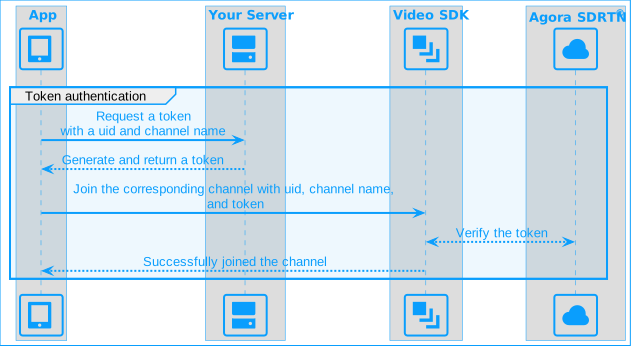
When a user attempts to connect to an Agora channel, your app retrieves a token from the token server in your security infrastructure. Your app then sends this token to Agora SDRTN® for authentication. Agora SDRTN® reads the information stored in the token to validate the request.
The following figure shows the call flow you implement to create step-up-authentication with Agora Video Calling:
## Prerequisites [#prerequisites]
Before starting, ensure that you have:
* Implemented the [Quickstart](/en/realtime-media/video/get-started-sdk) in your project.
* Deployed a token server using either of the following guides:
* [Deploy a token server](/en/realtime-media/video/build/authenticate-users/deploy-token-server)
* [Deploy a middleware server](/en/realtime-media/video/build/authenticate-users/middleware-token-server)
## Implement basic authentication [#implement-basic-authentication]
This section shows you how to implement basic authentication by acquiring a token and using it to join a channel.
### Use a token to join a channel [#use-a-token-to-join-a-channel-4]
The client requests a token from your authentication server corresponding to the user ID and the channel name. You use the received token to join a channel.
```swift
// Channel name
let channelId: String = "xxxx"
// User ID
let uid: UInt = 0
// Request the server to generate a token corresponding to channelId and uid
let token = getToken()
// Set channel media options
let mediaOption = AgoraRtcChannelMediaOptions()
// Set the user role as host
mediaOption.clientRoleType = .broadcaster
// Use the token to join a channel
agoraKit.joinChannel(byToken: token, channelId: channelId, uid: uid, mediaOptions: mediaOption)
```
### Token expiration [#token-expiration-2]
After you join a channel using a token, the SDK triggers an `onTokenPrivilegeWillExpire` callback, 30 seconds before the token is set to expire.
When the token expires, the SDK triggers an `onRequestToken` callback. After receiving the callback, you regenerate a new token on the server side, and then update the token in one of the following ways:
#### Single channel use-case [#single-channel-use-case-2]
* Call `renewToken` to pass in the newly generated Token (Recommended).
* Call `updateChannelWithMediaOptions` to update the token.
* Call `leaveChannel` \[2/2] to leave the current channel, and then pass in a new token when calling `joinChannelByToken` \[2/4] to rejoin the channel.
#### Multi-channel use-case [#multi-channel-use-case-2]
If you call `joinChannelEx` to join multiple channels, call the `updateChannelExWithMediaOptions` method to update the token.
The following sample code demonstrates how to call `renewToken` to update the token upon receiving an `tokenPrivilegeWillExpire` callback notification.
```swift
extension JoinChannelVideoToken: AgoraRtcEngineDelegate {
// Callback is triggered when the token is about to expire
func rtcEngine(_ engine: AgoraRtcEngineKit, tokenPrivilegeWillExpire token: String) {
// Request to generate a fresh token
let token = getToken()
// Update token
engine.renewToken(token)
}
}
```
### Complete sample code [#complete-sample-code-2]
For a complete implementation of token authentication, replace the content in `ViewController.swift` with the following code. Replace `Your App ID` with your App ID and `` with the host URL and port of the local Golang server you have deployed. For example, `123.1.23.123:8082`.
**Complete sample code for token authentication**
```swift
import UIKit
import AgoraRtcKit
import Foundation
public enum TokenError: Error {
case noData
case invalidData
}
class ViewController: UIViewController {
var localView: UIView!
var remoteView: UIView!
var agoraKit: AgoraRtcEngineKit!
override func viewDidLoad() {
super.viewDidLoad()
// After loading the view, you can make other settings.
initView()
initializeAgoraEngine()
setClientRole()
setupLocalVideo()
fetchToken(channelName: "test", userId: 1234, role: 1) { result in
switch result {
case .success(let token):
print("token is: \\(token)")
self.joinChannel(token: token)
case .failure(let err):
print("Could not fetch token: \\(err)")
}
}
}
override func viewDidLayoutSubviews() {
super.viewDidLayoutSubviews()
remoteView.frame = self.view.bounds
localView.frame = CGRect(x: self.view.bounds.width - 90, y: 0, width: 90, height: 160)
}
override func viewDidDisappear(_ animated: Bool) {
super.viewDidDisappear(true)
leaveChannel()
destroy()
}
func initView() {
remoteView = UIView()
self.view.addSubview(remoteView)
localView = UIView()
self.view.addSubview(localView)
}
func initializeAgoraEngine() {
let config = AgoraRtcEngineConfig()
config.appId = "Your App ID"
config.channelProfile = .liveBroadcasting
agoraKit = AgoraRtcEngineKit.sharedEngine(with: config, delegate: self)
if agoraKit != nil {
print("Initialization successful")
} else {
print("Initialization failed")
}
}
func setClientRole() {
agoraKit.setClientRole(.broadcaster)
}
func setupLocalVideo() {
agoraKit.enableVideo()
agoraKit.startPreview()
let videoCanvas = AgoraRtcVideoCanvas()
videoCanvas.uid = 0
videoCanvas.renderMode = .hidden
videoCanvas.view = localView
agoraKit.setupLocalVideo(videoCanvas)
}
func joinChannel(token: String) {
let option = AgoraRtcChannelMediaOptions()
agoraKit.joinChannel(byToken: token, channelId: "test", uid: 123456, mediaOptions: option)
}
func leaveChannel() {
agoraKit.stopPreview()
agoraKit.leaveChannel(nil)
}
func destroy() {
AgoraRtcEngineKit.destroy()
}
func fetchToken(
channelName: String,
userId: UInt,
role: UInt,
callback: @escaping (Result) -> Void
) {
let url = URL(string: "http:///fetch_rtc_token")
let parameters = ["uid": userId, "channelName": channelName, "role": role] as [String : Any]
print(parameters.self)
var request = URLRequest(
url: url!,
timeoutInterval: 10
)
request.httpMethod = "POST"
do {
request.httpBody = try JSONSerialization.data(withJSONObject: parameters, options: .prettyPrinted)
} catch let error {
print(error.localizedDescription)
}
URLSession.shared.dataTask(with: request) { data, _, err in
guard let data = data else {
if let err = err {
callback(.failure(err))
} else {
callback(.failure(TokenError.noData))
}
return
}
let responseJSON = try? JSONSerialization.jsonObject(with: data, options: [])
if let responseDict = responseJSON as? [String: Any], let token = responseDict["token"] as? String {
callback(.success(token))
} else {
callback(.failure(TokenError.invalidData))
}
}.resume()
}
}
extension ViewController: AgoraRtcEngineDelegate {
func rtcEngine(_ engine: AgoraRtcEngineKit, didJoinedOfUid uid: UInt, elapsed: Int) {
let videoCanvas = AgoraRtcVideoCanvas()
videoCanvas.uid = uid
videoCanvas.renderMode = .hidden
videoCanvas.view = remoteView
agoraKit.setupRemoteVideo(videoCanvas)
}
func rtcEngine(_ engine: AgoraRtcEngineKit, tokenPrivilegeWillExpire token: String) {
self.fetchToken(channelName: "test", userId: 1234, role: 1) { result in
switch result {
case .success(let token):
print("token is: \\(token)")
self.agoraKit.renewToken(token)
print("Renewed the token")
case .failure(let err):
print("Could not fetch token: \\(err)")
}
}
}
func rtcEngine(
_ engine: AgoraRtcEngineKit,
connectionStateChanged state: AgoraConnectionState,
reason: AgoraConnectionChangedReason
) {
print("Connection state changed to")
print(state.rawValue)
}
func rtcEngineRequestToken(_ engine: AgoraRtcEngineKit) {
fetchToken(channelName: "test", userId: 1234, role: 1) { result in
switch result {
case .success(let token):
print("token is: \\(token)")
self.joinChannel(token: token)
case .failure(let err):
print("Could not fetch token: \\(err)")
}
}
}
}
```
Note
The user ID and channel name used to join a channel must be consistent with the values used to generate the token.
## Reference [#reference]
This section contains content that completes the information on this page, or points you to documentation that explains other aspects to this product.
### API reference [#api-reference-2]
* [`joinChannel`](https://api-ref.agora.io/en/video-sdk/macos/4.x/documentation/agorartckit/agorartcenginekit/joinchannel\(bytoken\:channelid\:info\:uid\:joinsuccess:\))
* [`renewToken`](https://api-ref.agora.io/en/video-sdk/macos/4.x/documentation/agorartckit/agorartcenginekit/renewtoken\(_:\))
* [`rtcEngine(_:tokenPrivilegeWillExpire:)`](https://api-ref.agora.io/en/video-sdk/macos/4.x/documentation/agorartckit/agorartcenginedelegate/rtcengine\(_\:tokenprivilegewillexpire:\))