# Use tokens (/en/realtime-media/video/build/authenticate-users/authentication-workflow/electron)
> For AI agents: see the complete documentation index at [llms.txt](/llms.txt).
To protect your business, it is best practice to authenticate every client that joins a channel. This guide explains how to fetch an authentication token from your token server, use it to join a channel, and renew the token when it expires.
## Understand the tech [#understand-the-tech]
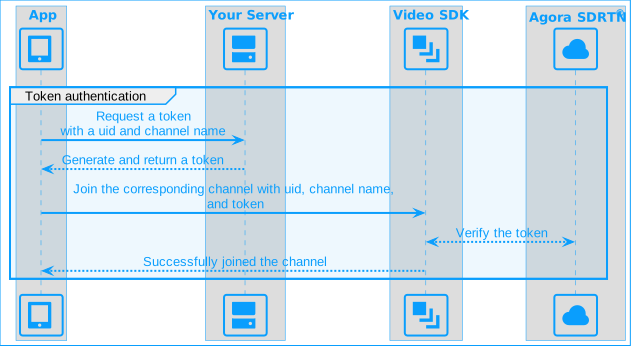
When a user attempts to connect to an Agora channel, your app retrieves a token from the token server in your security infrastructure. Your app then sends this token to Agora SDRTN® for authentication. Agora SDRTN® reads the information stored in the token to validate the request.
The following figure shows the call flow you implement to create step-up-authentication with Agora Video Calling:
## Prerequisites [#prerequisites]
Before starting, ensure that you have:
* Implemented the [Quickstart](/en/realtime-media/video/get-started-sdk) in your project.
* Deployed a token server using either of the following guides:
* [Deploy a token server](/en/realtime-media/video/build/authenticate-users/deploy-token-server)
* [Deploy a middleware server](/en/realtime-media/video/build/authenticate-users/middleware-token-server)
## Implement basic authentication [#implement-basic-authentication]
This section shows you how to implement basic authentication by acquiring a token and using it to join a channel.
### Use a token to join a channel [#use-a-token-to-join-a-channel-1]
This section shows you how to integrate token authentication in your app.
1. Open the [SDK quickstart](/en/realtime-media/video/get-started-sdk) project you created earlier.
2. In `renderer.js` replace the contents with the following:
**Sample code for basic authentication**
```dart
const {
createAgoraRtcEngine,
VideoMirrorModeType,
VideoSourceType,
RenderModeType,
ChannelProfileType,
ClientRoleType,
} = require("agora-electron-sdk");
let rtcEngine;
let localVideoContainer;
let remoteVideoContainer;
let isJoined = false;
const EventHandles = {
// Listen to local user joining channel events
onJoinChannelSuccess: ({ channelId, localUid }, elapsed) => {
console.log('Successfully joined the channel:' + channelId);
isJoined = true;
// After local users join the channel, set the local video window
rtcEngine.setupLocalVideo({
sourceType: VideoSourceType.VideoSourceCameraPrimary,
view: localVideoContainer,
mirrorMode: VideoMirrorModeType.VideoMirrorModeDisabled,
renderMode: RenderModeType.RenderModeFit,
});
},
onLeaveChannel: ({ channelId, localUid }, stats) => {
console.log('Successfully left the channel:' + channelId);
isJoined = false;
},
// Listen to remote user join event
onUserJoined: ({ channelId, localUid }, remoteUid, elapsed) => {
console.log('Remote user ' + remoteUid + ' 已加入');
// Listen to remote user join event
rtcEngine.setupRemoteVideoEx(
{
sourceType: VideoSourceType.VideoSourceRemote,
uid: remoteUid,
view: remoteVideoContainer,
mirrorMode: VideoMirrorModeType.VideoMirrorModeDisabled,
renderMode: RenderModeType.RenderModeFit,
},
{ channelId },
);
},
// Listen for the token expiration event
onTokenPrivilegeWillExpire: ({ channelId, localUid }, token) => {
console.log('token ' + token + '即将过期');
// Obtain a new token from the server
fetchToken(channelId, localUid, ClientRoleType.ClientRoleBroadcaster)
},
// Listen for the token expired event
onRequestToken: ({ channelId, localUid }) => {
console.log('token expired');
token = ''
}
};
// Send a token request to the token server
function fetchToken(channelName, uid, role) {
//Token server URL example: http://12.123.1.123:8082/fetch_rtc_token
const url = '/fetch_rtc_token';
const body = JSON.stringify({
uid,
ChannelName: channelName,
role
});
fetch(url, {
method: 'POST',
body,
})
.then((res) => res.json())
.then((res) => {
console.log('token ' + res.token);
if (+res.code === 200) {
if (isJoined) {
rtcEngine.renewToken(res.token)
} else {
rtcEngine.joinChannel(res.token, channelName, uid, { clientRoleType: role })
}
}
return res;
});
}
window.onload = () => {
const os = require("os");
const path = require("path");
// Fill in your app ID
const APPID = "";
// Fill in the channel name
const channel = "Test";
localVideoContainer = document.getElementById("join-channel-local-video");
remoteVideoContainer = document.getElementById("join-channel-remote-video");
const sdkLogPath = path.resolve(os.homedir(), "./test.log");
// Create an RtcEngine instance
rtcEngine = createAgoraRtcEngine();
// Initialize the RtcEngine instance
rtcEngine.initialize({
appId: APPID,
logConfig: { filePath: sdkLogPath }
});
// Register event handler
rtcEngine.registerEventHandler(EventHandles);
//Set the channel profile to live broadcast
rtcEngine.setChannelProfile(ChannelProfileType.ChannelProfileLiveBroadcasting);
// Set the user role, for host use ClientRoleBroadcaster, for audience use ClientRoleAudience
rtcEngine.setClientRole(ClientRoleType.ClientRoleBroadcaster);
// Enable the video module
rtcEngine.enableVideo();
// Enable camera preview
rtcEngine.startPreview();
// Use the token to join a channel
// You need to specify the user ID yourself and ensure its uniqueness within the channel
fetchToken(channel, 123456, ClientRoleType.ClientRoleBroadcaster);
};
```
Replace `` with your app ID, which must be consistent with the app ID you specified in the server configuration. Update `` with the host URL and port of the local Golang server you have deployed. For example `99.9.9.99:8082`.
The sample code implements the following logic:
* Calls `joinChannel` to join a channel using the user ID, the channel name, and a token you obtain from the server. The user ID and channel name you specify must be consistent with the values you used to generate the token.
* The SDK triggers an `onTokenPrivilegeWillExpire` callback 30 seconds before the token expires. After receiving the callback, you obtain a new token from the server and call `renewToken` to pass the newly generated token to the SDK.
* If the token expires, the SDK triggers an `onRequestToken` callback. After receiving the callback, obtain a new token from the server and call `joinChannel` with the new token to rejoin the channel.
Build and run the project on the local device, the app performs the following operations:
* Obtains a token from your token server.
* Joins the channel.
* Automatically renews the token when it is about to expire.
Note
The user ID and channel name used to join a channel must be consistent with the values used to generate the token.
## Reference [#reference]
This section contains content that completes the information on this page, or points you to documentation that explains other aspects to this product.
### API reference [#api-reference-4]
* [renewToken](https://api-ref.agora.io/en/voice-sdk/electron/4.x/API/class_irtcengine.html#api_irtcengine_renewtoken)
* [onTokenPrivilegeWillExpire](https://api-ref.agora.io/en/voice-sdk/electron/4.x/API/class_irtcengineeventhandler.html#callback_irtcengineeventhandler_ontokenprivilegewillexpire)
* [onRequestToken](https://api-ref.agora.io/en/voice-sdk/electron/4.x/API/class_irtcengineeventhandler.html#callback_irtcengineeventhandler_onrequesttoken)