# Signaling Quickstart (/en/realtime-media/rtm/quickstart)
> For AI agents: see the complete documentation index at [llms.txt](/llms.txt).
Use Signaling SDK to add low-latency, high-concurrency signaling and synchronization capabilities to your app.
Signaling also helps you enhance the user experience in Video Calling, Voice Calling, Interactive Live Streaming, and Broadcast Streaming applications.
This page shows you how to use the Signaling SDK to rapidly build a simple application that sends and receives messages. It shows you how to integrate the Signaling SDK in your project and implement pub/sub messaging through [Message channels](/en/realtime-media/rtm/build/work-with-channels/message-channel). To get started with stream channels, follow this guide to create a basic Signaling app and then refer to the [Stream channels](/en/realtime-media/rtm/build/work-with-channels/stream-channel) guide.
<_PlatformTabsGroup groupMode="structured" canonicalPlatform="web" platforms="["android","ios","web","flutter","linux-cpp","unity"]" showTabs="true">
<_PlatformPanel platform="android">
<_PlatformProcessedMarker groupMode="structured" canonicalPlatform="web" platform="android" />
## Understand the tech [#understand-the-tech]
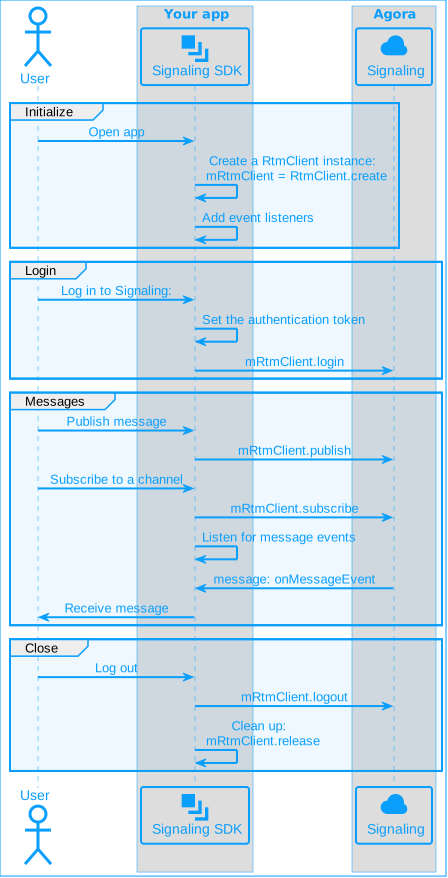
To use Signaling features in your app, you initialize a Signaling client instance and add event listeners. To connect to Signaling, you login using an authentication token. To send a message to a message channel, you publish the message. Signaling creates a channel when a user subscribes to it. To receive messages other users publish to a channel, your app listens for events.
To create a pub/sub session for Signaling, implement the following steps in your app:
## Prerequisites [#prerequisites]
To implement the code presented on this page you need to have:
* An Agora [account](/en/realtime-media/rtm/manage-agora-account) and [project](/en/realtime-media/rtm/manage-agora-account).
* [Enabled Signaling](/en/realtime-media/rtm/manage-agora-account) in Agora Console
* [Android Studio](https://developer.android.com/studio) 4.1 or higher.
* Android SDK API Level 24 or higher.
* A mobile device that runs Android 4.1 or higher.
* Ensure that a firewall is not blocking your network communication.
Signaling 2.x is an enhanced version compared to 1.x with a wide range of new features. It follows a new pricing structure. See [Pricing](/en/realtime-media/rtm/reference/pricing) for details.
## Project setup [#project-setup]
### Create a project [#create-a-project]
1. **Create a [new project](https://developer.android.com/studio/projects/create-project)**.
1. Open Android Studio and select **File > New > New Project...**.
2. Select **Phone and Tablet** > **Empty Activity** and click **Next**.
3. Set the project name and storage path.
4. Select **Java** or **Kotlin** as the language, and click **Finish** to create the project.
After you create a project, Android Studio automatically starts gradle sync. Ensure that the synchronization is successful before proceeding to the next step.
2. **Add network permissions**
Open the `/app/src/main/AndroidManifest.xml` file and add the following permissions before ``:
```xml
```
3. **Prevent code obfuscation**
Open the `/app/proguard-rules.pro` file and add the following line to prevent code obfuscation:
```java
-keep class io.agora.**{*;}
```
### Integrate the SDK [#integrate-the-sdk]
Use either of the following methods to integrate Signaling SDK into your project.
**Using Maven Central**
1. Open the `settings.gradle` file in the project's root directory and add the Maven Central dependency, if it doesn't already exist:
```java
repositories {
mavenCentral()
}
```
If your Android project uses [`dependencyResolutionManagement`](https://docs.gradle.org/current/userguide/declaring_repositories.html#sub\:centralized-repository-declaration), there may be differences in how you add Maven Central dependencies.
2. Add the following to the `/Gradle Scripts/build.gradle(Module: .app)` file under `dependencies` to integrate the SDK into your Android project:
* Groovy
```text
implementation 'io.agora.rtm:rtm-sdk:x.y.z'
```
To resolve integration issues when co-integrating with the RTC SDK use:
```text
implementation 'io.agora.rtm:rtm-sdk-lite:x.y.z'
```
* Kotlin
```kotlin
implementation("io.agora.rtm:rtm-sdk:x.y.z")
```
To resolve integration issues when co-integrating with the RTC SDK use:
```kotlin
implementation("io.agora.rtm:rtm-sdk-lite:x.y.z")
```
Replace `x.y.z` with the specific SDK version number, such as `2.2.8`. To get the latest version number, check the [Release notes](/en/realtime-media/rtm/reference/release-notes).
**Using CDN**
1. [Download](/en/api-reference/sdks?product=signaling\&platform=android) the latest version of Signaling SDK for Android.
2. Copy all files in the `sdk` folder of the package to the `/app/libs` folder of the project.
3. To add the SDK reference, open the project file `/Gradle Scripts/build.gradle(Module: .app)` and add the following code:
1. Add a `ndk` node under the default `Config` node, to specify the supported architectures:
```text
Config {
// ...
ndk{
abiFilters 'armeabi-v7a', 'arm64-v8a', 'x86', 'x86_64'
}
}
```
Supporting all architectures increases the app size. Best practice is to only add essential architectures based on your targets. For most use-cases, `armeabi-v7a` and `arm64-v8a` architectures are sufficient when releasing the Android app.
2. Add a `sourceSets` node under the `android` node to include the jni libraries copied to the `libs` folder:
```text
android {
// ...
sourceSets {
main {
jniLibs.srcDirs = ['libs']
}
}
}
```
3. To include all `jar` files in the `libs` folder as dependencies, add the following under the `dependencies` node:
```text
dependencies {
implementation fileTree(dir: 'libs', include: ['*.jar'])
// ...
}
```
To integrate Signaling SDK version `2.2.0` or later alongside Video SDK version `4.3.0` or later, refer to [handle integration issues](/en/api-reference/faq/integration/rtm2_rtc_integration_issue).
### Create a user interface [#create-a-user-interface]
This section helps you create a simple user interface to explore the basic features of Signaling. Modify it according to your specific needs.
The demo interface consists of the following UI elements:
* Input boxes for user ID, channel name, and message
* Buttons to log in and log out of Signaling
* Buttons to subscribe and unsubscribe from a channel
* A button to publish a message
**Sample code to create the user interface**
Open the `/app/res/layout/activity_main.xml` file, and replace the contents with the following:
```xml
```
Open the `app/res/values/strings.xml` file and add following string resources:
```xml
Signaling QuickstartLoginLogoutSubscribeUnsubscribePublish messageUser IDMessage contentChannel nameyour_appidyour_token
```
## Implement Signaling [#implement-signaling]
A complete code sample that implements the basic features of Signaling is presented here for your reference. To use the sample code, copy the following lines into the `/app/src/main/java/com/example//MainActivity` file and replace `` in `package com.example.` with the name of your project.
**Complete sample code for Signaling**
Java
Kotlin
```java
package com.example.;
import android.os.Bundle;
import android.view.View;
import android.widget.EditText;
import android.widget.TextView;
import android.widget.Toast;
import androidx.appcompat.app.AppCompatActivity;
import io.agora.rtm.*;
public class JavaActivity extends AppCompatActivity {
private EditText etUserId;
private EditText etChannelName;
private EditText etMessageContent;
private TextView mMessageHistory;
private RtmClient mRtmClient;
private final RtmEventListener eventListener = new RtmEventListener() {
@Override
public void onMessageEvent(MessageEvent event) {
String text = "Message received from " + event.getPublisherId()
+ ", Message: " + event.getMessage().getData();
writeToMessageHistory(text);
}
@Override
public void onPresenceEvent(PresenceEvent event) {
String text = "Received presence event, user: " + event.getPublisherId()
+ ", Event: " + event.getEventType();
writeToMessageHistory(text);
}
@Override
public void onLinkStateEvent(LinkStateEvent event) {
String text = "Connection state changed to " + event.getCurrentState()
+ ", Reason: " + event.getReason();
writeToMessageHistory(text);
}
};
@Override
protected void onCreate(Bundle savedInstanceState) {
super.onCreate(savedInstanceState);
setContentView(R.layout.activity_main);
}
public void onClickLogin(View v) {
etUserId = findViewById(R.id.uid);
String userId = etUserId.getText().toString();
String token = getString(R.string.token);
if (createClient(userId)) {
login(token);
}
}
public void onClickLogout(View v) {
logout();
}
public void onClickSubscribe(View v) {
etChannelName = findViewById(R.id.channel_name);
String channelName = etChannelName.getText().toString();
subscribe(channelName);
}
public void onClickUnsubscribe(View v) {
etChannelName = findViewById(R.id.channel_name);
String channelName = etChannelName.getText().toString();
unsubscribe(channelName);
}
public void onClickSendChannelMsg(View v) {
etChannelName = findViewById(R.id.channel_name);
String channelName = etChannelName.getText().toString();
etMessageContent = findViewById(R.id.msg_box);
String message = etMessageContent.getText().toString();
publishMessage(channelName, message);
}
private boolean createClient(String userId) {
if (userId.isEmpty()) {
showToast("Invalid userId");
return false;
}
try {
RtmConfig config = new RtmConfig.Builder(getString(R.string.app_id), userId)
.eventListener(eventListener)
.build();
mRtmClient = RtmClient.create(config);
return true;
} catch (Exception e) {
showToast("Error creating RTM client.");
return false;
}
}
private void login(String token) {
if (mRtmClient == null) {
showToast("RTM client is null");
return;
}
mRtmClient.login(token, new ResultCallback<>() {
@Override
public void onSuccess(Void responseInfo) {
writeToMessageHistory("Successfully logged in to Signaling!");
}
@Override
public void onFailure(ErrorInfo errorInfo) {
writeToMessageHistory("Failed to log in to Signaling: " + errorInfo);
}
});
}
private void logout() {
if (mRtmClient == null) {
showToast("RTM client is null");
return;
}
mRtmClient.logout(new ResultCallback<>() {
@Override
public void onSuccess(Void responseInfo) {
writeToMessageHistory("Successfully logged out.");
}
@Override
public void onFailure(ErrorInfo errorInfo) {
writeToMessageHistory("Failed to log out: " + errorInfo);
}
});
}
private void subscribe(String channelName) {
if (mRtmClient == null) {
showToast("RTM client is null");
return;
}
SubscribeOptions options = new SubscribeOptions();
options.setWithMessage(true);
mRtmClient.subscribe(channelName, options, new ResultCallback<>() {
@Override
public void onSuccess(Void responseInfo) {
writeToMessageHistory("Successfully subscribed to the channel!");
}
@Override
public void onFailure(ErrorInfo errorInfo) {
writeToMessageHistory("Failed to subscribe to the channel: " + errorInfo);
}
});
}
private void unsubscribe(String channelName) {
if (mRtmClient == null) {
showToast("RTM client is null");
return;
}
mRtmClient.unsubscribe(channelName, new ResultCallback<>() {
@Override
public void onSuccess(Void responseInfo) {
writeToMessageHistory("Successfully unsubscribed from the channel!");
}
@Override
public void onFailure(ErrorInfo errorInfo) {
writeToMessageHistory("Failed to unsubscribe from the channel: " + errorInfo);
}
});
}
private void publishMessage(String channelName, String message) {
if (mRtmClient == null) {
showToast("RTM client is null");
return;
}
PublishOptions options = new PublishOptions();
options.setCustomType("");
mRtmClient.publish(channelName, message, options, new ResultCallback<>() {
@Override
public void onSuccess(Void responseInfo) {
writeToMessageHistory("Message sent to channel " + channelName + ": " + message);
}
@Override
public void onFailure(ErrorInfo errorInfo) {
writeToMessageHistory("Failed to send message to channel " + channelName + ": " + errorInfo);
}
});
}
private void writeToMessageHistory(String record) {
if (mMessageHistory == null) {
mMessageHistory = findViewById(R.id.message_history);
}
mMessageHistory.append("- " + record + "
");
}
private void showToast(String text) {
Toast.makeText(this, text, Toast.LENGTH_SHORT).show();
}
}
```
```kotlin
package com.example.
import android.content.pm.ActivityInfo
import android.os.Bundle
import android.view.View
import android.widget.EditText
import android.widget.TextView
import android.widget.Toast
import androidx.appcompat.app.AppCompatActivity
import io.agora.rtm.*
class MainActivity : AppCompatActivity() {
private lateinit var etUserId: EditText
private lateinit var etChannelName: EditText
private lateinit var etMessageContent: EditText
private var mRtmClient: RtmClient? = null
private lateinit var mMessageHistory: TextView
private val eventListener = object : RtmEventListener {
override fun onMessageEvent(event: MessageEvent) {
val text = "Message received from \${event.publisherId}, Message: \${event.message.data}"
writeToMessageHistory(text)
}
override fun onPresenceEvent(event: PresenceEvent) {
val text = "Received presence event, user: \${event.publisherId}, Event: \${event.eventType}"
writeToMessageHistory(text)
}
override fun onLinkStateEvent(event: LinkStateEvent) {
val text = "Connection state changed to \${event.currentState}, Reason: \${event.reason}"
writeToMessageHistory(text)
}
}
override fun onCreate(savedInstanceState: Bundle?) {
super.onCreate(savedInstanceState)
setContentView(R.layout.activity_main)
setRequestedOrientation(ActivityInfo.SCREEN_ORIENTATION_PORTRAIT)
}
fun onClickLogin(v: View) {
etUserId = findViewById(R.id.uid)
val userId = etUserId.text.toString()
val token = getString(R.string.token)
if (createClient(userId)) {
login(token)
}
}
fun onClickLogout(v: View) {
logout()
}
fun onClickSubscribe(v: View) {
etChannelName = findViewById(R.id.channel_name)
val channelName = etChannelName.text.toString()
subscribe(channelName)
}
fun onClickUnsubscribe(v: View) {
etChannelName = findViewById(R.id.channel_name)
val channelName = etChannelName.text.toString()
unsubscribe(channelName)
}
fun onClickSendChannelMsg(v: View) {
etChannelName = findViewById(R.id.channel_name)
val channelName = etChannelName.text.toString()
etMessageContent = findViewById(R.id.msg_box)
val message = etMessageContent.text.toString()
publishMessage(channelName, message)
}
private fun createClient(userId: String): Boolean {
if (userId.isEmpty()) {
showToast("Invalid userId")
return false
}
return try {
val config = RtmConfig.Builder(getString(R.string.app_id), userId)
.eventListener(eventListener)
.build()
mRtmClient = RtmClient.create(config)
true
} catch (e: Exception) {
showToast("Error creating RTM client.")
false
}
}
private fun login(token: String) {
mRtmClient?.login(token, object : ResultCallback {
override fun onSuccess(responseInfo: Void?) {
writeToMessageHistory("Successfully logged in to Signaling!")
}
override fun onFailure(errorInfo: ErrorInfo) {
writeToMessageHistory("Failed to log in to Signaling: $errorInfo")
}
}) ?: showToast("RTM client is null")
}
private fun logout() {
mRtmClient?.logout(object : ResultCallback {
override fun onSuccess(responseInfo: Void?) {
writeToMessageHistory("Successfully logged out.")
}
override fun onFailure(errorInfo: ErrorInfo) {
writeToMessageHistory("Failed to log out: $errorInfo")
}
}) ?: showToast("RTM client is null")
}
private fun subscribe(channelName: String) {
mRtmClient ?: run {
showToast("RTM client is null")
return
}
val options = SubscribeOptions().apply {
withMessage = true
}
mRtmClient!!.subscribe(channelName, options, object : ResultCallback {
override fun onSuccess(responseInfo: Void?) {
writeToMessageHistory("Successfully subscribed to the channel!")
}
override fun onFailure(errorInfo: ErrorInfo) {
writeToMessageHistory("Failed to subscribe to the channel: $errorInfo")
}
})
}
private fun unsubscribe(channelName: String) {
mRtmClient ?: run {
showToast("RTM client is null")
return
}
mRtmClient!!.unsubscribe(channelName, object : ResultCallback {
override fun onSuccess(responseInfo: Void?) {
writeToMessageHistory("Successfully unsubscribed from the channel!")
}
override fun onFailure(errorInfo: ErrorInfo) {
writeToMessageHistory("Failed to unsubscribe from the channel: $errorInfo")
}
})
}
private fun publishMessage(channelName: String, message: String) {
mRtmClient ?: run {
showToast("RTM client is null")
return
}
val options = PublishOptions().apply {
customType = ""
}
mRtmClient!!.publish(channelName, message, options, object : ResultCallback {
override fun onSuccess(responseInfo: Void?) {
writeToMessageHistory("Message sent to channel $channelName: $message")
}
override fun onFailure(errorInfo: ErrorInfo) {
writeToMessageHistory("Failed to send message to channel $channelName: $errorInfo")
}
})
}
private fun writeToMessageHistory(record: String) {
mMessageHistory = findViewById(R.id.message_history)
mMessageHistory.append("- $record
")
}
private fun showToast(text: String) {
Toast.makeText(this, text, Toast.LENGTH_SHORT).show()
}
}
```
Follow the implementation steps to understand the core API calls in the sample code or use the snippets in your own code.
### Import Agora classes [#import-agora-classes]
To use Signaling APIs in your project, import the relevant Agora classes and interfaces:
Java
Kotlin
```java
import io.agora.rtm.*;
```
```kotlin
import io.agora.rtm.*
```
### Initialize the Signaling engine [#initialize-the-signaling-engine]
Before calling any other Signaling SDK API, initialize an `RtmClient` object instance.
Java
Kotlin
```java
private boolean createClient(String userId) {
if (userId.isEmpty()) {
showToast("Invalid userId");
return false;
}
try {
RtmConfig config = new RtmConfig.Builder(getString(R.string.app_id), userId)
.eventListener(eventListener)
.build();
mRtmClient = RtmClient.create(config);
return true;
} catch (Exception e) {
showToast("Error creating RTM client.");
return false;
}
}
```
```kotlin
private fun createClient(userId: String): Boolean {
if (userId.isEmpty()) {
showToast("Invalid userId")
return false
}
return try {
// Create a configuration object
val config = RtmConfig.Builder(getString(R.string.app_id), userId)
.eventListener(eventListener)
.build()
// Use the configuration object to instantiate the engine
mRtmClient = RtmClient.create(config)
true
} catch (e: Exception) {
showToast("Error creating RTM client.")
false
}
}
```
### Add an event listener [#add-an-event-listener]
The event listener enables you to implement the processing logic in response to Signaling events. Use the following code to handle event notifications or display received messages:
Java
Kotlin
```java
private RtmEventListener eventListener = new RtmEventListener() {
@Override
public void onMessageEvent(MessageEvent event) {
String text = "Message received from " + event.getPublisherId()
+ " Message: " + event.getMessage().getData();
writeToMessageHistory(text);
}
@Override
public void onPresenceEvent(PresenceEvent event) {
String text = "Received presence event, user: " + event.getPublisherId()
+ " Event: " + event.getEventType();
writeToMessageHistory(text);
}
@Override
public void onLinkStateEvent(LinkStateEvent event) {
String text = "Connection state changed to " + event.getCurrentState()
+ ", Reason: " + event.getReason();
writeToMessageHistory(text);
}
};
```
```kotlin
private val eventListener = object : RtmEventListener {
override fun onMessageEvent(event: MessageEvent) {
val text = "Message received from \${event.publisherId} Message: \${event.message.data}"
writeToMessageHistory(text)
}
override fun onPresenceEvent(event: PresenceEvent) {
val text = "Received presence event, user: \${event.publisherId} event: \${event.eventType}"
writeToMessageHistory(text)
}
override fun onLinkStateEvent(event: LinkStateEvent) {
val text = "Connection state changed to \${event.currentState}, Reason: \${event.reason}"
writeToMessageHistory(text)
}
}
```
### Log in to Signaling [#log-in-to-signaling]
To connect to Signaling and access Signaling network resources, such as sending messages, and subscribing to channels, call `login`.
During a login operation, the client attempts to establish a connection with Signaling. Once the connection is established, the client transmits heartbeat information to the Signaling server at fixed intervals to keep the client active until the client actively logs out or is disconnected. The connection is interrupted when timeout occurs. During this period, users may freely access the Signaling network resources subject to their own permissions and usage restrictions.
Java
Kotlin
```java
private void login(String token) {
if (mRtmClient == null) {
showToast("RTM client is null");
return;
}
mRtmClient.login(token, new ResultCallback<>() {
@Override
public void onSuccess(Void responseInfo) {
writeToMessageHistory("Successfully logged in to Signaling!");
}
@Override
public void onFailure(ErrorInfo errorInfo) {
writeToMessageHistory("Failed to log in to Signaling: " + errorInfo);
}
});
}
```
```kotlin
private fun login(token: String) {
mRtmClient?.login(token, object : ResultCallback {
override fun onSuccess(responseInfo: Void?) {
writeToMessageHistory("Successfully logged in to Signaling!")
}
override fun onFailure(errorInfo: ErrorInfo) {
writeToMessageHistory("Failed to log in to Signaling: $errorInfo")
}
}) ?: showToast("RTM client is null")
}
```
To confirm that login is successful, use the `login` return value, or listen to the `onLinkStateEvent` event notification which provides the error code and reason for the login failure. When performing a login operation, the client's network connection state is `CONNECTING`. After a successful login, the state is updated to `CONNECTED`.
Best practice
To continuously monitor the network connection state of the client, best practice is to continue to listen for `onLinkStateEvent` notifications throughout the life cycle of the application. For further details, see [Event listeners](/en/realtime-media/rtm/build/send-and-receive-messages/add-event-listener).
After a user successfully logs into Signaling, the application's PCU increases, which affects your billing data.
### Publish a message [#publish-a-message]
To distribute a message to all subscribers of a message channel, call `publish`. The following code sends a string type message.
Java
Kotlin
```java
private void publishMessage(String channelName, String message) {
if (mRtmClient == null) {
showToast("RTM client is null");
return;
}
PublishOptions options = new PublishOptions();
options.setCustomType("");
mRtmClient.publish(channelName, message, options, new ResultCallback<>() {
@Override
public void onSuccess(Void responseInfo) {
writeToMessageHistory("Message sent to channel " + channelName + ": " + message);
}
@Override
public void onFailure(ErrorInfo errorInfo) {
writeToMessageHistory("Failed to send message to channel " + channelName + ": " + errorInfo);
}
});
}
```
```kotlin
private fun publishMessage(channelName: String, message: String) {
mRtmClient ?: run {
showToast("RTM client is null")
return
}
val options = PublishOptions().apply {
customType = ""
}
mRtmClient!!.publish(channelName, message, options, object : ResultCallback {
override fun onSuccess(responseInfo: Void?) {
writeToMessageHistory("Message sent to channel $channelName: $message")
}
override fun onFailure(errorInfo: ErrorInfo) {
writeToMessageHistory("Failed to send message to channel $channelName: $errorInfo")
}
})
}
```
Before calling `publish` to send a message, serialize the message payload as a string.
### Subscribe and unsubscribe [#subscribe-and-unsubscribe]
To subscribe to a channel, call `subscribe`. When you subscribe to a channel, you receive all messages published to the channel.
Java
Kotlin
```java
private void subscribe(String channelName) {
if (mRtmClient == null) {
showToast("RTM client is null");
return;
}
SubscribeOptions options = new SubscribeOptions();
options.setWithMessage(true);
mRtmClient.subscribe(channelName, options, new ResultCallback<>() {
@Override
public void onSuccess(Void responseInfo) {
writeToMessageHistory("Successfully subscribed to the channel!");
}
@Override
public void onFailure(ErrorInfo errorInfo) {
writeToMessageHistory("Failed to subscribe to the channel: " + errorInfo);
}
});
}
```
```kotlin
private fun subscribe(channelName: String) {
mRtmClient ?: run {
showToast("RTM client is null")
return
}
val options = SubscribeOptions().apply {
withMessage = true
}
mRtmClient!!.subscribe(channelName, options, object : ResultCallback {
override fun onSuccess(responseInfo: Void?) {
writeToMessageHistory("Successfully subscribed to the channel!")
}
override fun onFailure(errorInfo: ErrorInfo) {
writeToMessageHistory("Failed to subscribe to the channel: $errorInfo")
}
})
}
```
When you no longer need to receive messages from a channel, call `unsubscribe` to unsubscribe from the channel:
Java
Kotlin
```java
private void unsubscribe(String channelName) {
if (mRtmClient == null) {
showToast("RTM client is null");
return;
}
mRtmClient.unsubscribe(channelName, new ResultCallback<>() {
@Override
public void onSuccess(Void responseInfo) {
writeToMessageHistory("Successfully unsubscribed from the channel!");
}
@Override
public void onFailure(ErrorInfo errorInfo) {
writeToMessageHistory("Failed to unsubscribe from the channel: " + errorInfo);
}
});
}
```
```kotlin
private fun unsubscribe(channelName: String) {
mRtmClient ?: run {
showToast("RTM client is null")
return
}
mRtmClient!!.unsubscribe(channelName, object : ResultCallback {
override fun onSuccess(responseInfo: Void?) {
writeToMessageHistory("Successfully unsubscribed from the channel!")
}
override fun onFailure(errorInfo: ErrorInfo) {
writeToMessageHistory("Failed to unsubscribe from the channel: $errorInfo")
}
})
}
```
For more information about subscribing and sending messages, see [Message channels](/en/realtime-media/rtm/build/work-with-channels/message-channel) and [Stream channels](/en/realtime-media/rtm/build/work-with-channels/stream-channel).
### Log out of Signaling [#log-out-of-signaling]
When a user no longer needs to use Signaling, call `logout`. Logging out means closing the connection between the client and Signaling. The user is automatically logged out or unsubscribed from all message and stream channels. Other users in the channel receive an `onPresenceEvent` notification of the user leaving the channel.
Java
Kotlin
```java
private void logout() {
if (mRtmClient == null) {
showToast("RTM client is null");
return;
}
mRtmClient.logout(new ResultCallback<>() {
@Override
public void onSuccess(Void responseInfo) {
writeToMessageHistory("Successfully logged out.");
}
@Override
public void onFailure(ErrorInfo errorInfo) {
writeToMessageHistory("Failed to log out: " + errorInfo);
}
});
// Release resources
mRtmClient.release();
}
```
```kotlin
private fun logout() {
mRtmClient?.logout(object : ResultCallback {
override fun onSuccess(responseInfo: Void?) {
writeToMessageHistory("Successfully logged out.")
}
override fun onFailure(errorInfo: ErrorInfo) {
writeToMessageHistory("Failed to log out: $errorInfo")
}
}) ?: showToast("RTM client is null")
// Release resources
mRtmClient.release()
}
```
## Test Signaling [#test-signaling]
Take the following steps to test the sample code:
1. Use the [Token Builder](https://agora-token-generator-demo.vercel.app/) to generate a Signaling token:
1. Select Signaling from the Agora products dropdown.
2. Fill in your app ID and app certificate from [Agora Console](https://console.agora.io/v2). Leave the remaining fields blank.
3. Click **Generate Token**.
2. In `strings.xml`, replace the values for `app_id` and `token` with your app ID and generated token.
3. Enable developer options on your Android test device. Turn on USB debugging, connect the Android device to your development machine through a USB cable, and check that your device appears in the Android device options.
4. In Android Studio, click **Sync Project with Gradle Files** to resolve project dependencies and update the configuration.
5. After synchronization is successful, click ▶️. Android Studio starts compilation. After a few moments, the app is installed and launched on your Android device.
6. Use the device as the receiving end and perform the following operations:
1. Enter your **User ID** and click **Login**.
2. Enter the **Channel name** and click **Subscribe** .
7. On a second Android device, repeat the previous steps to install and launch the app. Use this device as the sending end.
1. Enter a different **User ID** and click **Login**.
2. Enter the same **Channel name**.
3. Type a message and click **Publish message**.
8. Swap the sending and receiving device roles and repeat the previous steps.
Congratulations! You have successfully integrated Signaling into your project.
## Reference [#reference]
This section contains content that completes the information on this page, or points you to documentation that explains other aspects to this product.
### Token authentication [#token-authentication]
In this guide you retrieve a temporary token from a [Token Builder](https://agora-token-generator-demo.vercel.app/). To understand how to create an authentication server for development purposes, see [Secure authentication with tokens](./build/connect-and-authenticate/authentication-workflow).
### Sample projects [#sample-projects]
Agora provides the following open source sample projects on GitHub for your reference.
**Java**
* [Quickstart](https://github.com/AgoraIO/RTM2/tree/main/Agora-RTM2-QuickStart-Android-Java)
* [Tutorial](https://github.com/AgoraIO/RTM2/tree/main/Agora-RTM2-Tutorial-Android-Java)
**Kotlin**
* [Quickstart](https://github.com/AgoraIO/RTM2/tree/main/Agora-RTM2-QuickStart-Android-Kotlin)
* [Tutorial](https://github.com/AgoraIO/RTM2/tree/main/Agora-RTM2-Tutorial-Android-Kotlin)
Download the projects or view the source code for more detailed examples.
### API reference [#api-reference]
* [API reference](/en/api-reference/api-ref/signaling)
* [Event listeners](./build/send-and-receive-messages/add-event-listener)
<_PlatformProcessedMarker close="true" />
<_PlatformPanel platform="ios">
<_PlatformProcessedMarker groupMode="structured" canonicalPlatform="web" platform="ios" />
## Understand the tech [#understand-the-tech-1]
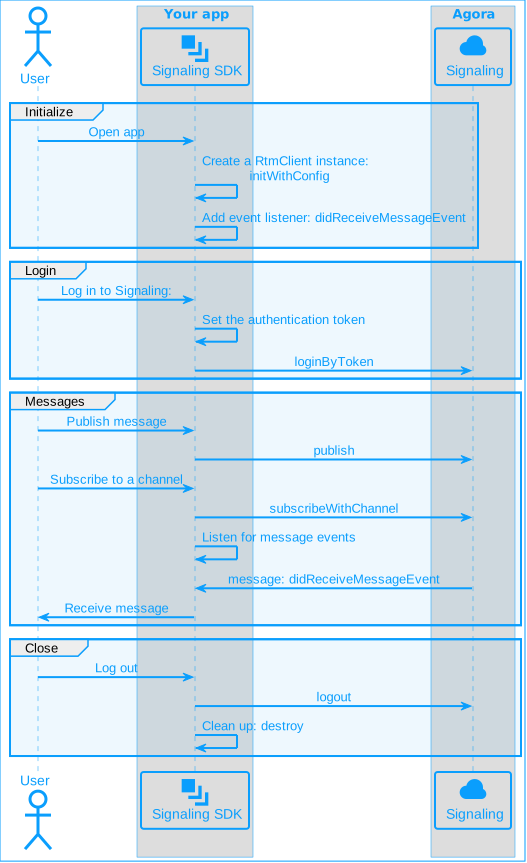
To use Signaling features in your app, you initialize a Signaling client instance and add event listeners. To connect to Signaling, you login using an authentication token. To send a message to a message channel, you publish the message. Signaling creates a channel when a user subscribes to it. To receive messages other users publish to a channel, your app listens for events.
To create a pub/sub session for Signaling, implement the following steps in your app:
## Prerequisites [#prerequisites-1]
To implement the code presented on this page you need to have:
* An Agora [account](/en/realtime-media/rtm/manage-agora-account) and [project](/en/realtime-media/rtm/manage-agora-account).
* [Enabled Signaling](/en/realtime-media/rtm/manage-agora-account) in Agora Console
* Xcode 12.0 or higher.
* A device running iOS 9.0 or higher.
* Ensure that a firewall is not blocking your network communication.
Signaling 2.x is an enhanced version compared to 1.x with a wide range of new features. It follows a new pricing structure. See [Pricing](/en/realtime-media/rtm/reference/pricing) for details.
## Project setup [#project-setup-1]
### Create a project [#create-a-project-1]
In Xcode, create a Single View app under the iOS platform. Configure the project settings as follows:
* Product Name: `RtmQuickstart`
* Organization Identifier: `agora`
* User Interface: Storyboard
* Language: Choose Swift or Objective-C
### Integrate the SDK [#integrate-the-sdk-1]
Use either of the following methods to integrate Signaling SDK into your project.
**Using CDN**
1. [Download](/en/api-reference/sdks?product=signaling\&platform=ios) the latest version of Signaling SDK.
2. Copy the files in the SDK package folder `/libs/AgoraRtmKit.xcframework` to the project path.
3. Open Xcode and navigate to the **TARGETS > Project Name > General > Frameworks, Libraries, and Embedded Content** menu.
4. Click **+ > Add Other… > Add Files** to add the dynamic library `EmbedAgoraRtmKit.xcframework`, and ensure that the **Embed** property of the added dynamic library is set to **Embed & Sign**.
**Using Cocoapods**
1. To follow this procedure, ensure that you have Cocoapods installed. To install Cocoapods, refer to [Getting Started with CocoaPods](https://guides.cocoapods.org/using/getting-started.html#getting-started).
2. In the terminal, go to the project root directory and run the `pod init` command. A text file named `Podfile` is generated in the project folder .
3. Open the `Podfile` and modify the content as follows:
```ruby
platform :ios, '11.0'
target 'Your App' do
pod 'AgoraRtm', 'x.y.z'
end
```
Replace `Your App` with your target name and `x.y.z` with the specific SDK version number, such as 2.2.0. To get the latest version number, check the [Release notes](/en/realtime-media/rtm/reference/release-notes).
If you are using an SDK version earlier than `2.2.0`, change the package name to `AgoraRtm_iOS`.
4. Run the `pod install` command in the terminal to install the Signaling SDK. You see the message "Pod installation complete!".
5. After successful installation, a file with the `.xcworkspace` suffix is generated in the project folder. Open the file in Xcode for subsequent operations.
**Using Swift Package Manager**
Use the following link to integrate the SDK using Swift Package Manager (SPM):
```text
{`https://github.com/AgoraIO/AgoraRtm_Apple.git`}
```
To integrate Signaling SDK version 2.2.0 or above, and Video SDK version 4.3.0 or above at the same time, refer to [handle integration issues](/en/api-reference/faq/integration/rtm2_rtc_integration_issue).
### Create a user interface [#create-a-user-interface-1]
This section helps you create a simple user interface to explore the basic features of Signaling. Modify it according to your specific needs.
The demo interface consists of the following UI elements:
* Input boxes for user ID, channel name, and message
* Buttons to log in and log out of Signaling
* Buttons to subscribe and unsubscribe from a channel
* A button to publish a message
**Sample code to create the user interface**
Swift
Objective-C
```swift
// User Interface
struct ContentView: View {
@StateObject private var viewModel = ChatViewModel()
var body: some View {
VStack {
TextField("Enter username", text: $viewModel.username)
.padding()
.textFieldStyle(RoundedBorderTextFieldStyle())
.font(.title)
HStack {
Button("Login") {
viewModel.login()
}
.buttonStyle(LoginButtonStyle())
Button("Logout") {
viewModel.logout()
}
.buttonStyle(LogoutButtonStyle())
}
TextField("Channel name", text: $viewModel.channel)
.padding()
.textFieldStyle(RoundedBorderTextFieldStyle())
.font(.title)
HStack {
Button("Subscribe") {
viewModel.subscribe()
}
.buttonStyle(SubscribeButtonStyle())
Button("Unsubscribe") {
viewModel.unsubscribe()
}
.buttonStyle(UnsubscribeButtonStyle())
}
TextField("Enter message", text: $viewModel.message)
.padding()
.textFieldStyle(RoundedBorderTextFieldStyle())
.font(.title)
Button("Send") {
viewModel.sendMessage()
}
.buttonStyle(SendButtonStyle())
// Display messages
ScrollViewReader { scrollProxy in
List(viewModel.messages) { message in
Text(message.content)
.id(message.id)
}
.onChange(of: viewModel.messages) { _ in
if let lastMessage = viewModel.messages.last {
withAnimation {
scrollProxy.scrollTo(lastMessage.id, anchor: .bottom)
}
}
}
}
.padding()
}
.padding()
}
}
// Preview
struct ContentView_Previews: PreviewProvider {
static var previews: some View {
ContentView()
}
}
```
Open `Main.storyboard` using **Code View** and replace the file contents with the following:
```xml
```
Open the file `ViewController.h` and replace the contents with the following:
```objc
#import
#import
@interface ViewController : UIViewController
// Buttons
@property (weak, nonatomic) IBOutlet UIButton *LoginButton;
@property (weak, nonatomic) IBOutlet UIButton *LogoutButton;
@property (weak, nonatomic) IBOutlet UIButton *SubsctibeButton;
@property (weak, nonatomic) IBOutlet UIButton *UnSubscribeButton;
@property (weak, nonatomic) IBOutlet UIButton *GroupMsgButton;
// TextFields
@property (weak, nonatomic) IBOutlet UITextField *UserIDTextField;
@property (weak, nonatomic) IBOutlet UITextField *ChannelIDTextField;
@property (weak, nonatomic) IBOutlet UITextField *GroupMsgTextField;
@property (weak, nonatomic) IBOutlet UITextView *MsgTextView;
@end
```
## Implement Signaling [#implement-signaling-1]
A complete code sample that implements the basic features of Signaling is presented here for your reference. To use the sample code, open `ViewController.m` and replace the contents with the following:
**Complete sample code for real-time Signaling**
Swift
Objective-C
```swift
import SwiftUI
import Combine
import AgoraRtmKit
struct Message: Identifiable, Equatable {
let id = UUID()
let content: String
}
class ChatViewModel: NSObject, ObservableObject, AgoraRtmClientDelegate {
var appid: String = <#YOUR APPID#>
var token: String = <#YOUR TOKEN#>
var rtmKit: AgoraRtmClientKit? = nil
@Published var username: String = ""
@Published var message: String = ""
@Published var channel: String = ""
@Published var messages: [Message] = []
override init() {
super.init()
initializeEngine()
}
// Initialization the engine
func initializeEngine() {
if rtmKit == nil {
let config = AgoraRtmClientConfig(appId: appid)
rtmKit = try? AgoraRtmClientKit(config, delegate: self)
}
}
// Log in to Signaling
func login() {
if rtmKit != nil {
addToMessageList(str: "RTM already logged in! Logout first!")
return
}
let config = AgoraRtmClientConfig(appId: appid, userId: username)
rtmKit = try! AgoraRtmClientKit(config, delegate: self)
rtmKit?.login(token, userId: username, completion: { response, error in
if let error = error {
self.addToMessageList(str: "Login failed. Error code: \(error.errorCode.rawValue), reason: \(error.reason)")
} else {
self.addToMessageList(str: "\(self.username) logged in successfully.")
}
})
}
// Log out from the RTM server
func logout() {
guard let rtmKit = rtmKit else {
addToMessageList(str: "RTM is already logged out!")
return
}
rtmKit.logout()
rtmKit.destroy()
self.rtmKit = nil
addToMessageList(str: "RTM logged out!")
}
// Subscribe to a channel
func subscribe() {
guard let rtmKit = rtmKit else { return }
rtmKit.subscribe(channelName: channel, option: nil) { response, error in
if let error = error {
self.addToMessageList(str: "Subscribe to channel '\(self.channel)' failed. Error code: \(error.errorCode.rawValue), reason: \(error.reason)")
} else {
self.addToMessageList(str: "Subscribed to channel: \(self.channel) successfully.")
}
}
}
// Unsubscribe from a channel
func unsubscribe() {
guard let rtmKit = rtmKit else { return }
rtmKit.unsubscribe(channel) { response, error in
if let error = error {
self.addToMessageList(str: "Unsubscribe from channel '\(self.channel)' failed. Error code: \(error.errorCode.rawValue), reason: \(error.reason)")
} else {
self.addToMessageList(str: "Unsubscribed from channel: \(self.channel) successfully.")
}
}
}
// Publish a message
func sendMessage() {
guard !message.isEmpty, let rtmKit = rtmKit else { return }
rtmKit.publish(channelName: channel, message: message, option: nil) { response, error in
if let error = error {
self.addToMessageList(str: "Publish failed. Error code: \(error.errorCode.rawValue), reason: \(error.reason)")
} else {
self.addToMessageList(str: "Message published to channel: \(self.channel) successfully.")
}
}
message = ""
}
func addToMessageList(str: String) {
messages.append(Message(content: str))
}
// AgoraRtmClientDelegate methods
func rtmKit(_ rtmKit: AgoraRtmClientKit, didReceiveLinkStateEvent event: AgoraRtmLinkStateEvent) {
addToMessageList(str: "RTM link state changed. Current state: \(event.currentState.rawValue), previous state: \(event.previousState.rawValue)")
}
func rtmKit(_ rtmKit: AgoraRtmClientKit, didReceiveMessageEvent event: AgoraRtmMessageEvent) {
addToMessageList(str: "Message received. Channel: \(event.channelName), Publisher: \(event.publisher), Message: \(event.message.stringData!)")
}
}
// User Interface
struct ContentView: View {
@StateObject private var viewModel = ChatViewModel()
var body: some View {
VStack {
TextField("Enter username", text: $viewModel.username)
.padding()
.textFieldStyle(RoundedBorderTextFieldStyle())
.font(.title)
HStack {
Button("Login") {
viewModel.login()
}
Button("Logout") {
viewModel.logout()
}
}
TextField("Channel name", text: $viewModel.channel)
.padding()
.textFieldStyle(RoundedBorderTextFieldStyle())
.font(.title)
HStack {
Button("Subscribe") {
viewModel.subscribe()
}
Button("Unsubscribe") {
viewModel.unsubscribe()
}
}
TextField("Enter message", text: $viewModel.message)
.padding()
.textFieldStyle(RoundedBorderTextFieldStyle())
.font(.title)
Button("Send") {
viewModel.sendMessage()
}
.buttonStyle(SendButtonStyle())
// Display messages
ScrollViewReader { scrollProxy in
List(viewModel.messages) { message in
Text(message.content)
.id(message.id)
}
.onChange(of: viewModel.messages) { _ in
if let lastMessage = viewModel.messages.last {
withAnimation {
scrollProxy.scrollTo(lastMessage.id, anchor: .bottom)
}
}
}
}
.padding()
}
.padding()
}
}
// Preview
struct ContentView_Previews: PreviewProvider {
static var previews: some View {
ContentView()
}
}
```
```objc
#import "ViewController.h"
@interface ViewController ()
@property(nonatomic, strong) AgoraRtmClientKit* kit;
@property NSString* appID;
@property NSString* token;
@property NSString* uid;
@property NSString* peerID;
@property NSString* channelID;
@property NSString* peerMsg;
@property NSString* channelMsg;
@property NSString* text;
@property NSMutableArray* textArray;
- (void)AddMsgToRecord:(NSString*)text;
@end
@implementation ViewController
- (void)viewDidLoad {
[super viewDidLoad];
// Enter your App ID
self.appID = @"your_appid";
self.MsgTextView.textColor = UIColor.blueColor;
self.textArray = [[NSMutableArray alloc]init];
}
- (void)rtmKit:(AgoraRtmClientKit *)rtmKit didReceiveMessageEvent:(AgoraRtmMessageEvent *)event {
NSLog(@"%@", self.text);
self.text = [NSString stringWithFormat:@"receive message
From channel: %@
publisher:%@
message:%@
", event.channelName, event.publisher, event.message.stringData];
[self AddMsgToRecord:(self.text)];
}
// Add message to the UI TextView
- (void)AddMsgToRecord:(NSString*)text {
[self.textArray addObject:(self.text)];
self.MsgTextView.text = [self.textArray componentsJoinedByString:(@"
")];
}
- (IBAction)Login:(id)sender {
self.uid = self.UserIDTextField.text;
// Enter your token
self.token = @"your_token";
AgoraRtmClientConfig* rtm_config = [[AgoraRtmClientConfig alloc] initWithAppId:_appID userId:_uid];
NSError* initError = nil;
_kit = [[AgoraRtmClientKit alloc] initWithConfig:rtm_config delegate:self error:&initError];
if (initError != nil) {
self.text = [NSString stringWithFormat:@"init error %@",initError];
NSLog(@"%@", self.text);
[self AddMsgToRecord:(self.text)];
}
// Log in to the RTM server
[_kit loginByToken:self.token completion:^(AgoraRtmCommonResponse * _Nullable response, AgoraRtmErrorInfo * _Nullable errorInfo) {
if (errorInfo.errorCode != AgoraRtmErrorOk) {
self.text = [NSString stringWithFormat:@"Login failed for user %@. Code: %ld", self.uid, (long)errorInfo.errorCode];
NSLog(@"%@", self.text);
} else {
self.text = [NSString stringWithFormat:@"Login successful for user %@. Code: %ld", self.uid, (long)errorInfo.errorCode];
NSLog(@"%@", self.text);
}
[self AddMsgToRecord:(self.text)];
}];
}
- (IBAction)Logout:(id)sender {
if (_kit != nil) {
// Log out from the RTM server
[_kit logout:^(AgoraRtmCommonResponse * _Nullable response, AgoraRtmErrorInfo * _Nullable errorInfo) {
if (errorInfo == nil) {
self.text = [NSString stringWithFormat:@"Logout successful"];
NSLog(@"%@", self.text);
[_kit destroy];
_kit = nil;
} else {
self.text = [NSString stringWithFormat:@"Logout failed. Code: %ld", (long)errorInfo.errorCode];
NSLog(@"%@", self.text);
}
[self AddMsgToRecord:(self.text)];
}];
}
}
- (IBAction)SubscribeChannel:(id)sender {
self.channelID = self.ChannelIDTextField.text;
if (_kit != nil) {
// Subscribe to a channel
[_kit subscribeWithChannel:self.channelID option:nil completion:^(AgoraRtmCommonResponse * _Nullable response, AgoraRtmErrorInfo * _Nullable errorInfo) {
if (errorInfo == nil) {
self.text = [NSString stringWithFormat:@"Successfully subscribed to channel %@", self.channelID];
NSLog(@"%@", self.text);
} else {
self.text = [NSString stringWithFormat:@"Failed to subscribe to channel %@. Code: %ld", self.channelID, (long)errorInfo.errorCode];
NSLog(@"%@", self.text);
}
[self AddMsgToRecord:(self.text)];
}];
}
}
- (IBAction)UnsubscribeChannel:(id)sender {
if (_kit == nil) return;
// Unsubscribe from a channel
[_kit unsubscribeWithChannel:self.channelID completion:^(AgoraRtmCommonResponse * _Nullable response, AgoraRtmErrorInfo * _Nullable errorInfo) {
if (errorInfo == nil) {
self.text = [NSString stringWithFormat:@"Successfully unsubscribed from channel"];
} else {
self.text = [NSString stringWithFormat:@"Failed to unsubscribe from channel. Code: %ld", (long)errorInfo.errorCode];
}
[self AddMsgToRecord:(self.text)];
}];
}
- (IBAction)SendMessageToMessageChannel:(id)sender {
self.channelID = self.ChannelIDTextField.text;
self.channelMsg = self.GroupMsgTextField.text;
// Publish a message
[_kit publish:self.channelID message:self.channelMsg option:nil completion:^(AgoraRtmCommonResponse * _Nullable response, AgoraRtmErrorInfo * _Nullable errorInfo) {
if (errorInfo == nil) {
self.text = [NSString stringWithFormat:@"Message sent to channel %@ : %@", self.channelID, self.channelMsg];
} else {
self.text = [NSString stringWithFormat:@"Message failed to send to channel %@ : %@. ErrorCode: %ld", self.channelID, self.channelMsg, (long)errorInfo.errorCode];
}
[self AddMsgToRecord:(self.text)];
}];
}
@end
```
Follow the implementation steps to understand the core API calls in the sample code or use the snippets in your own code.
### Declare the variables you need [#declare-the-variables-you-need]
To connect to Signaling from your project and send messages to a channel, declare variables to hold the app ID, token, user ID, and channel name:
Swift
Objective-C
```swift
var appid: String = <#YOUR APPID#>
var token: String = <#YOUR TOKEN#>
var rtmKit: AgoraRtmClientKit? = nil
@Published var username: String = ""
@Published var message: String = ""
@Published var channel: String = ""
@Published var messages: [Message] = []
```
```objc
#import "ViewController.h"
@interface ViewController ()
@property(nonatomic, strong)AgoraRtmClientKit* kit;
@property NSString* appID;
@property NSString* token;
@property NSString* uid;
@property NSString* peerID;
@property NSString* channelID;
@property NSString* peerMsg;
@property NSString* channelMsg;
@property NSString* text;
@property NSMutableArray* textArray;
```
### Initialize the Signaling engine [#initialize-the-signaling-engine-1]
Before calling any other Signaling SDK API, initialize an `AgoraRtmClientKit` object instance.
Swift
Objective-C
```swift
// Initialization the engine
func initializeEngine() {
if rtmKit == nil {
let config = AgoraRtmClientConfig(appId: appid)
rtmKit = try? AgoraRtmClientKit(config, delegate: self)
}
}
```
```objc
self.uid = self.UserIDTextField.text;
// Set engine configuration
AgoraRtmClientConfig* rtm_config = [[AgoraRtmClientConfig alloc] initWithAppId:_appID userId:_uid];
// Initialize the engine
NSError* initError = nil;
_kit = [[AgoraRtmClientKit alloc] initWithConfig:rtm_config delegate:self error:&initError];
if (initError != nil) {
self.text = [NSString stringWithFormat:@"init error %@",initError];
NSLog(@"%@", self.text);
[self AddMsgToRecord:(self.text)];
}
```
### Add an event listener [#add-an-event-listener-1]
The event listener enables you to implement the processing logic in response to Signaling events. Use the following code to handle event notifications or display received messages:
Swift
Objective-C
```swift
// Add the event listener
func rtmKit(_ rtmKit: AgoraRtmClientKit, didReceiveLinkStateEvent event: AgoraRtmLinkStateEvent) {
addToMessageList(str: "Signaling link state change current state is: \(event.currentState.rawValue) previous state is :\(event.previousState.rawValue)")
}
func rtmKit(_ rtmKit: AgoraRtmClientKit, didReceiveMessageEvent event: AgoraRtmMessageEvent) {
addToMessageList(str: "Message received.
channel: \(event.channelName), publisher: \(event.publisher), message content: \(event.message.stringData!)")
}
```
```objc
// Add the event listener
- (void)rtmKit:(AgoraRtmClientKit *)rtmKit didReceiveMessageEvent:(AgoraRtmMessageEvent *)event {
NSLog(@"%@", self.text);
self.text = [NSString stringWithFormat:@"receive message
From channel: %@
publisher:%@
message:%@
",event.channelName,event.publisher, event.message.stringData];
[self AddMsgToRecord:(self.text)];
}
```
### Log in to Signaling [#log-in-to-signaling-1]
To connect to Signaling and access Signaling network resources, such as sending messages, and subscribing to channels, login to Signaling server.
During a login operation, the client attempts to establish a connection with Signaling. Once the connection is established, the client transmits heartbeat information to the Signaling server at fixed intervals to keep the client active until the client actively logs out or is disconnected. The connection is interrupted when timeout occurs. During this period, users may freely access the Signaling network resources subject to their own permissions and usage restrictions.
Swift
Objective-C
```swift
// Log in to the Signaling server
func login() {
if rtmKit != nil {
addToMessageList(str: "RTM already logged in! Logout first!")
return
}
let config = AgoraRtmClientConfig(appId: appid, userId: username)
rtmKit = try! AgoraRtmClientKit(config, delegate: self)
rtmKit?.login(token, userId: username, completion: { response, error in
if let error = error {
self.addToMessageList(str: "Login failed. Error code: \(error.errorCode.rawValue), reason: \(error.reason)")
} else {
self.addToMessageList(str: "\(self.username) logged in successfully.")
}
})
}
```
```objc
// Log in to signaling
[_kit loginByToken:self.token completion:^(AgoraRtmCommonResponse * _Nullable response, AgoraRtmErrorInfo * _Nullable errorInfo) {
if (errorInfo.errorCode != AgoraRtmErrorOk){
self.text = [NSString stringWithFormat:@"Login failed for user %@. Code: %ld",self.uid, (long)errorInfo.errorCode];
NSLog(@"%@", self.text);
} else {
NSLog(@"%@", self.text);
self.text = [NSString stringWithFormat:@"Login successful for user %@. Code: %ld",self.uid, (long)errorInfo.errorCode];
}
[self AddMsgToRecord:(self.text)];
}];
```
Use the `login` return value, or listen to the `didReceiveLinkStateEvent` event notification to confirm that login is successful or obtain the error code and cause of login failure. When performing a login operation, the client's network connection state is `connecting`. After a successful login, the state is updated to `Connected`.
Best practice
To continuously monitor the network connection state of the client, best practice is to continue to listen for `AgoraRtmLinkState` event notifications throughout the life cycle of the application. For further details, see [Event listeners](/en/realtime-media/rtm/build/send-and-receive-messages/add-event-listener).
Use the `loginByToken` return value, or listen to the `connectionChangedToState` event notification to confirm that login is successful or obtain the error code and cause of login failure. When performing a login operation, the client's network connection state is `AgoraRtmClientConnectionStateConnecting`. After a successful login, the state is updated to `AgoraRtmClientConnectionStateConnected`.
Best practice
To continuously monitor the network connection state of the client, best practice is to continue to listen for `connectionChangedToState` event notifications throughout the life cycle of the application. For further details, see [Event listeners](/en/realtime-media/rtm/build/send-and-receive-messages/add-event-listener).
After a user successfully logs into Signaling, the application's Peak Connection Usage (PCU) increases, which affects your billing data.
### Send a message [#send-a-message]
To distribute a message to all subscribers of a message channel, call `publish`. The following code sends a string type message.
Swift
Objective-C
```swift
// Publish a message
func sendMessage() {
guard !message.isEmpty, let rtmKit = rtmKit else { return }
rtmKit.publish(channelName: channel, message: message, option: nil) { response, error in
if let error = error {
self.addToMessageList(str: "Publish failed. Error code: (error.errorCode.rawValue), reason: (error.reason)")
} else {
self.addToMessageList(str: "Message published to channel: (self.channel) successfully.")
}
}
message = ""
}
```
```objc
// Send a message
[_kit publish:self.channelID message:self.channelMsg option:nil completion:^(AgoraRtmCommonResponse * _Nullable response, AgoraRtmErrorInfo * _Nullable errorInfo) {
if (errorInfo == nil) {
self.text = [NSString stringWithFormat:@"Message sent to channel %@ : %@", self.channelID, self.channelMsg];
} else {
self.text = [NSString stringWithFormat:@"Message failed to send to channel %@ : %@ ErrorCode: %ld", self.channelID, self.channelMsg, (long)errorInfo.errorCode];
}
[self AddMsgToRecord:(self.text)];
}];
```
### Subscribe and unsubscribe [#subscribe-and-unsubscribe-1]
To receive messages sent to a channel, subscribe to channel messages:
Swift
Objective-C
```swift
// Subscribe to a channel
func subscribe() {
guard let rtmKit = rtmKit else { return }
rtmKit.subscribe(channelName: channel, option: nil) { response, error in
if let error = error {
self.addToMessageList(str: "Subscribe to channel '(self.channel)' failed. Error code: (error.errorCode.rawValue), reason: (error.reason)")
} else {
self.addToMessageList(str: "Subscribed to channel: (self.channel) successfully.")
}
}
}
```
```objc
// Subscribe to a channel
[_kit subscribeWithChannel:self.channelID option:nil completion:^(AgoraRtmCommonResponse * _Nullable response, AgoraRtmErrorInfo * _Nullable errorInfo) {
if(errorInfo == nil) {
self.text = [NSString stringWithFormat:@"Successfully subscribe channel %@",self.channelID];
NSLog(@"%@", self.text);
} else {
self.text = [NSString stringWithFormat:@"Failed to subscribe channel %@ Code: %ld",self.channelID, (long)errorInfo.errorCode];
NSLog(@"%@", self.text);
}
[self AddMsgToRecord:(self.text)];
}];
```
When you no longer need to receive messages from a channel, unsubscribe from the channel:
Swift
Objective-C
```swift
// Unsubscribe from a channel
func unsubscribe() {
guard let rtmKit = rtmKit else { return }
rtmKit.unsubscribe(channel) { response, error in
if let error = error {
self.addToMessageList(str: "Unsubscribe from channel '(self.channel)' failed. Error code: (error.errorCode.rawValue), reason: (error.reason)")
} else {
self.addToMessageList(str: "Unsubscribed from channel: (self.channel) successfully.")
}
}
}
```
```objc
// Unsubscribe from a channel
[_kit unsubscribeWithChannel:self.channelID completion:^(AgoraRtmCommonResponse * _Nullable response, AgoraRtmErrorInfo * _Nullable errorInfo) {
if (errorInfo == nil){
self.text = [NSString stringWithFormat:@"Leave channel successful"];
} else {
self.text = [NSString stringWithFormat:@"Failed to leave channel Code: %ld", (long)errorInfo.errorCode];
}
[self AddMsgToRecord:(self.text)];
}];
```
For more information about sending and receiving messages see [Message channels](/en/realtime-media/rtm/build/work-with-channels/message-channel) and [Stream channels](/en/realtime-media/rtm/build/work-with-channels/stream-channel).
### Log out of Signaling [#log-out-of-signaling-1]
When a user no longer needs to use Signaling, call `logout`. Logging out means closing the connection between the client and Signaling. The user is automatically logged out or unsubscribed from all message and stream channels. Other users in the channel receive a `didReceivePresenceEvent` notification of the user leaving the channel.
Swift
Objective-C
```swift
// Log out from the Signaling server
func logout() {
guard let rtmKit = rtmKit else {
addToMessageList(str: "Signaling is already logged out!")
return
}
rtmKit.logout()
rtmKit.destroy()
self.rtmKit = nil
addToMessageList(str: "Signaling logged out!")
}
```
```objc
// Log out of Signaling
[_kit logout:^(AgoraRtmCommonResponse * _Nullable response, AgoraRtmErrorInfo * _Nullable errorInfo) {
if (errorInfo == nil){
self.text = [NSString stringWithFormat:@"Logout successful"];
NSLog(@"%@", self.text);
[_kit destroy];
_kit = nil;
} else {
self.text = [NSString stringWithFormat:@"Logout failed. Code: %ld",(long)errorInfo.errorCode];
NSLog(@"%@", self.text);
}
[self AddMsgToRecord:(self.text)];
}];
// Clean up
[_kit destroy];
_kit = nil;
```
## Test Signaling [#test-signaling-1]
Take the following steps to test the sample code:
1. Use the [Token Builder](https://agora-token-generator-demo.vercel.app/) to generate a Signaling token:
1. Select Signaling from the Agora products dropdown.
2. Fill in your app ID and app certificate from [Agora Console](https://console.agora.io/v2). Leave the remaining fields blank.
3. Click **Generate Token**.
2. In your code, replace the values for `appID` and `token` with your app ID and the generated token.
3. Choose the device or simulator you want to run the app on from the device selection dropdown menu in the Xcode toolbar.
4. Click **Run** in the Xcode toolbar, or press Command + R on your keyboard. Xcode builds your project and launches the app on the selected device or simulator.
5. Use the device as the receiving end and perform the following operations:
1. Enter your **User ID** and click **Login**.
2. Enter the **Channel name** and click **Subscribe** .
6. On a second device, repeat the previous steps to install and launch the app. Use this device as the sending end.
1. Enter a different **User ID** and click **Login**.
2. Enter the same **Channel name**.
3. Type a message and click **Publish message**.
7. Swap the sending and receiving device roles and repeat the previous steps.
Congratulations! You have successfully integrated Signaling into your project.
## Reference [#reference-1]
This section contains content that completes the information on this page, or points you to documentation that explains other aspects to this product.
### Token authentication [#token-authentication-1]
In this guide you retrieve a temporary token from a [Token Builder](https://agora-token-generator-demo.vercel.app/). To understand how to create an authentication server for development purposes, see [Secure authentication with tokens](./build/connect-and-authenticate/authentication-workflow).
### Sample projects [#sample-projects-1]
Agora provides the following open source sample projects on GitHub for your reference.
* [Quickstart - Swift](https://github.com/AgoraIO/RTM2/tree/main/Agora-RTM2-QuickStart-iOS-Swift)
* [Quickstart - Objective-C](https://github.com/AgoraIO/RTM2/tree/main/Agora-RTM2-QuickStart-iOS-Objective-C)
### API reference [#api-reference-1]
**Swift**
* [API reference](/en/api-reference/api-ref/signaling)
* [Event listeners](./build/send-and-receive-messages/add-event-listener)
**Objective-C**
* [API reference](/en/api-reference/api-ref/signaling)
* [Event listeners](./build/send-and-receive-messages/add-event-listener)
<_PlatformProcessedMarker close="true" />
<_PlatformPanel platform="web">
<_PlatformProcessedMarker groupMode="structured" canonicalPlatform="web" platform="web" />
## Understand the tech [#understand-the-tech-2]
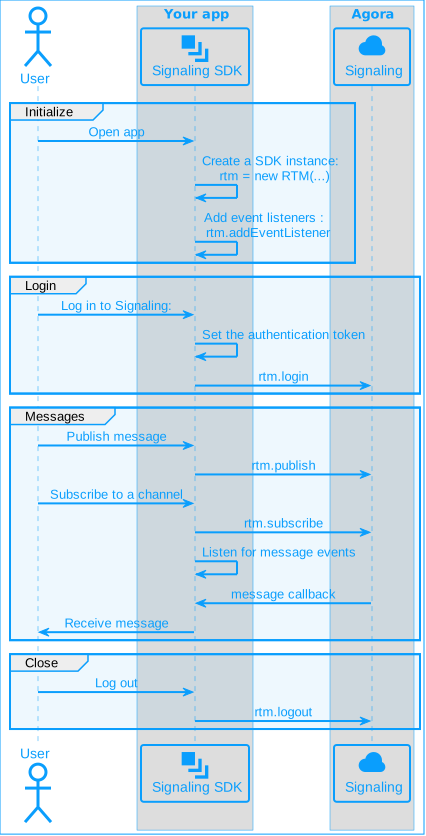
To use Signaling features in your app, you initialize a Signaling client instance and add event listeners. To connect to Signaling, you login using an authentication token. To send a message to a message channel, you publish the message. Signaling creates a channel when a user subscribes to it. To receive messages other users publish to a channel, your app listens for events.
To create a pub/sub session for Signaling, implement the following steps in your app:
## Prerequisites [#prerequisites-2]
To implement the code presented on this page you need to have:
* An Agora [account](/en/realtime-media/rtm/manage-agora-account) and [project](/en/realtime-media/rtm/manage-agora-account).
* [Enabled Signaling](/en/realtime-media/rtm/manage-agora-account) in Agora Console
* A [supported browser](/en/realtime-media/rtm/reference/supported-platforms).
* A JavaScript package manager such as [npm](https://www.npmjs.com/package/npm).
* Ensure that a firewall is not blocking your network communication.
Signaling 2.x is an enhanced version compared to 1.x with a wide range of new features. It follows a new pricing structure. See [Pricing](/en/realtime-media/rtm/reference/pricing) for details.
## Project setup [#project-setup-2]
### Create a project [#create-a-project-2]
To create a folder for your project, and an `index.html` file for your app, execute the following commands in the terminal:
```bash
mkdir HelloWorld
cd HelloWorld
touch index.html
```
### Integrate the SDK [#integrate-the-sdk-2]
Use either of the following methods to integrate Signaling SDK into your project.
**Using CDN**
1. [Download](/en/api-reference/sdks?product=signaling\&platform=web) the latest version of Signaling SDK for Web.
2. Add the following code to your project to reference the SDK:
```js
```
Replace `x.y.z` with the specific SDK version number, such as 2.2.0. To get the latest version number, check the [Release notes](/en/realtime-media/rtm/reference/release-notes).
**Using npm**
1. Install the SDK using npm
```js
npm install agora-rtm-sdk
```
2. Import `AgoraRTM` from the SDK
```js
import AgoraRTM from 'agora-rtm-sdk';
```
## Implement Signaling [#implement-signaling-2]
A complete code sample that implements the basic features of Signaling is presented here for your reference. To use the sample code, copy the following lines into the `index.html` file:
**Complete sample code for Signaling**
```js
Text Display App
Hello RTM !
```
Follow the implementation steps to understand the core API calls in the sample code or use the snippets in your own code.
### Initialize the Signaling engine [#initialize-the-signaling-engine-2]
Before calling any other Signaling SDK API, initialize an `RTM` object instance.
```js
try {
const rtm = new RTM(appId, userId);
} catch (status) {
console.log("Error");
console.log(status);
}
```
### Add an event listener [#add-an-event-listener-2]
The event listener enables you to implement the processing logic in response to Signaling events. Use the following code to handle event notifications or display received messages:
```js
// Message event handler.
rtm.addEventListener("message", event => {
showMessage(event.publisher, event.message);
});
// Presence event handler.
rtm.addEventListener("presence", event => {
if (event.eventType === "SNAPSHOT") {
showMessage("INFO", "I Join");
}
else {
showMessage("INFO", event.publisher + " is " + event.eventType);
}
});
// Connection state changed event handler.
rtm.addEventListener("status", event => {
// The current connection state.
const currentState = event.state;
// The reason why the connection state changes.
const changeReason = event.reason;
showMessage("INFO", JSON.stringify(event));
});
```
### Log in to Signaling [#log-in-to-signaling-2]
To connect to Signaling and access Signaling network resources, such as sending messages, and subscribing to channels, call `login`.
During a login operation, the client attempts to establish a connection with Signaling. Once the connection is established, the client transmits heartbeat information to the Signaling server at fixed intervals to keep the client active until the client actively logs out or is disconnected. The connection is interrupted when timeout occurs. During this period, users may freely access the Signaling network resources subject to their own permissions and usage restrictions.
```js
// Log in to Signaling
try {
const result = await rtm.login({ token: 'your_token' });
console.log(result);
} catch (status) {
console.log(status);
}
```
Use the `login` return value, or listen to the `status` event notification to confirm that login is successful or obtain the error code and cause of login failure. When performing a login operation, the client's network connection state is `CONNECTING`. After a successful login, the state is updated to `CONNECTED`.
Best practice
To continuously monitor the network connection state of the client, best practice is to continue to listen for `status` event notifications throughout the life cycle of the application. For further details, see [Event listeners](/en/realtime-media/rtm/build/send-and-receive-messages/add-event-listener).
After a user successfully logs into Signaling, the application's PCU increases, which affects your billing data.
### Send a message [#send-a-message-1]
To distribute a message to all subscribers of a message channel, call `publish`. The following code sends a string type message.
```js
// Send a message to a channel
const publishMessage = async (message) => {
const payload = { type: "text", message: message };
const publishMessage = JSON.stringify(payload);
const publishOptions = { channelType: 'MESSAGE'}
try {
const result = await rtm.publish(msChannelName, publishMessage, publishOptions);
showMessage(userId, publishMessage);
console.log(result);
} catch (status) {
console.log(status);
}
}
```
Before calling `publish` to send a message, serialize the message payload as a string.
### Subscribe and unsubscribe [#subscribe-and-unsubscribe-2]
To receive messages sent to a channel, call `subscribe` to subscribe to channel messages:
```js
// Subscribe to a channel
try {
const result = await rtm.subscribe(msChannelName);
console.log(result);
} catch (status) {
console.log(status);
}
```
When you no longer need to receive messages from a channel, call `unsubscribe` to unsubscribe from the channel:
```js
// Unsubscribe from a channel
try {
const result = await rtm.unsubscribe(msChannelName);
console.log(result);
} catch (status) {
console.log(status);
}
```
For more information about sending and receiving messages see [Message channels](/en/realtime-media/rtm/build/work-with-channels/message-channel) and [Stream channels](/en/realtime-media/rtm/build/work-with-channels/stream-channel).
### Log out of Signaling [#log-out-of-signaling-2]
When a user no longer needs to use Signaling, call `logout`. Logging out means closing the connection between the client and Signaling. The user is automatically logged out or unsubscribed from all message and stream channels. Other users in the channel receive a `presence` notification of the user leaving the channel.
```js
// Logout of Signaling
try {
const result = await rtm.logout();
} catch (status) {
const { operation, reason, errorCode } = status;
console.log(`${operation} failed, the error code is ${errorCode}, because of: ${reason}.`);
}
```
## Test Signaling [#test-signaling-2]
Take the following steps to test the sample code:
1. Use the [Token Builder](https://agora-token-generator-demo.vercel.app/) to generate a Signaling token:
1. Select Signaling from the Agora products dropdown.
2. Fill in your app ID and app certificate from [Agora Console](https://console.agora.io/v2). Leave the remaining fields blank.
3. Click **Generate Token**.
2. In `index.html`, replace `your_appid` and `your_token` values in the code with your project's app ID and the generated token.
3. Update the value for the `userId` with an integer value.
4. Save the file and run it in your browser.
5. Make a copy of the project. Use the same `app_id` but a different `userId`. Launch another instance of the page in a separate browser tab.
6. Type a message in the text input box in either instance and click the **Send** button. The message is displayed in the other app instance.
7. Swap the sending and receiving instances and send another message.
Congratulations! You have successfully integrated Signaling into your project.
## Reference [#reference-2]
This section contains content that completes the information on this page, or points you to documentation that explains other aspects to this product.
### Token authentication [#token-authentication-2]
In this guide you retrieve a temporary token from a [Token Builder](https://agora-token-generator-demo.vercel.app/). To understand how to create an authentication server for development purposes, see [Secure authentication with tokens](./build/connect-and-authenticate/authentication-workflow).
### Sample project [#sample-project]
Explore and experiment with the [Signaling Online demo](https://digitallysavvy.github.io/RTM2/). To download and customize the source code, refer to the [GitHub repository](https://github.com/digitallysavvy/RTM2).
### API reference [#api-reference-2]
* [API reference](/en/api-reference/api-ref/signaling)
* [Event listeners](./build/send-and-receive-messages/add-event-listener)
<_PlatformProcessedMarker close="true" />
<_PlatformPanel platform="flutter">
<_PlatformProcessedMarker groupMode="structured" canonicalPlatform="web" platform="flutter" />
## Understand the tech [#understand-the-tech-3]
To use Signaling features in your app, you initialize a Signaling client instance and add event listeners. To connect to Signaling, you login using an authentication token. To send a message to a message channel, you publish the message. Signaling creates a channel when a user subscribes to it. To receive messages other users publish to a channel, your app listens for events.
To create a pub/sub session for Signaling, implement the following steps in your app:
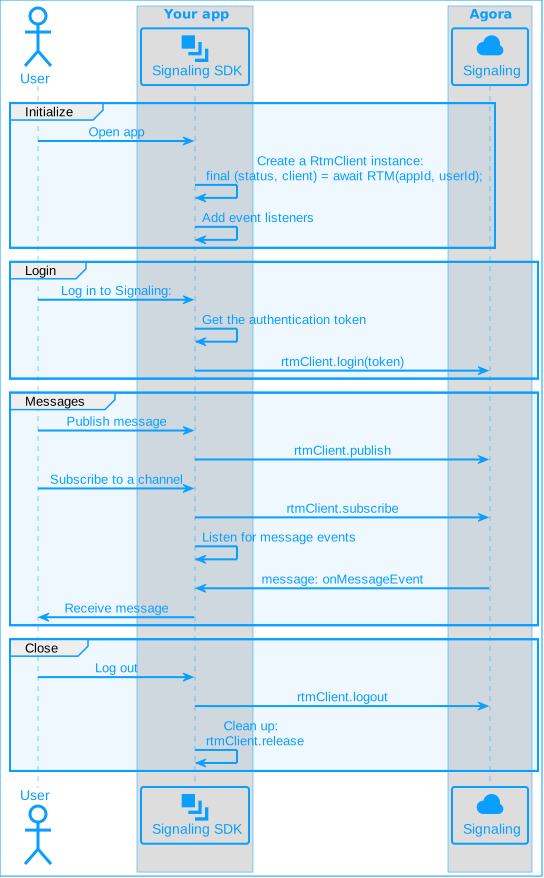
## Prerequisites [#prerequisites-3]
To implement the code presented on this page you need to have:
* An Agora [account](/en/realtime-media/rtm/manage-agora-account) and [project](/en/realtime-media/rtm/manage-agora-account).
* [Enabled Signaling](/en/realtime-media/rtm/manage-agora-account) in Agora Console
* [Flutter](https://docs.flutter.dev/get-started/install) 2.0.0 or higher
* Dart 2.15.1 or higher
* [Android Studio](https://developer.android.com/studio), IntelliJ, VS Code, or any other IDE that supports Flutter, see [Set up an editor](https://docs.flutter.dev/get-started/editor).
* If your target platform is iOS:
* Xcode on macOS (latest version recommended)
* A physical iOS device
* iOS version 12.0 or later
* If your target platform is Android:
* Android Studio on macOS or Windows (latest version recommended)
* An Android emulator or a physical Android device.
* If you are developing a desktop application for Windows, macOS or Linux, make sure your development device meets the [Flutter desktop development requirements](https://docs.flutter.dev/development/platform-integration/desktop).
* Ensure that a firewall is not blocking your network communication.
Signaling 2.x is an enhanced version compared to 1.x with a wide range of new features. It follows a new pricing structure. See [Pricing](/en/realtime-media/rtm/reference/pricing) for details.
## Project setup [#project-setup-3]
To create a new Flutter project, follow these steps:
1. Open a terminal and execute the following command:
```bash
flutter create sdk_quickstart
```
2. Open the project in your IDE. Add the Signaling SDK dependency to `pubspec.yaml` under `dependencies`:
```yaml
dependencies:
# Add the Signaling SDK dependency, use the latest version number
agora_rtm: ^2.2.1
```
To integrate Signaling SDK version 2.2.1 or above, and Video SDK version 4.3.0 or above at the same time, refer to [handle integration issues](/en/api-reference/faq/integration/rtm2_rtc_integration_issue).
3. To install the dependencies, open the terminal and execute the following command in the project path:
```bash
flutter pub get
```
4. To create a basic template for your project, open `main.dart`, delete the contents of the file, and paste the following code:
```dart
import 'package:agora_rtm/agora_rtm.dart';
import 'package:flutter/material.dart';
import 'dart:convert';
void main() async {
// Wait for Widgets to be initialized.
WidgetsFlutterBinding.ensureInitialized();
// Create a Signaling client instance
// Login to Signaling
// Subscribe to a channel
// Publish messages
// Unsubscribe from a channel
// Logout from Signaling
}
```
## Implement Signaling [#implement-signaling-3]
A complete code sample that implements the basic features of Signaling is presented here for your reference. To use the sample code, copy the following lines into the `lib/main.dart` file.
**Complete sample code**
```dart
import 'package:flutter/material.dart';
import 'package:agora_rtm/agora_rtm.dart';
import 'dart:convert';
void main() async {
WidgetsFlutterBinding.ensureInitialized();
const userId = 'your_userId';
const appId = 'your_appId';
const token = 'your_token';
const channelName = 'getting-started';
late RtmClient rtmClient;
// Create a Signaling client instance
try {
// Create rtm client
final (status, client) = await RTM( appId, userId);
if (status.error == true) {
print('\${status.operation} failed due to \${status.reason}, error code: \${status.errorCode}');
} else {
rtmClient = client;
print('Initialize success!');
}
// Add events listener
rtmClient.addListener(
// Add message event handler
message: (event) {
print('received a message from channel: \${event.channelName}, channel type : \${event.channelType}');
print('message content: \${utf8.decode(event.message!)}, custom type: \${event.customType}');
},
// add link state event handler
linkState: (event) {
print('link state changed from \${event.previousState} to \${event.currentState}');
print('reason: \${event.reason}, due to operation \${event.operation}');
});
} catch (e) {
print('Initialize failed!:\${e}');
}
// Login to Signaling
try {
// login rtm service
var (status,response) = await rtmClient.login(token);
if (status.error == true) {
print('\${status.operation} failed due to \${status.reason}, error code: \${status.errorCode}');
} else {
print('login RTM success!');
}
} catch (e) {
print('Failed to login: $e');
}
// Subscribe to a channel
try {
var (status,response) = await rtmClient.subscribe(channelName);
if (status.error == true) {
print('\${status.operation} failed due to \${status.reason}, error code: \${status.errorCode}');
} else {
print('subscribe channel: \${channelName} success!');
}
} catch (e) {
print('Failed to subscribe channel: $e');
}
// Publish messages
// Send a message every second for 100 seconds
for (var i = 0; i < 100; i++) {
try {
var (status, response) = await rtmClient.publish(
channelName,
'message number : $i',
channelType: RtmChannelType.message,
customType: 'PlainText'
);
if (status.error == true ){
print('\${status.operation} failed, errorCode: \${status.errorCode}, due to \${status.reason}');
} else {
print('\${status.operation} success! message number:$i');
}
} catch (e) {
print('Failed to publish message: $e');
}
await Future.delayed(Duration(seconds: 1));
}
// Unsubscribe from a channel
try {
var (status,response) = await rtmClient.unsubscribe(channelName);
if (status.error == true) {
print('\${status.operation} failed due to \${status.reason}, error code: \${status.errorCode}');
} else {
print('unsubscribe success!');
}
} catch (e) {
print('something went wrong with logout: $e');
}
// Logout of Signaling
try {
// logout rtm service
var (status,response) = await rtmClient.logout();
if (status.error == true) {
print('\${status.operation} failed due to \${status.reason}, error code: \${status.errorCode}');
} else {
print('logout RTM success!');
}
} catch (e) {
print('something went wrong with logout: $e');
}
}
```
Follow the implementation steps to understand the core API calls in the sample code or to build the demo step-by-step.
### Initialize the Signaling engine [#initialize-the-signaling-engine-3]
Before calling any other Signaling SDK API, initialize an `RtmClient` object instance. Add the following code to the `lib/main.dart` file.
```dart
import 'package:agora_rtm/agora_rtm.dart';
import 'package:flutter/material.dart';
import 'dart:convert';
void main() async {
// Wait for Widgets to be initialized.
WidgetsFlutterBinding.ensureInitialized();
const userId = 'your_userId';
const appId = 'your_appId';
const token = 'your_token';
const channelName = 'getting-started';
late RtmClient rtmClient;
try {
// Create rtm client
final (status, client) = await RTM( appId, userId);
if (status.error == true) {
print('${status.operation} failed due to ${status.reason}, error code: ${status.errorCode}');
} else {
rtmClient = client;
print('Initialize success!');
}
// Add events listener
} catch (e) {
print('Initialize failed!:${e}');
}
}
```
### Add an event listener [#add-an-event-listener-3]
The event listener enables you to implement the processing logic in response to Signaling events. Use the following code to handle event notifications or display received messages:
```dart
// Paste the following code snippet below the "add event listener" comment
rtmClient.addListener(
// Add message event handler
message: (event) {
print('received a message from channel: ${event.channelName}, channel type : ${event.channelType}');
print('message content: ${utf8.decode(event.message!)}, custome type: ${event.customType}');
},
// Add linkState event handler
linkState: (event) {
print('link state changed from ${event.previousState} to ${event.currentState}');
print('reason: ${event.reason}, due to operation ${event.operation}');
});
```
### Log in to Signaling [#log-in-to-signaling-3]
To connect to Signaling and access Signaling network resources, such as sending messages, and subscribing to channels, call `login`.
During a login operation, the client attempts to establish a connection with Signaling. Once the connection is established, the client transmits heartbeat information to the Signaling server at fixed intervals to keep the client active until the client actively logs out or is disconnected. The connection is interrupted when timeout occurs. During this period, users may freely access the Signaling network resources subject to their own permissions and usage restrictions.
```dart
// Paste the following code snippet below "Login to Signaling" comment
try {
// Login to Signaling
var (status,response) = await rtmClient.login(token);
if (status.error == true) {
print('${status.operation} failed due to ${status.reason}, error code: ${status.errorCode}');
} else {
print('login RTM success!');
}
} catch (e) {
print('Failed to login: $e');
}
```
### Send a message [#send-a-message-2]
To distribute a message to all subscribers of a message channel, call `publish`. The following code sends a string type message every second for 100 seconds.
```dart
// Paste the following code snippet below the "Publish messages" comment
// Send a message every second for 100 seconds
for (var i = 0; i < 100; i++) {
try {
var (status, response) = await rtmClient.publish(
channelName,
'message number : $i',
channelType: RtmChannelType.message,
customType: 'PlainText'
);
if (status.error == true ){
print('${status.operation} failed, errorCode: ${status.errorCode}, due to ${status.reason}');
} else {
print('${status.operation} success! message number:$i');
}
} catch (e) {
print('Failed to publish message: $e');
}
await Future.delayed(Duration(seconds: 1));
}
```
### Subscribe and unsubscribe [#subscribe-and-unsubscribe-3]
To receive messages sent to a channel, call `subscribe` to subscribe to channel messages:
```dart
// Paste the following code snippet below the "Subscribe to a channel" comment
try {
// Subscribe to a channel
var (status,response) = await rtmClient.subscribe(channelName);
if (status.error == true) {
print('${status.operation} failed due to ${status.reason}, error code: ${status.errorCode}');
} else {
print('subscribe channel: ${channelName} success!');
}
} catch (e) {
print('Failed to subscribe channel: $e');
}
```
When you no longer need to receive messages from a channel, `unsubscribe` from the channel:
```dart
// Paste the following code snippet below the "Unsubscribe from a channel" comment
try {
// Unsubscribe from a channel
var (status,response) = await rtmClient.unsubscribe(channelName);
if (status.error == true) {
print('${status.operation} failed due to ${status.reason}, error code: ${status.errorCode}');
} else {
print('unsubscribe success!');
}
} catch (e) {
print('something went wrong with logout: $e');
}
```
For more information about subscribing and sending messages, see [Message channels](/en/realtime-media/rtm/build/work-with-channels/message-channel) and [Stream channels](/en/realtime-media/rtm/build/work-with-channels/stream-channel).
### Log out of Signaling [#log-out-of-signaling-3]
When a user no longer needs to use Signaling, call `logout`. Logging out means closing the connection between the client and Signaling. The user is automatically logged out or unsubscribed from all message and stream channels. Other users in the channel receive an `onPresenceEvent` notification of the user leaving the channel.
```dart
// Paste the following code snippet below the "Log out of Signaling" comment
try {
// Log out of Signaling
var (status,response) = await rtmClient.logout();
if (status.error == true) {
print('${status.operation} failed due to ${status.reason}, error code: ${status.errorCode}');
} else {
print('logout RTM success!');
}
} catch (e) {
print('something went wrong with logout: $e');
}
```
## Test Signaling [#test-signaling-3]
Take the following steps to test the sample code:
1. Use the [Token Builder](https://agora-token-generator-demo.vercel.app/) to generate a Signaling token:
1. Select Signaling from the Agora products dropdown.
2. Fill in your app ID and app certificate from [Agora Console](https://console.agora.io/v2). Leave the remaining fields blank.
3. Click **Generate Token**.
2. In your code, replace `your_appId` with your app ID from Agora Console, `your_userId` with a numeric string and `your_token` with the generated token.
3. Save the project.
4. Connect the target device to your computer, or open the device emulator.
5. In the terminal, execute the following command in the project path to run the sample project on the target device:
```bash
flutter run
```
You see the following output in the terminal:
```text
flutter: publish success! message number:0
flutter: publish success! message number:1
flutter: publish success! message number:2
flutter: publish success! message number:3
```
6. Run a second instance of the project on another device or emulator using a different `userId`.
You see the following notifications for messages sent from the first app instance:
```text
flutter: received a message from channel: getting-started, channel type : RtmChannelType.message
flutter: message content: message number : 0, custom type: PlainText
flutter: received a message from channel: getting-started, channel type : RtmChannelType.message
flutter: message content: message number : 1, custom type: PlainText
```
## Reference [#reference-3]
This section contains content that completes the information on this page, or points you to documentation that explains other aspects to this product.
### Token authentication [#token-authentication-3]
In this guide you retrieve a temporary token from a [Token Builder](https://agora-token-generator-demo.vercel.app/). To understand how to create an authentication server for development purposes, see [Secure authentication with tokens](./build/connect-and-authenticate/authentication-workflow).
### Sample project [#sample-project-1]
Agora provides an open source [sample project](https://github.com/AgoraIO/RTM2/tree/main/Agora-RTM2-QuickStart-Flutter) on GitHub for your reference. Download it or view the source code for a more detailed example.
### API reference [#api-reference-3]
* [API reference](/en/api-reference/api-ref/signaling)
* [Event listeners](./build/send-and-receive-messages/add-event-listener)
<_PlatformProcessedMarker close="true" />
<_PlatformPanel platform="linux-cpp">
<_PlatformProcessedMarker groupMode="structured" canonicalPlatform="web" platform="linux-cpp" />
## Understand the tech [#understand-the-tech-4]
To use Signaling features in your app, you initialize a Signaling client instance and add event listeners. To connect to Signaling, you login using an authentication token. To send a message to a message channel, you publish the message. Signaling creates a channel when a user subscribes to it. To receive messages other users publish to a channel, your app listens for events.
To create a pub/sub session for Signaling, implement the following steps in your app:
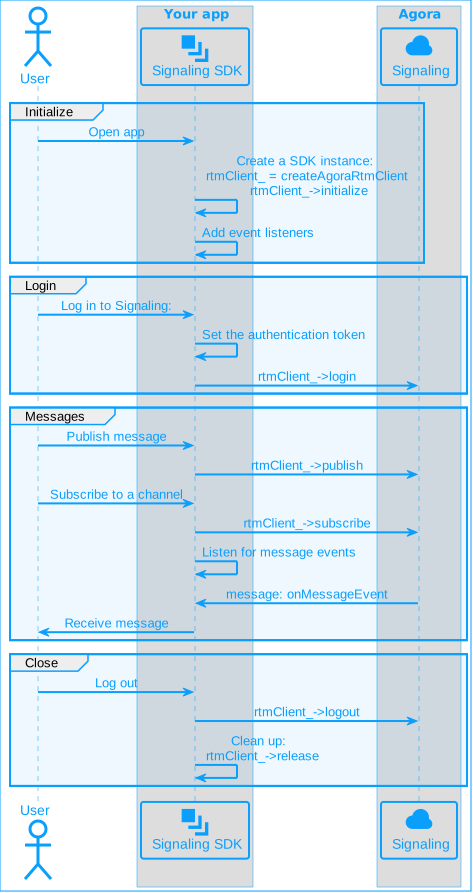
## Prerequisites [#prerequisites-4]
To implement the code presented on this page you need to have:
* An Agora [account](/en/realtime-media/rtm/manage-agora-account) and [project](/en/realtime-media/rtm/manage-agora-account).
* [Enabled Signaling](/en/realtime-media/rtm/manage-agora-account) in Agora Console
- A device running Linux Ubuntu 14.04 or above; 18.04+ is recommended.
- At least 2 GB of memory.
- `cmake` 3.6.0 or above.
* Ensure that a firewall is not blocking your network communication.
Signaling 2.x is an enhanced version compared to 1.x with a wide range of new features. It follows a new pricing structure. See [Pricing](/en/realtime-media/rtm/reference/pricing) for details.
## Project setup [#project-setup-4]
### Create a project [#create-a-project-3]
Create the following folder structure for your project:
```bash
RTMProject/
├── include/
└── lib/
```
### Integrate the SDK [#integrate-the-sdk-3]
To integrate the Linux C++ Signaling SDK into your project:
1. [Download](/en/api-reference/sdks?product=signaling\&platform=linux) the latest version of the SDK and unzip it.
To integrate Signaling SDK 2.2.1 or later, and Video SDK 4.3.0 or later in the same project, refer to [handle integration issues](/en/api-reference/faq/integration/rtm2_rtc_integration_issue).
2. Copy the files in the SDK package to the project folder as follows:
* Copy the `/rtm/sdk/libagora_rtm_sdk.so` file to the project's `lib` folder.
* Copy all `*.h` files in `/rtm/sdk/high_level_api/include` to the project's `include` folder.
3. To use `CMake` to compile the project, create the following files in the `RTMProject` folder:
* `CMakeLists.txt`
```bash
# CMakeLists.txt
cmake_minimum_required (VERSION 2.8)
project(RTMProject)
set(TARGET_NAME RTMQuickStart)
set(SOURCES RTMQuickStart.cpp)
set(HEADERS)
set(TARGET_BUILD_TYPE "Debug")
set(CMAKE_CXX_FLAGS "-fPIC -O2 -g -std=c++11 -msse2")
include_directories(${CMAKE_SOURCE_DIR}/include)
link_directories(${CMAKE_SOURCE_DIR}/lib)
add_executable(${TARGET_NAME} ${SOURCES} ${HEADERS})
target_link_libraries(${TARGET_NAME} agora_rtm_sdk pthread)
```
* `clean_build.sh`
```bash
# clean_build.sh
rm -fr build
mkdir -p build
cd build
cmake ..
make
cd ..
```
## Implement Signaling [#implement-signaling-4]
A complete code sample that implements the basic features of Signaling is presented here for your reference. To use the sample code, create a new file named `RTMQuickStart.cpp` in the `RTMProject` folder and add the following code:
**Complete sample code for Signaling**
```cpp
#include
#include
#include
#include
//#include
#include "IAgoraRtmClient.h"
// Pass in your App ID and token
const std::string APP_ID = "";
const std::string TOKEN = "";
// Terminal color codes for UBUNTU/LINUX
#define RESET "\\033\[0m"
#define BLACK "\\033\[30m" /* Black */
#define RED "\\033\[31m" /* Red */
#define GREEN "\\033\[32m" /* Green */
#define YELLOW "\\033\[33m" /* Yellow */
#define BLUE "\\033\[34m" /* Blue */
#define MAGENTA "\\033\[35m" /* Magenta */
#define CYAN "\\033\[36m" /* Cyan */
#define WHITE "\\033\[37m" /* White */
#define BOLDBLACK "\\033\[1m\\033\[30m" /* Bold Black */
#define BOLDRED "\\033\[1m\\033\[31m" /* Bold Red */
#define BOLDGREEN "\\033\[1m\\033\[32m" /* Bold Green */
#define BOLDYELLOW "\\033\[1m\\033\[33m" /* Bold Yellow */
#define BOLDBLUE "\\033\[1m\\033\[34m" /* Bold Blue */
#define BOLDMAGENTA "\\033\[1m\\033\[35m" /* Bold Magenta */
#define BOLDCYAN "\\033\[1m\\033\[36m" /* Bold Cyan */
#define BOLDWHITE "\\033\[1m\\033\[37m" /* Bold White */
using namespace agora::rtm;
class RtmEventHandler : public IRtmEventHandler {
public:
// Add the event listener
void onLoginResult(const uint64_t requestId, RTM_ERROR_CODE errorCode) override {
cbPrint("onLoginResult, request id: %lld, errorCode: %d", requestId, errorCode);
}
void onLogoutResult(const uint64_t requestId, RTM_ERROR_CODE errorCode) {
cbPrint("onLogoutResult, request id: %lld, errorCode: %d", requestId, errorCode);
}
void onConnectionStateChanged(const char *channelName, RTM_CONNECTION_STATE state, RTM_CONNECTION_CHANGE_REASON reason) override {
cbPrint("onConnectionStateChanged, channelName: %s, state: %d, reason: %d", channelName, state, reason);
}
void onLinkStateEvent(const LinkStateEvent& event) override {
cbPrint("onLinkStateEvent, state: %d -> %d, operation: %d, reason: %s", event.previousState, event.currentState, event.operation, event.reason);
}
void onPublishResult(const uint64_t requestId, RTM_ERROR_CODE errorCode) override {
cbPrint("onPublishResult request id: %lld result: %d", requestId, errorCode);
}
void onMessageEvent(const MessageEvent &event) override {
cbPrint("receive message from: %s, message: %s", event.publisher, event.message);
}
void onSubscribeResult(const uint64_t requestId, const char *channelName, RTM_ERROR_CODE errorCode) override {
cbPrint("onSubscribeResult: channel:%s, request id: %lld result: %d", channelName, requestId, errorCode);
}
void onUnsubscribeResult(const uint64_t requestId, const char *channelName, RTM_ERROR_CODE errorCode) override {
cbPrint("onUnsubscribeResult: channel:%s, request id: %lld result: %d", channelName, requestId, errorCode);
}
private:
void cbPrint(const char* fmt, ...) {
printf("\\x1b[32m<< RTM async callback: ");
va_list args;
va_start(args, fmt);
vprintf(fmt, args);
va_end(args);
printf(" >>\\x1b[0m\\n");
}
};
class RtmDemo {
public:
RtmDemo()
: eventHandler_(new RtmEventHandler()),
rtmClient_(nullptr) { Init(); }
void Init() {
std::cout << YELLOW << "Please enter userID (literal \\"null\\" or starting"
<< "with space is not allowed, no more than 64 characters!):" << std::endl;
std::string userID;
std::getline(std::cin, userID);
RtmConfig config;
config.appId = APP_ID.c_str();
config.userId = userID.c_str();
config.eventHandler = eventHandler_.get();
// Create an IRtmClient instance
int errorCode = 0;
rtmClient_ = createAgoraRtmClient(config, errorCode);
if (!rtmClient_ || errorCode != 0) {
std::cout << RED <<"error creating rtm service!" << std::endl;
exit(0);
}
}
void start() {
// Log in the RTM server
uint64_t requestId = 0;
rtmClient_->login(TOKEN.c_str(), requestId);
// Sample codes for the user interface
mainMeun();
std::cout << YELLOW << "quit ? yes/no" << std::endl;
std::string input;
std::getline(std::cin, input);
if (input.compare("yes") == 0) {
exit(0);
}
}
// Log out from the RTM server
void logout() {
uint64_t requestId = 0;
rtmClient_->logout(requestId);
}
// Subscribe to a channel
void subscribeChannel(const std::string& channelName) {
uint64_t requestId = 0;
rtmClient_->subscribe(channelName.c_str(), SubscribeOptions(), requestId);
}
// Unsubscribe from a channel
void unsubscribeChannel(const std::string& channelName) {
uint64_t requestId = 0;
rtmClient_->unsubscribe(channelName.c_str(), requestId);
}
// Publish a message
void publishMessage(const std::string& channelName, const std::string& message) {
PublishOptions options;
options.messageType = RTM_MESSAGE_TYPE_STRING;
uint64_t requestId;
rtmClient_->publish(channelName.c_str(), message.c_str(), message.size(), options, requestId);
}
// Sample codes for the user interface
void mainMeun() {
bool quit = false;
while (!quit) {
std::cout << WHITE
<< "1: subscribe channel\\n"
<< "2: unsubscribe channel\\n"
<< "3: publish message\\n"
<< "4: logout" << std::endl;
std::cout << YELLOW <<"please input your choice: " << std::endl;
std::string input;
std::getline(std::cin, input);
int32_t choice = 0;
try {
choice = std::stoi(input);
} catch(...) {
std::cout < eventHandler_;
IRtmClient* rtmClient_;
};
int main(int argc, const char * argv[]) {
RtmClient messaging;
messaging.login();
return 0;
}
```
Follow the implementation steps to understand the core API calls in the sample code or use the snippets in your own code.
### Include the header file [#include-the-header-file]
To use Signaling APIs in your project, include the `IAgoraRtmClient` header file:
```cpp
#include "IAgoraRtmClient.h"
```
### Initialize the Signaling engine [#initialize-the-signaling-engine-4]
Before calling any other Signaling SDK API, initialize an `IRtmClient` object instance.
```cpp
std::string userID;
std::getline(std::cin, userID);
RtmConfig config;
config.appId = APP_ID.c_str();
config.userId = userID.c_str();
config.eventHandler = eventHandler_.get();
// Create an IRtmClient instance
int errorCode = 0;
rtmClient_ = createAgoraRtmClient(config, errorCode);
if (!rtmClient_ || errorCode != 0) {
std::cout << RED <<"error creating rtm service!" << std::endl;
exit(0);
}
```
### Add an event listener [#add-an-event-listener-4]
The event listener enables you to implement the processing logic in response to Signaling events. Use the following code to handle event notifications or display received messages:
```cpp
void onLoginResult(const uint64_t requestId, RTM_ERROR_CODE errorCode) override {
cbPrint("onLoginResult, request id: %lld, errorCode: %d", requestId, errorCode);
}
void onLogoutResult(const uint64_t requestId, RTM_ERROR_CODE errorCode) {
cbPrint("onLogoutResult, request id: %lld, errorCode: %d", requestId, errorCode);
}
void onConnectionStateChanged(const char *channelName, RTM_CONNECTION_STATE state, RTM_CONNECTION_CHANGE_REASON reason) override {
cbPrint("onConnectionStateChanged, channelName: %s, state: %d, reason: %d", channelName, state, reason);
}
void onLinkStateEvent(const LinkStateEvent& event) override {
cbPrint("onLinkStateEvent, state: %d -> %d, operation: %d, reason: %s", event.previousState, event.currentState, event.operation, event.reason);
}
void onPublishResult(const uint64_t requestId, RTM_ERROR_CODE errorCode) override {
cbPrint("onPublishResult request id: %lld result: %d", requestId, errorCode);
}
void onMessageEvent(const MessageEvent &event) override {
cbPrint("receive message from: %s, message: %s", event.publisher, event.message);
}
void onSubscribeResult(const uint64_t requestId, const char *channelName, RTM_ERROR_CODE errorCode) override {
cbPrint("onSubscribeResult: channel:%s, request id: %lld result: %d", channelName, requestId, errorCode);
}
void onUnsubscribeResult(const uint64_t requestId, const char *channelName, RTM_ERROR_CODE errorCode) override {
cbPrint("onUnsubscribeResult: channel:%s, request id: %lld result: %d", channelName, requestId, errorCode);
}
```
### Log in to Signaling [#log-in-to-signaling-4]
To connect to Signaling and access Signaling network resources, such as sending messages, and subscribing to channels, call `login`.
During a login operation, the client attempts to establish a connection with Signaling. Once the connection is established, the client transmits heartbeat information to the Signaling server at fixed intervals to keep the client active until the client actively logs out or is disconnected. The connection is interrupted when timeout occurs. During this period, users may freely access the Signaling network resources subject to their own permissions and usage restrictions.
```cpp
// Log in to Signaling
uint64_t requestId = 0;
rtmClient_->login(TOKEN.c_str(), requestId);
```
After you call this method, the SDK triggers the `onLoginResult` callback and returns the API call result.
Use the `login` return value, or listen to the `onConnectionStateChanged` event notification to confirm that login is successful or obtain the error code and cause of login failure. When performing a login operation, the client's network connection state is `RTM_CONNECTION_STATE_CONNECTING`. After a successful login, the state is updated to `RTM_CONNECTION_STATE_CONNECTED`.
Best practice
To continuously monitor the network connection state of the client, best practice is to continue to listen for `onConnectionStateChanged` event notifications throughout the life cycle of the application. For further details, see [Event listeners](/en/realtime-media/rtm/build/send-and-receive-messages/add-event-listener).
After a user successfully logs into Signaling, the application's PCU increases, which affects your billing data.
### Send a message [#send-a-message-3]
To distribute a message to all subscribers of a message channel, call `publish`. The following code sends a string type message.
```cpp
// Publish a message to the channel
void publishMessage(const std::string& channelName, const std::string& message) {
PublishOptions options;
options.messageType = RTM_MESSAGE_TYPE_STRING;
uint64_t requestId;
rtmClient_->publish(channelName.c_str(), message.c_str(), message.size(), options, requestId);
}
```
Before calling `publish` to send a message, serialize the message payload as a string.
### Subscribe and unsubscribe [#subscribe-and-unsubscribe-4]
To receive messages sent to a channel, call `subscribe` to subscribe to channel messages:
```cpp
// Subscribe to a channel
void subscribeChannel(const std::string& channelName) {
uint64_t requestId = 0;
rtmClient_->subscribe(channelName.c_str(), SubscribeOptions(), requestId);
}
```
When you no longer need to receive messages from a channel, call `unsubscribe` to unsubscribe from the channel:
```cpp
// Unsubscribe from a channel
void unsubscribeChannel(const std::string& channelName) {
uint64_t requestId = 0;
rtmClient_->unsubscribe(channelName.c_str(), requestId);
}
```
For more information about sending and receiving messages see [Message channels](/en/realtime-media/rtm/build/work-with-channels/message-channel) and [Stream channels](/en/realtime-media/rtm/build/work-with-channels/stream-channel).
### Log out of Signaling [#log-out-of-signaling-4]
When a user no longer needs to use Signaling, call `logout`. Logging out means closing the connection between the client and Signaling. The user is automatically logged out or unsubscribed from all message and stream channels. Other users in the channel receive an `onPresenceEvent` notification of the user leaving the channel.
```cpp
// Log out of Signaling
void logout() {
uint64_t requestId = 0;
rtmClient_->logout(requestId);
}
// Clean up
rtmClient_->release();
```
## Test Signaling [#test-signaling-4]
Take the following steps to test the sample code:
1. Use the [Token Builder](https://agora-token-generator-demo.vercel.app/) to generate a Signaling token:
1. Select Signaling from the Agora products dropdown.
2. Fill in your app ID and app certificate from [Agora Console](https://console.agora.io/v2). Leave the remaining fields blank.
3. Click **Generate Token**.
2. In your code, replace `` with your app ID from Agora Console and `` with the generated token. Save the project. Make sure Signaling is activated for your project in [Agora Console](https://console.agora.io/v2).
3. In the terminal, run the following command to compile the project:
```bash
sh +x clean_build.sh
```
4. Use the following commands to navigate to the `build` folder and run the app:
```bash
cd build
./RTMQuickStart
```
You see menu options to **subscribe**, **unsubscribe**, **publish**, and **logout**.
5. Follow the prompts to **subscribe** to a channel.
6. Run another instance of the app using a different user ID. Follow the prompts to **publish** a message to the same channel that you subscribed to from the other instance.
7. You see the message displayed in the instance that you used to subscribe to the channel.
Congratulations! You have successfully integrated Signaling into your project.
## Reference [#reference-4]
This section contains content that completes the information on this page, or points you to documentation that explains other aspects to this product.
### Token authentication [#token-authentication-4]
In this guide you retrieve a temporary token from a [Token Builder](https://agora-token-generator-demo.vercel.app/). To understand how to create an authentication server for development purposes, see [Secure authentication with tokens](./build/connect-and-authenticate/authentication-workflow).
### Sample project [#sample-project-2]
Agora provides an open source [sample project](https://github.com/AgoraIO/RTM2/tree/main/Agora-RTM2-QuickStart-Linux-C%2B%2B) on GitHub for your reference. Download it or view the source code for a more detailed example.
### API reference [#api-reference-4]
* [API reference](/en/api-reference/api-ref/signaling)
* [Event listeners](./build/send-and-receive-messages/add-event-listener)
<_PlatformProcessedMarker close="true" />
<_PlatformPanel platform="unity">
<_PlatformProcessedMarker groupMode="structured" canonicalPlatform="web" platform="unity" />
## Understand the tech [#understand-the-tech-5]
To use Signaling features in your game, you initialize a Signaling client instance and add event listeners. To connect to Signaling, you login using an authentication token. To send a message to a message channel, you publish the message. Signaling creates a channel when a user subscribes to it. To receive messages other users publish to a channel, your game listens for events.
To create a pub/sub session for Signaling, implement the following steps in your game:
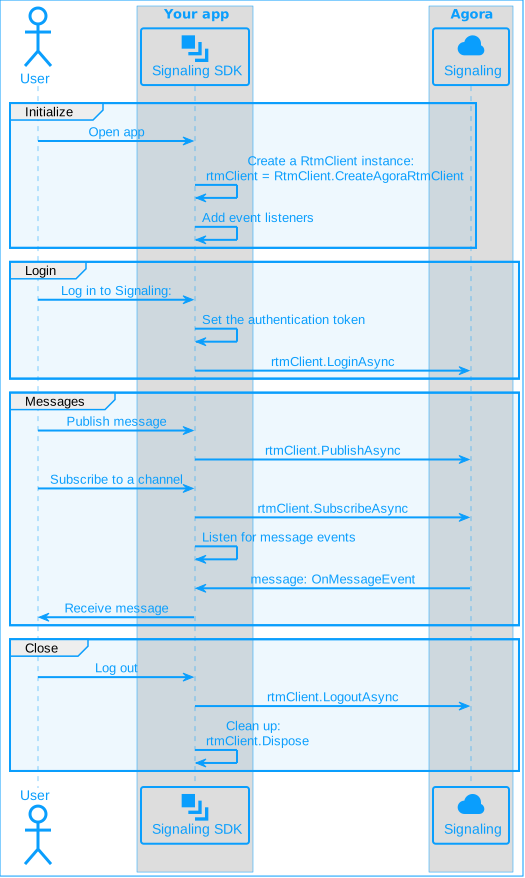
## Prerequisites [#prerequisites-5]
To implement the code presented on this page you need to have:
* An Agora [account](/en/realtime-media/rtm/manage-agora-account) and [project](/en/realtime-media/rtm/manage-agora-account).
* [Enabled Signaling](/en/realtime-media/rtm/manage-agora-account) in Agora Console
* [Unity Hub](https://unity.com/download)
* [Unity Editor 2018.4.0 or higher](https://unity.com/releases/editor/archive)
* Operating System and compiler requirements:
| Development Platform | Operating system version | Compiler version |
| -------------------- | ------------------------ | ------------------------------------- |
| Android | Android 4.1 or above | Android Studio 3.0 or above |
| iOS | iOS 11.0 or above | Xcode 9.0 or above |
| macOS | macOS 10.10 or above | Xcode 9.0 or above |
| Windows | Windows 7 or above | Microsoft Visual Studio 2017 or above |
* Ensure that a firewall is not blocking your network communication.
Signaling 2.x is an enhanced version compared to 1.x with a wide range of new features. It follows a new pricing structure. See [Pricing](/en/realtime-media/rtm/reference/pricing) for details.
## Project setup [#project-setup-5]
### Create a project [#create-a-project-4]
1. In Unity Hub, select **Projects**, then click **New Project**.
2. In **All templates**, select **3D**. Set the **Project name** and **Location**, then click **Create Project**.
3. In **Projects**, double-click the project you created. Your project opens in Unity.
### Integrate the SDK [#integrate-the-sdk-4]
1. [Download](/en/api-reference/sdks?product=signaling\&platform=unity) the latest version of the Agora Signaling SDK, and unzip the contents to a local folder.
2. In Unity, click **Assets > Import Package > Custom Package**.
3. Navigate to the Signaling SDK package and click **Open**.
4. In **Import Unity Package**, click **Import**.
### Create a user interface [#create-a-user-interface-2]
To create a simple UI for verifying the basic features of Signaling, add the following elements to your interface:
```text
SampleScene
- Main Camera
- Canvas
- Image // Window background
- Txt1 // Text label, text content is Send string message to message channel
- InputField1 // Message input box
- Btn1 // Send message
- Txt2 // Text label, text content is Send binary message to stream channel
- Btn2 // Create Stream Channel
- Btn3 // Join Stream Channel
- Btn4 // Join Topic
- Btn5 // Subscribe to message publishers in Topic
- InputField2 // Message input box
- Btn6 // Send message button
- Btn7 // Release Stream Channel button
- Btn8 // Leave Stream Channel button
- Btn9 // Leave Topic button
- Btn10 // Unsubscribe from message publishers in Topic
- Pannel // Information output panel
- Txt3 // Information output text
- EventSystem
```
Your interface should look similar to the following:
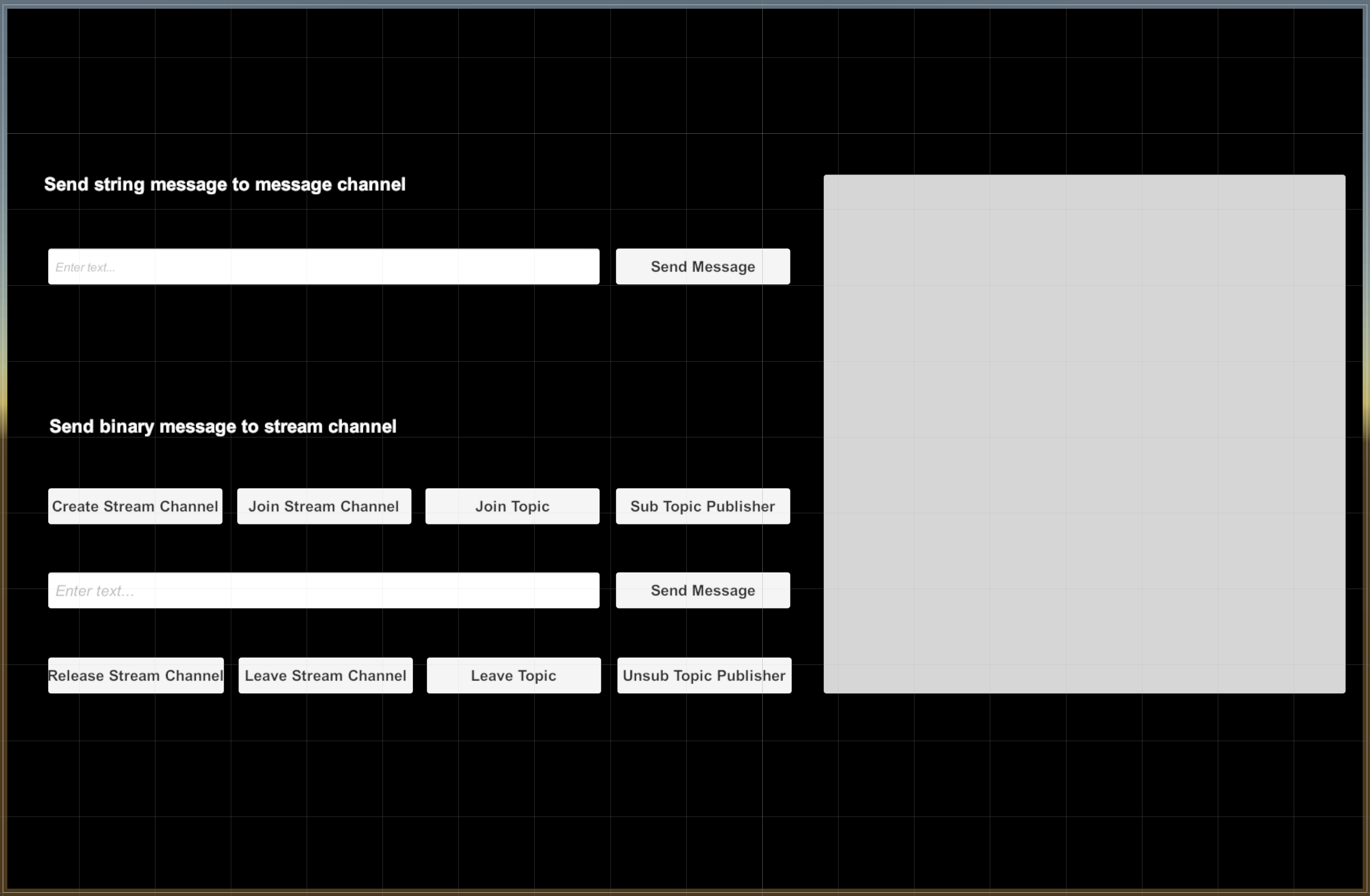
## Implement Signaling [#implement-signaling-5]
A complete code sample that implements the basic features of Signaling is presented here for your reference. To use the sample code, create a new script for the project. In Unity editor, from the **Assets** menu, select **Create**, then **C# Script**. Name the new script file `HelloWorld.cs` and paste the following code in the file:
**Complete sample code for Signaling**
```csharp
using System.Collections.Generic;
using UnityEngine;
using UnityEngine.UI;
using Agora.Rtm;
public class HelloWorld : MonoBehaviour
{
[SerializeField]
private string appId = "your_appId"; // Get an App ID from Agora console
private string userId = "your_userId"; // Change the user ID to a numeric string
private string token = "your_token"; // Login token
private string rtcToken = "your_RTC_token"; // Token to join a stream channel
private string msChannelName = "SeeYou";
private string stChannelName = "Greeting";
private string topicName = "Hello_world";
private IRtmClient rtmClient;
private IStreamChannel streamChannel;
public void Awake()
{
Initialize();
}
// Initialize RTM
public async void Initialize()
{
if (string.IsNullOrEmpty(userId) || string.IsNullOrEmpty(appId))
{
ShowMessage("We need a userId and appId to initialize!");
return;
}
RtmLogConfig logConfig = new RtmLogConfig();
// Set log file path
logConfig.filePath = "myFilePath";
// Set the file size of the agore.log file
logConfig.fileSizeInKB = 512;
// Set the log report level
logConfig.level = RTM_LOG_LEVEL.INFO;
RtmConfig config = new RtmConfig();
config.appId = appId;
config.userId = userId;
config.logConfig = logConfig;
// Create the RTM Client
try
{
rtmClient = RtmClient.CreateAgoraRtmClient(config);
ShowMessage("RTM Client Initialize Sucessfull");
// Inactive unnecessary components
string[] activeComponentsList = { "Btn2" };
string[] inactiveComponentList = { "Btn3", "Btn4", "Btn5", "Btn6", "Btn7", "Btn8", "Btn9", "Btn10" };
ChangeComponentView(activeComponentsList, "ACTIVATE");
ChangeComponentView(inactiveComponentList, "INACTIVATE");
}
catch (RTMException e)
{
ShowMessage(string.Format("{0} is failed", e.Status.Operation));
ShowMessage(string.Format("The error code is {0}, due to: {1}", e.Status.ErrorCode, e.Status.Reason));
}
// Add listener
if (rtmClient != null)
{
// Add the message event listener
rtmClient.OnMessageEvent += OnMessageEvent;
// Add the presence event listener
rtmClient.OnPresenceEvent += OnPresenceEvent;
// Add the connection state change listener
rtmClient.OnConnectionStateChanged += OnConnectionStateChanged;
// Log in to the RTM server
var result = await rtmClient.LoginAsync(token);
var status = result.Status;
var response = result.Response;
if (status.Error)
{
ShowMessage(string.Format("{0} is failed", status.Operation));
ShowMessage(string.Format("The error code is {0}, due to: {1}", status.ErrorCode, status.Reason));
Debug.Log(string.Format("Login failed"));
}
else
{
ShowMessage("Login Successfully");
}
//Subscribe to a Message Channel
SubscribeOptions options = new SubscribeOptions()
{
withMessage = true,
withPresence = true
};
var result2 = await rtmClient.SubscribeAsync(msChannelName, options);
var status2 = result2.Status;
var response2 = result2.Response;
if (status2.Error)
{
ShowMessage(string.Format("{0} is failed", status2.Operation));
ShowMessage(string.Format("The error code is {0}, due to: {1}", status2.ErrorCode, status2.Reason));
}
else
{
ShowMessage(string.Format("Subscribe channel success! at Channel:{0}", response2.ChannelName));
}
}
}
private void ChangeComponentView(string[] componentsList, string viewType)
{
for (int i = 0; i < componentsList.Length; i++)
{
if (viewType == "ACTIVATE")
GameObject.Find(componentsList[i]).GetComponent