# Secure authentication with tokens (/en/realtime-media/rtm/build/connect-and-authenticate/authentication-workflow/web)
> For AI agents: see the complete documentation index at [llms.txt](/llms.txt).
Authentication is the act of validating the identity of a user before they access a system. Agora
uses digital tokens to authenticate users and their privileges before they access Signaling. A token is a string used to verify user privileges when logging in or joining a channel. When a user connects to Agora and passes in the token, the server verifies the user's identity and permissions based on the information in the token.
This page shows you how to set up a token server, and use it to connect securely to Signaling.
## Understand the tech [#understand-the-tech]
Signaling provides two types of channels:
* **Message channels**: To join a message channel, you only need to use an RTM token when calling the login method. An RTM token is valid only for the user Id that you use to generate it.
* **Stream channels**: To join a stream channel, you use an RTC token when calling the join method. An RTC token is valid only for the channel name and the user Id that you used to generate it.
The following figure shows the call flow you implement to create step-up-authentication with Signaling:
**Authentication workflow**
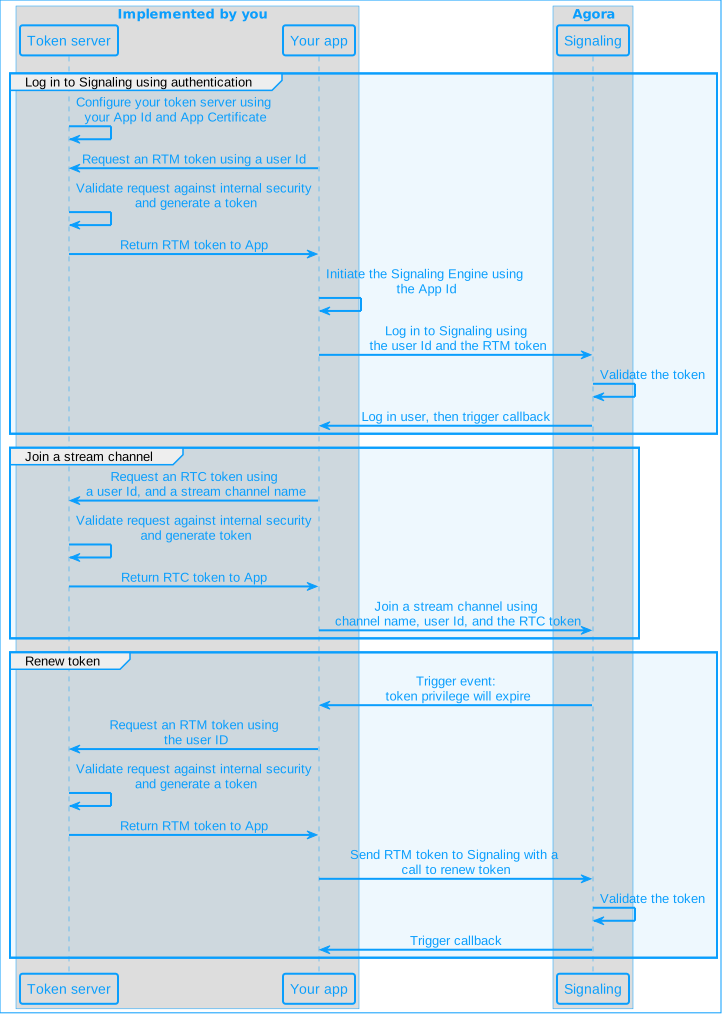
To log in to Signaling, your app retrieves an RTM token from the token server in your security infrastructure. Your app then sends this token to Agora SDRTN® for authentication. Agora SDRTN® validates the token and reads the user and project information stored in the token. To join a stream channel you request an RTC token from the server by supplying a user Id and a channel name. You do not need an authentication token to subscribe to a message channel.
A token contains the following information:
* The [App ID](../../manage-agora-account#get-the-app-id) of your Agora project
* The user Id of the user to be authenticated
* The stream channel name (RTC token only)
* The Unix timestamp indicating when the token will expire
## Prerequisites [#prerequisites]
Ensure that you have:
* Integrated the Signaling SDK in your project, and implemented the framework functionality from the [SDK quickstart](/en/realtime-media/rtm/quickstart) page.
* The following information from Agora Console:
* App ID: A unique string provided by Agora that identifies your project.
* App certificate: A string generated using Agora Console to enable token authentication. To obtain the App certificate for your project, enable primary certificate.
## Implement basic authentication [#implement-basic-authentication]
In the [SDK quickstart](/en/realtime-media/rtm/quickstart), the app uses an authentication token obtained from Agora Console to join a channel. In a production environment, your app retrieves this token from a token server.
### Token generation code [#token-generation-code]
Agora provides an open source token generator code repository on [GitHub](https://github.com/AgoraIO/Tools/tree/master/DynamicKey/AgoraDynamicKey). The repository contains code samples, based on the `HMAC-SHA256` algorithm, in the following languages to generate tokens on your own server:
| Language | Core method | Sample code |
| :------- | :------------------------------------------------------------------------------------------------------------------------------------------ | :-------------------------------------------------------------------------------------------------------------------------------------------------------------------- |
| Go | [buildToken](https://github.com/AgoraIO/Tools/blob/master/DynamicKey/AgoraDynamicKey/go/src/rtmtokenbuilder2/rtmtokenbuilder.go) | [sample.go](https://github.com/AgoraIO/Tools/blob/master/DynamicKey/AgoraDynamicKey/go/sample/rtmtokenbuilder2/sample.go) |
| PHP | [buildToken](https://github.com/AgoraIO/Tools/blob/master/DynamicKey/AgoraDynamicKey/php/src/RtmTokenBuilder2.php) | [RtmTokenBuilder2Sample.php](https://github.com/AgoraIO/Tools/blob/master/DynamicKey/AgoraDynamicKey/php/sample/RtmTokenBuilder2Sample.php) |
| Python 2 | [buildToken](https://github.com/AgoraIO/Tools/blob/master/DynamicKey/AgoraDynamicKey/python/src/RtmTokenBuilder2.py) | [RtmTokenBuilder2Sample.py](https://github.com/AgoraIO/Tools/blob/master/DynamicKey/AgoraDynamicKey/python/sample/RtmTokenBuilder2Sample.py) |
| Python 3 | [buildToken](https://github.com/AgoraIO/Tools/blob/master/DynamicKey/AgoraDynamicKey/python3/src/RtmTokenBuilder2.py) | [RtmTokenBuilder2Sample.py](https://github.com/AgoraIO/Tools/blob/master/DynamicKey/AgoraDynamicKey/python3/sample/RtmTokenBuilder2Sample.py) |
| C++ | [buildToken](https://github.com/AgoraIO/Tools/blob/master/DynamicKey/AgoraDynamicKey/cpp/src/RtmTokenBuilder2.h) | [RtmTokenBuilder2Sample.cpp](https://github.com/AgoraIO/Tools/blob/master/DynamicKey/AgoraDynamicKey/cpp/sample/RtmTokenBuilder2Sample.cpp) |
| Java | [buildToken](https://github.com/AgoraIO/Tools/blob/master/DynamicKey/AgoraDynamicKey/java/src/main/java/io/agora/rtm/RtmTokenBuilder2.java) | [RtmTokenBuilder2Sample.java](https://github.com/AgoraIO/Tools/blob/master/DynamicKey/AgoraDynamicKey/java/src/main/java/io/agora/sample/RtmTokenBuilder2Sample.java) |
### Generate a token [#generate-a-token]
This section shows you how to generate an RTM token using Go language AccessToken2 code from the GitHub repository. To use another language refer to the code samples and READMEs in the [Github](https://github.com/AgoraIO/Tools/tree/master/DynamicKey/AgoraDynamicKey) repository. To generate an RTC token refer to [Secure authentication with tokens](/en/realtime-media/video/build/authenticate-users/deploy-token-server).
Before proceeding, make sure that you have:
* [Installed Go](https://golang.org/) 1.14 or above
* If you are using a Go version lower than 1.16, set the `GO111MODULE` environment variable to `on`.
Take the following steps to set up a token generation server:
**Create `server.go`**
Create a `server.go` file containing the following code. Replace `Your_App_ID` and `Your_App_Certificate` with your app ID and app certificate from Agora Console.
```go
package main
import (
rtmtokenbuilder "github.com/AgoraIO/Tools/DynamicKey/AgoraDynamicKey/go/src/rtmtokenbuilder2"
"fmt"
"log"
"net/http"
"time"
"encoding/json"
"errors"
"strconv"
)
type rtm_token_struct struct{
Uid_rtm string `json:"uid"`
}
var rtm_token string
var rtm_uid string
// Use RtmTokenBuilder to generate an RTM Token
func generateRtmToken(rtm_uid string){
appID := "Your_App_ID"
appCertificate := "Your_App_Certificate"
// Token expiration time in seconds
expireTimeInSeconds := uint32(3600)
currentTimestamp := uint32(time.Now().UTC().Unix())
expireTimestamp := currentTimestamp + expireTimeInSeconds
result, err := rtmtokenbuilder.BuildToken(appID, appCertificate, rtm_uid, expireTimestamp)
if err != nil {
fmt.Println(err)
} else {
fmt.Printf("Rtm Token: %s\n", result)
rtm_token = result
}
}
func rtmTokenHandler(w http.ResponseWriter, r *http.Request){
w.Header().Set("Content-Type", "application/json;charset=UTF-8")
w.Header().Set("Access-Control-Allow-Origin", "*")
w.Header().Set("Access-Control-Allow-Methods", "POST, OPTIONS");
w.Header().Set("Access-Control-Allow-Headers", "*");
if r.Method == "OPTIONS" {
w.WriteHeader(http.StatusOK)
return
}
if r.Method != "POST" && r.Method != "OPTIONS" {
http.Error(w, "Unsupported method. Please check.", http.StatusNotFound)
return
}
var t_rtm_str rtm_token_struct
var unmarshalErr *json.UnmarshalTypeError
str_decoder := json.NewDecoder(r.Body)
rtm_err := str_decoder.Decode(&t_rtm_str)
if (rtm_err == nil) {
rtm_uid = t_rtm_str.Uid_rtm
}
if (rtm_err != nil) {
if errors.As(rtm_err, &unmarshalErr){
errorResponse(w, "Bad request. Please check your params.", http.StatusBadRequest)
} else {
errorResponse(w, "Bad request.", http.StatusBadRequest)
}
return
}
generateRtmToken(rtm_uid)
errorResponse(w, rtm_token, http.StatusOK)
log.Println(w, r)
}
func errorResponse(w http.ResponseWriter, message string, httpStatusCode int){
w.Header().Set("Content-Type", "application/json")
w.Header().Set("Access-Control-Allow-Origin", "*")
w.WriteHeader(httpStatusCode)
resp := make(map[string]string)
resp["token"] = message
resp["code"] = strconv.Itoa(httpStatusCode)
jsonResp, _ := json.Marshal(resp)
w.Write(jsonResp)
}
func main(){
// Use an int type uid to generate an RTM Token
http.HandleFunc("/fetch_rtm_token", rtmTokenHandler)
fmt.Printf("Starting server at port 8082\n")
if err := http.ListenAndServe(":8082", nil); err != nil {
log.Fatal(err)
}
}
```
Refer to the [`BuildToken` API reference](#buildtoken-api-reference) for parameter descriptions.
**Create `go.mod`**
The `go.mod` file defines the import paths and dependencies. To create this file for your token server, run the following command:
```bash
go mod init sampleServer
```
**Install dependencies**
To install the dependencies, run the following command:
```bash
go get
```
**Start the server**
To start the server, execute:
```bash
go run server.go
```
Important
This sample server is for development purposes only. It should not be used in a production environment.
### Login with a token [#login-with-a-token]
To log in to Signaling using an RTM token, fetch a token from your token server and pass it to the SDK by calling `login`. Refer to the following sample code:
```javascript
// Whether to enable the Token update loop
let started = true;
function sleep(time) {
return new Promise((resolve) => setTimeout(resolve, time));
}
function fetchToken(uid) {
return new Promise(function (resolve) {
axios
.post(
"http:///fetch_rtm_token",
{
uid: uid,
},
{
headers: {
"Content-Type": "application/json; charset=UTF-8",
},
},
)
.then(function (response) {
const token = response.data.token;
resolve(token);
})
.catch(function (error) {
console.log(error);
});
});
}
async function loginRTM() {
// Your App ID
const appID = "";
// Set RTM user ID
const uid = "1234";
// Get Token
const token = await fetchToken(uid);
// Initialize the client
const client = new AgoraRTM.RTM(appID, uid);
// Display connection status changes
client.on('status', function (state, reason) {
console.log("State changed To: " + state + " Reason: " + reason)
});
// Log in to the RTM system
await client.login({ token });
while (started) {
// Update the Token every 30 seconds. This update frequency is for demonstration purposes; in production, it's recommended to update every hour.
await sleep(30 * 1000);
const newToken = await fetchToken(uid);
await client.renewToken(newToken);
let currentDate = new Date();
let time = currentDate.getHours() + ":" + currentDate.getMinutes() + ":" + currentDate.getSeconds();
console.log("Renew RTM token at " + time);
}
}
loginRTM();
```
In the sample code:
* Replace `` with your actual app ID.
* Replace `` with the actual host URL and port of your token server, for example, `10.123.123.123:8082`.
Note
* The user ID and app ID you use to initialize the Signaling client instance must be the same as the user ID and app ID you use on the token server to generate a token.
* When integrating the Signaling SDK into your app, ensure that the app certificate is properly configured. The app certificate serves as a key authentication mechanism between your app and Agora SDRTN® to ensure secure and reliable communication.
### Join a stream channel using a token [#join-a-stream-channel-using-a-token]
To join a stream channel using a token, fetch an **RTC** token from your token server and pass it to the SDK when you call `join`. For details, refer to the [API reference](/en/api-reference/api-ref/signaling#channeljoinpropsag_platform).
### Token expiration and renewal [#token-expiration-and-renewal]
You configure the validity period of an RTM token in your token generator according to your business needs. The maximum validity period of a token is 24 hours. When an RTM token is about to expire, the `tokenPrivilegeWillExpire` callback is triggered 30 seconds before the expiration time. When you receive this callback, retrieve a fresh RTM token from your token server, and call `renewToken` to pass the new token to the SDK.
If the token expires, the SDK triggers the `linkState` callback with the following information:
* Current status `currentState`: `FAILED`
* The operation that triggers this state transition `operation`: `SERVER_REJECT`
* Reason for state change: `reason`: `Ticket expired`
In this case, log out of Signaling using the `logout` method, retrieve a fresh token, and `login` again.
An alternative approach to handling token expiration through the `tokenPrivilegeWillExpire` and `linkState` callbacks is to handle expiration proactively. Best practice is to update the token periodically to ensure seamless authentication and uninterrupted operation.
## Reference [#reference]
This section contains content that completes the information on this page, or points you to documentation that explains other aspects to this product.
### BuildToken API reference [#buildtoken-api-reference]
This section explains the API parameters and descriptions for generating `AccessToken2` using Golang as an example:
```go
func BuildToken(appId string, appCertificate string, userId string, expire uint32) (string, error) {
token := accesstoken.NewAccessToken(appId, appCertificate, expire)
serviceRtm := accesstoken.NewServiceRtm(userId)
serviceRtm.AddPrivilege(accesstoken.PrivilegeLogin, expire)
token.AddService(serviceRtm)
return token.Build()
}
```
| Parameter | Description |
| :--------------- | :---------------------------------------------------------------------------------------------------------------------------------------------------------------------------------------------------- |
| `appId` | The app ID generated when you create a project in Agora Console. |
| `appCertificate` | Your app certificate. |
| `userId` | The user ID, used to identify a user or device. To differentiate between users and devices, ensure that the `userId` is globally unique and remains unchanged for the lifetime of the user or device. |
| `expire` | The validity period of the token (in seconds). The maximum validity period is 24 hours. |