# Cross-channel media stream relay (/en/realtime-media/rtc/build/join-and-manage-channels/cross-channel-media-relay/windows)
> For AI agents: see the complete documentation index at [llms.txt](/llms.txt).
Some special use-cases require cross-channel media stream forwarding functionality. RTC SDK enables you to relay the media stream of a host, from a source channel, to multiple target channels simultaneously. This functionality allows you to realize the following interactions:
* The hosts publish and receive each other's audio and video streams while engaging in *cross-channel* real-time interaction.
* The audience receive all audio and video streams from hosts and watch multiple hosts interact at the same time.
Due to its real-time and interactive nature, this feature enriches live broadcasts and game-play, It is especially suitable for live scenes such as co-hosting PK and online choir. It provides the audience with a better viewing experience, while bringing more traffic and revenue to the hosts.
Cross-channel media stream relay is included in Agora's policy of [10,000 free minutes](/en/api-reference/faq/account/billing_free) every month. For usage beyond the free quota, please refer to [Pricing](/en/realtime-media/rtc/reference/pricing).
## Prerequisites
* Ensure that you have implemented the [SDK quickstart](/en/realtime-media/rtc/get-started-sdk) in your project.
* Contact [support@agora.io](mailto\:support@agora.io) to activate the cross-channel media stream relay feature.
## Implement cross-channel media stream relay
The following figure shows the workflow you implement to facilitate cross-channel media stream relay:
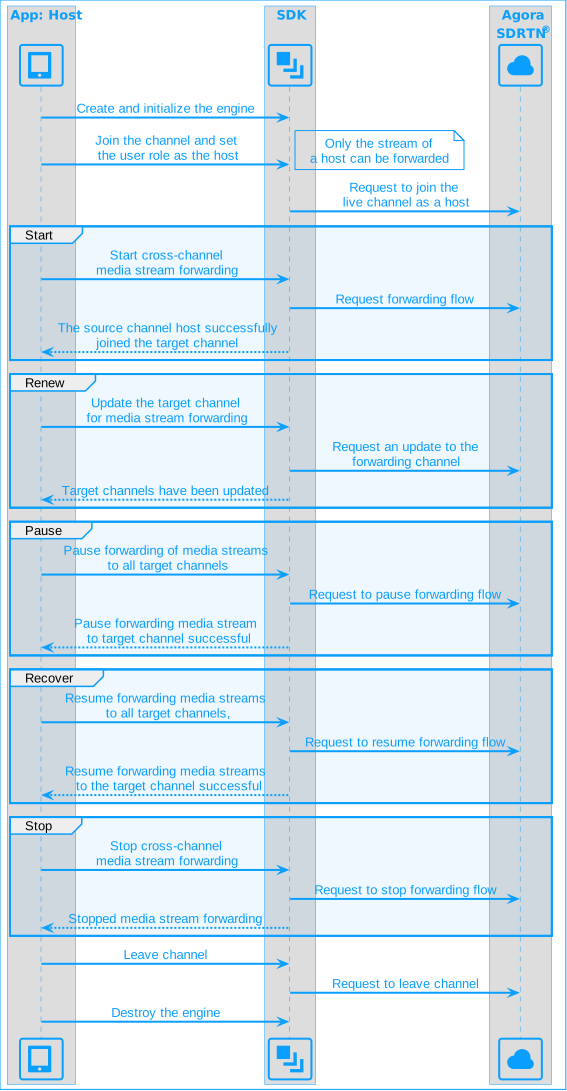
To implement cross-channel media stream relay in your app, take the following steps:
1. Start cross-channel media stream relay
After joining a channel, call `startOrUpdateChannelMediaRelay` to configure the source and target channel information and start forwarding a media stream. Calling this method before joining a channel fails. In live broadcasting, only hosts can call this method.
```cpp
// Configure source channel information
ChannelMediaInfo *m_srcInfo = new ChannelMediaInfo;
m_srcInfo->channelName = new char[szChannelId.size() + 1];
strcpy_s(const_cast(m_srcInfo->channelName), szChannelId.size() + 1,
szChannelId.data());
// Note: The token for source channel is different from the token used when joining the source channel.
// It needs to be regenerated using the source channel name and uid = 0
m_srcInfo->token = APP_TOKEN;
// It is recommended to set the uid of the source channel to 0, allowing the SDK to assign a random uid.
m_srcInfo->uid = 0;
// Configure destination channel information
int nDestCount = m_vecChannelMedias.size();
ChannelMediaInfo *lpDestInfos = new ChannelMediaInfo[nDestCount];
for (int nIndex = 0; nIndex < nDestCount; nIndex++) {
lpDestInfos[nIndex].channelName = m_vecChannelMedias[nIndex].channelName;
lpDestInfos[nIndex].token = m_vecChannelMedias[nIndex].token;
// Set the uid to 0, allowing the SDK to assign a random uid, or specify your own uid
// Ensure that it is different from all uids in the target channels
lpDestInfos[nIndex].uid = m_vecChannelMedias[nIndex].uid;
}
ChannelMediaRelayConfiguration cmrc;
cmrc.srcInfo = m_srcInfo;
cmrc.destInfos = lpDestInfos;
cmrc.destCount = nDestCount;
int ret = 0;
// Start or update the cross-channel media stream relay
ret = m_rtcEngine->startOrUpdateChannelMediaRelay(cmrc);
```
* Best practice is to set the UID of the source channel to `0`, allowing the SDK to assign a random UID.
* The source channel token in `srcChannelInfo` should be different from the one used when joining the source channel. Generate a new token using the source channel name and `uid = 0`.
* For the destination channel, set the uid to `0`, to allow the SDK to assign a random `uid`, or specify a `uid`, ensuring that it is different from all uids in the target channel.
* Cross-channel media stream relay doesn't support String-type user IDs. Join the channel with an int-type `uid`.
2. Update media stream relay channels
To forward the stream to multiple target channels or exit the current forwarding channel after starting channel media relay, call `startOrUpdateChannelMediaRelay` again to add or remove target channels for forwarding. Multiple hosts in a channel can forward media streams, and each host can forward to up to six target channels.
The updated configuration completely **replaces** the previous configuration.
3. Pause or resume media stream relay
To pause forwarding the media stream to all target channels, call `pauseAllChannelMediaRelay`.
```cpp
m_rtcEngine->pauseAllChannelMediaRelay();
```
To resume forwarding the media stream to all target channels, call `resumeAllChannelMediaRelay`.
```cpp
m_rtcEngine->resumeAllChannelMediaRelay();
```
4. Stop cross-channel media stream relay
To stop forwarding the media stream, call `stopChannelMediaRelay` . When forwarding stops, the host exits all target channels.
```cpp
m_rtcEngine->stopChannelMediaRelay();
m_lstInfo.AddString(_T("stopChannelMediaRelay"));
m_btnStartMediaRelay.SetWindowText(CrossChannelStartMediaRelay);
```
If this method fails, you can call `leaveChannel` to leave the channel, and cross-channel media stream relay will automatically stop.
5. Listen for cross-channel media stream status changes
During cross-channel media stream relay, the SDK reports changes in the status of media stream relay through the `onChannelMediaRelayStateChanged` callback. Implement relevant business logic based on the [status codes](#status-codes).
```cpp
class CAgoraCrossChannelEventHandler : public IRtcEngineEventHandler {
virtual void onChannelMediaRelayStateChanged(
CHANNEL_MEDIA_RELAY_STATE state,
CHANNEL_MEDIA_RELAY_ERROR code) override {
if (m_hMsgHanlder)
::PostMessage(m_hMsgHanlder,
WM_MSGID(EID_CHANNEL_MEDIA_RELAY_STATE_CHNAGENED),
state, code);
}
};
```
## Reference
This section contains content that completes the information on this page, or points you to documentation that explains other aspects to this product.
### Status codes
The main media stream forwarding states and their corresponding status codes are as follows:
| Media stream forwarding status | status code |
| :------------------------------------------------------------------------------------------------------------------------------------------------------------------------------------------------- | :----------------------------------------- |
| The source channel starts transmitting data to the target channel. | `RELAY_STATE_RUNNING`(2) and `RELAY_OK`(0) |
| Cross-channel media stream forwarding encounters an exception. You can troubleshoot based on the [error code](https://api-ref.agora.io/en/video-sdk/cpp/4.x/API/enum_channelmediarelayerror.html). | `RELAY_STATE_FAILURE`(3) |
| Media stream forwarding has stopped. | `RELAY_STATE_IDLE`(0) and `RELAY_OK`(0) |
### Sample project
Agora provides an open-source [CrossChannel](https://github.com/AgoraIO/API-Examples/tree/main/windows/APIExample/APIExample/Advanced/CrossChannel) sample project for your reference. Download the project or view the source code for a more detailed example.
### API reference
* [`startOrUpdateChannelMediaRelay`](https://api-ref.agora.io/en/video-sdk/cpp/4.x/API/api_irtcengine_startorupdatechannelmediarelay.html)
* [`stopChannelMediaRelay`](https://api-ref.agora.io/en/video-sdk/cpp/4.x/API/class_irtcengine.html#api_irtcengine_stopchannelmediarelay)
* [`pauseAllChannelMediaRelay`](https://api-ref.agora.io/en/video-sdk/cpp/4.x/API/class_irtcengine.html#api_irtcengine_pauseallchannelmediarelay)
* [`resumeAllChannelMediaRelay`](https://api-ref.agora.io/en/video-sdk/cpp/4.x/API/class_irtcengine.html#api_irtcengine_resumeallchannelmediarelay)
* [`onChannelMediaRelayStateChanged`](https://api-ref.agora.io/en/video-sdk/cpp/4.x/API/class_irtcengineeventhandler.html#callback_irtcengineeventhandler_onchannelmediarelaystatechanged)
* [`ChannelMediaRelayConfiguration`](https://api-ref.agora.io/en/video-sdk/cpp/4.x/API/class_channelmediarelayconfiguration.html)
* [`ChannelMediaInfo`](https://api-ref.agora.io/en/video-sdk/cpp/4.x/API/class_channelmediainfo.html)