# Cross-channel media stream relay (/en/realtime-media/rtc/build/join-and-manage-channels/cross-channel-media-relay/unity)
> For AI agents: see the complete documentation index at [llms.txt](/llms.txt).
Some special use-cases require cross-channel media stream forwarding functionality. RTC SDK enables you to relay the media stream of a host, from a source channel, to multiple target channels simultaneously. This functionality allows you to realize the following interactions:
* The hosts publish and receive each other's audio and video streams while engaging in *cross-channel* real-time interaction.
* The audience receive all audio and video streams from hosts and watch multiple hosts interact at the same time.
Due to its real-time and interactive nature, this feature enriches live broadcasts and game-play, It is especially suitable for live scenes such as co-hosting PK and online choir. It provides the audience with a better viewing experience, while bringing more traffic and revenue to the hosts.
Cross-channel media stream relay is included in Agora's policy of [10,000 free minutes](/en/api-reference/faq/account/billing_free) every month. For usage beyond the free quota, please refer to [Pricing](/en/realtime-media/rtc/reference/pricing).
## Prerequisites
* Ensure that you have implemented the [SDK quickstart](/en/realtime-media/rtc/get-started-sdk) in your project.
* Contact [support@agora.io](mailto\:support@agora.io) to activate the cross-channel media stream relay feature.
## Implement cross-channel media stream relay
The following figure shows the workflow you implement to facilitate cross-channel media stream relay:
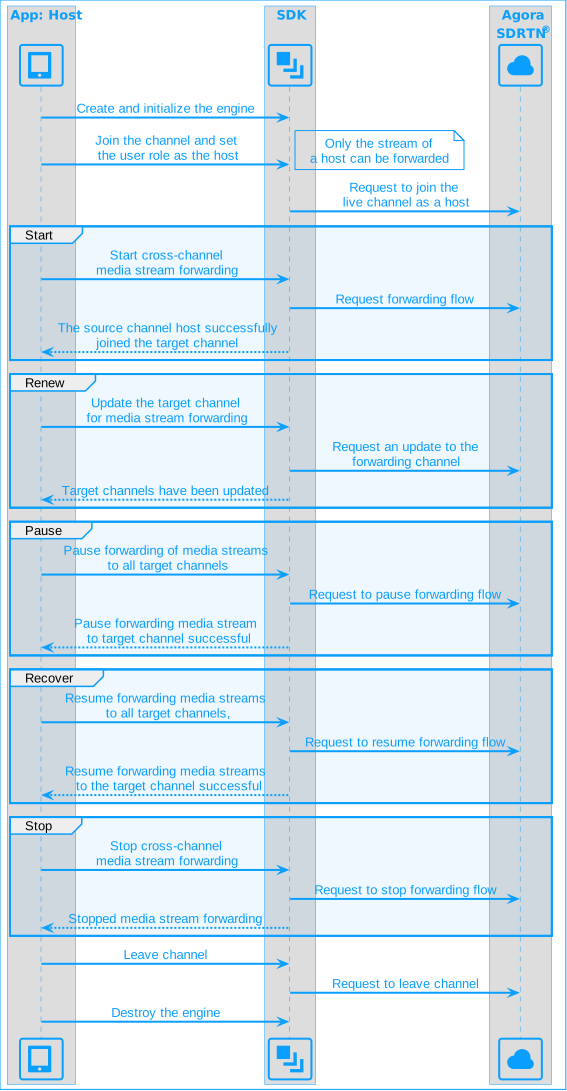
To implement cross-channel media stream relay in your game, take the following steps:
1. Start cross-channel media stream relay
After joining a channel, call `StartOrUpdateChannelMediaRelay` to configure the source and target channel information and start forwarding a media stream. Calling this method before joining a channel fails. In live broadcasting, only hosts can call this method.
```csharp
private void OnStartButtonClick()
{
ChannelMediaRelayConfiguration config = new ChannelMediaRelayConfiguration();
// Configure source channel
config.srcInfo = new ChannelMediaInfo
{
channelName = this._appIdInput.channelName,
uid = 0, // Let the SDK assign a random UID
token = this._appIdInput.token // Regenerate token for source channel with UID 0
};
// Configure target channel (up to 6 supported)
config.destInfos = new ChannelMediaInfo[1];
config.destInfos[0] = new ChannelMediaInfo
{
channelName = this._appIdInput.channelName + "_2",
uid = 0, // Random UID or specify a unique one
token = this._appIdInput.token
};
config.destCount = 1;
// Start media stream forwarding
var nRet = RtcEngine.StartOrUpdateChannelMediaRelay(config);
this.Log.UpdateLog(`StartOrUpdateChannelMediaRelay nRet: ${nRet}, New Channel: ${this._appIdInput.channelName}_2`);
}
```
Cross-channel media stream relay doesn't support String-type user IDs. Join the channel with an int-type `uid`.
2. Update media stream relay channels
To forward the stream to multiple target channels or exit the current forwarding channel after starting channel media relay, call `StartOrUpdateChannelMediaRelay` again to add or remove target channels for forwarding. Multiple hosts in a channel can forward media streams, and each host can forward to up to six target channels.
The updated configuration completely **replaces** the previous configuration.
3. Pause or resume media stream relay
To pause forwarding the media stream to all target channels, call `PauseAllChannelMediaRelay`.
```csharp
private void onPauseAllButtonClick()
{
var nRet = RtcEngine.PauseAllChannelMediaRelay();
this.Log.UpdateLog(`onPauseAllButtonClick nRet: ${nRet}`);
}
```
To resume forwarding the media stream to all target channels, call `ResumeAllChannelMediaRelay`:
```csharp
private void OnResumeAllButtonClick()
{
var nRet = RtcEngine.ResumeAllChannelMediaRelay();
this.Log.UpdateLog(`OnResumeAllButtonClick nRet: ${nRet}`);
}
```
4. Stop cross-channel media stream relay
To stop forwarding the media stream, call `StopChannelMediaRelay`. When forwarding stops, the host exits all target channels.
```csharp
private void OnStopButtonClick()
{
var nRet = RtcEngine.StopChannelMediaRelay();
this.Log.UpdateLog(`OnStopButtonClick nRet: ${nRet}`);
}
```
If this method fails, call `LeaveChannel` to leave the channel and stop cross-channel media stream relay.
5. Monitor cross-channel media stream status
During cross-channel media stream relay, the SDK reports changes in the status of media stream relay through the `OnChannelMediaRelayStateChanged` callback. Implement the relevant business logic based on the [status codes](#status-codes).
```csharp
public override void OnChannelMediaRelayStateChanged(int state, int code)
{
_channelMediaRelay.Log.UpdateLog(`OnChannelMediaRelayStateChanged state: ${state}, code: ${code}`);
}
```
## Reference
This section contains content that completes the information on this page, or points you to documentation that explains other aspects to this product.
### Status codes
To understand and respond to changes in the media relay state, refer to the [`CHANNEL_MEDIA_RELAY_STATE`](https://api-ref.agora.io/en/video-sdk/unity/4.x/API/enum_channelmediarelaystate.html) and [`CHANNEL_MEDIA_RELAY_ERROR`](https://api-ref.agora.io/en/video-sdk/unity/4.x/API/enum_channelmediarelayerror.html) enums in the API reference.
### Sample project
Agora provides an open-source [ChannelMediaRelay](https://github.com/AgoraIO-Extensions/Agora-Unity-Quickstart/blob/main/API-Example-Unity/Assets/API-Example/Examples/Advanced/ChannelMediaRelay/ChannelMediaRelay.cs) sample project for your reference. Download the project or view the source code for a more detailed example.
### API reference
* [`StartOrUpdateChannelMediaRelay`](https://api-ref.agora.io/en/video-sdk/unity/4.x/API/class_irtcengine.html#api_irtcengine_startorupdatechannelmediarelay)
* [`StopChannelMediaRelay`](https://api-ref.agora.io/en/video-sdk/unity/4.x/API/class_irtcengine.html#api_irtcengine_stopchannelmediarelay)
* [`PauseAllChannelMediaRelay`](https://api-ref.agora.io/en/video-sdk/unity/4.x/API/class_irtcengine.html#api_irtcengine_pauseallchannelmediarelay)
* [`ResumeAllChannelMediaRelay`](https://api-ref.agora.io/en/video-sdk/unity/4.x/API/class_irtcengine.html#api_irtcengine_resumeallchannelmediarelay)
* [`OnChannelMediaRelayStateChanged`](https://api-ref.agora.io/en/video-sdk/unity/4.x/API/class_irtcengineeventhandler.html#callback_irtcengineeventhandler_onchannelmediarelaystatechanged)
* [`ChannelMediaRelayConfiguration`](https://api-ref.agora.io/en/video-sdk/unity/4.x/API/class_channelmediarelayconfiguration.html)
* [`ChannelMediaInfo`](https://api-ref.agora.io/en/video-sdk/unity/4.x/API/class_channelmediainfo.html)