# AccessToken upgrade guide (/en/realtime-media/rtc/build/authenticate-users/integrate-token-generation)
> For AI agents: see the complete documentation index at [llms.txt](/llms.txt).
To secure user access, integrate token authentication into your Video Calling identity management system. This guide shows you how to use Agora token generation libraries to create access tokens.
## Understand the tech
A token contains the following information:
* The App ID for your project
* The App certificate for your project
* Channel name
* User ID
* User permissions, such as whether they can send or receive streams
* Token expiration Unix timestamp
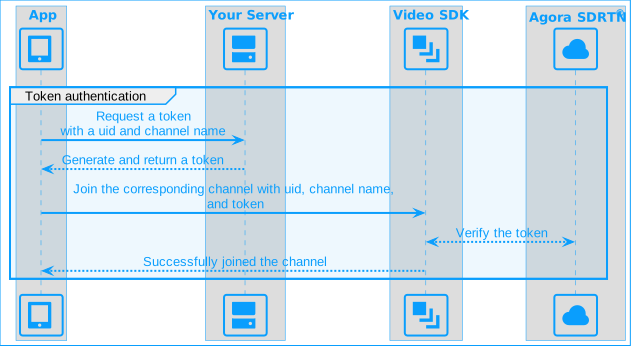
When a user attempts to connect to an Agora channel, your app requests a token from your authentication system. Your authentication system uses Agora libraries to generate a token specific to the user and the channel, then sends it to your app. The app then sends this token to Agora SDRTN® with the request to join a channel. Agora SDRTN® validates the token and adds the user to the channel. The following diagram shows the authentication call flow between your app, your authentication system and Agora SDRTN®:
## Prerequisites
Before starting, ensure that you have:
* Implemented the [SDK quickstart](/en/realtime-media/rtc/get-started-sdk) in your project.
* The following information from [Agora Console](https://console.agora.io/v2):
* App ID: A unique string generated by Agora that identifies your project.
* App Certificate: A string generated by Agora Console to enable token authentication. To obtain the App Certificate for your project, enable primary certificate.
## Deploy a token server
This section shows you how to quickly deploy a token server based on `AccessToken2`. If you already have a token server that uses `AccessToken` skip to [Upgrade to `AccessToken2`.](#upgrade-to-accesstoken2).
The following example uses Golang. Before starting, ensure that you have [Golang](https://golang.org/dl/) version 1.14 or above.
Follow these steps to build and run a token generator locally:
1. Create a new `token-server` folder. Create a `server.go` file inside the folder and paste the following Golang sample code into the file. Replace the values for `appID` and `appCertificate` with your App ID and App certificate.
```go
package main
import (
rtctokenbuilder "github.com/AgoraIO/Tools/DynamicKey/AgoraDynamicKey/go/src/rtctokenbuilder2"
"fmt"
"log"
"net/http"
"encoding/json"
"errors"
"strconv"
)
type rtc_int_token_struct struct{
Uid_rtc_int uint32 \`json:"uid"\`
Channel_name string \`json:"ChannelName"\`
Role uint32 \`json:"role"\`
}
var rtc_token string
var int_uid uint32
var channel_name string
var role_num uint32
var role rtctokenbuilder.Role
// Use RtcTokenBuilder to generate RTC Token
func generateRtcToken(int_uid uint32, channelName string, role rtctokenbuilder.Role){
appID := ""
appCertificate := ""
// Ensure that the expiration time of the token is later than the permission expiration time. Permission expiration time, unit is seconds
tokenExpireTimeInSeconds := uint32(40)
// The token-privilege-will-expire callback is triggered 30 seconds before the permission expires.
// For demonstration purposes, set the expiration time to 40 seconds. You can see the process of the client automatically updating the Token
privilegeExpireTimeInSeconds := uint32(40)
result, err := rtctokenbuilder.BuildTokenWithUid(appID, appCertificate, channelName, int_uid, role, tokenExpireTimeInSeconds, privilegeExpireTimeInSeconds)
if err != nil {
fmt.Println(err)
} else {
fmt.Printf("Token with uid: %s\\n", result)
fmt.Printf("uid is %d\\n", int_uid )
fmt.Printf("ChannelName is %s\\n", channelName)
fmt.Printf("Role is %d\\n", role)
}
rtc_token = result
}
func rtcTokenHandler(w http.ResponseWriter, r *http.Request){
w.Header().Set("Content-Type", "application/json; charset=UTF-8")
w.Header().Set("Access-Control-Allow-Origin", "*")
w.Header().Set("Access-Control-Allow-Methods", "POST, OPTIONS");
w.Header().Set("Access-Control-Allow-Headers", "*");
if r.Method == "OPTIONS" {
w.WriteHeader(http.StatusOK)
return
}
if r.Method != "POST" && r.Method != "OPTIONS" {
http.Error(w, "Unsupported method. Please check.", http.StatusNotFound)
return
}
var t_int rtc_int_token_struct
var unmarshalErr *json.UnmarshalTypeError
int_decoder := json.NewDecoder(r.Body)
int_err := int_decoder.Decode(&t_int)
if (int_err == nil) {
int_uid = t_int.Uid_rtc_int
channel_name = t_int.Channel_name
role_num = t_int.Role
switch role_num {
case 1:
role = rtctokenbuilder.RolePublisher
case 2:
role = rtctokenbuilder.RoleSubscriber
}
}
if (int_err != nil) {
if errors.As(int_err, &unmarshalErr){
errorResponse(w, "Bad request. Wrong type provided for field " + unmarshalErr.Value + unmarshalErr.Field + unmarshalErr.Struct, http.StatusBadRequest)
} else {
errorResponse(w, "Bad request.", http.StatusBadRequest)
}
return
}
generateRtcToken(int_uid, channel_name, role)
errorResponse(w, rtc_token, http.StatusOK)
log.Println(w, r)
}
func errorResponse(w http.ResponseWriter, message string, httpStatusCode int){
w.Header().Set("Content-Type", "application/json")
w.Header().Set("Access-Control-Allow-Origin", "*")
w.WriteHeader(httpStatusCode)
resp := make(map[string]string)
resp["token"] = message
resp["code"] = strconv.Itoa(httpStatusCode)
jsonResp, _ := json.Marshal(resp)
w.Write(jsonResp)
}
func main(){
// Use int type uid to generate RTC Token
http.HandleFunc("/fetch_rtc_token", rtcTokenHandler)
fmt.Printf("Starting server at port 8082\n")
if err := http.ListenAndServe(":8082", nil); err != nil {
log.Fatal(err)
}
}
```
1. Open the terminal, go to the `token-server` folder path, and run the following command line to create a `go.mod` file for your token generator. This file defines the import path and dependencies:
```go
go mod init sampleServer
```
2. Run the following command to install dependencies.
```go
go get github.com/AgoraIO/Tools/DynamicKey/AgoraDynamicKey/go/src/rtctokenbuilder2
```
3. Run the following command to start the token generator:
```go
go run server.go
```
After the token generator is deployed successfully, your terminal returns the token generated based on the App ID and App certificate you filled in.
## Reference
This section contains content that completes the information on this page, or points you to documentation that explains other aspects to this product.
### Upgrade to AccessToken2
If your current token server implementation uses `AccessToken`, follow these steps to upgrade your server to `AccessToken2`.
1. Replace the import `rtctokenbuilder` declaration with the following code and delete the declaration that imports `time`:
```go
import (
// Replace
// rtctokenbuilder "github.com/AgoraIO/Tools/DynamicKey/AgoraDynamicKey/go/src/RtcTokenBuilder"
rtctokenbuilder "github.com/AgoraIO/Tools/DynamicKey/AgoraDynamicKey/go/src/rtctokenbuilder2"
"fmt"
"log"
"net/http"
// delete
// "time"
"encoding/json"
"errors"
"strconv"
)
```
2. Remove the statement that generates the timestamp and add `tokenExpireTimeInSeconds` and `privilegeExpireTimeInSeconds` related code:
```go
// expireTimeInSeconds := uint32(40)
// Get the current timestamp
// currentTimestamp := uint32(time.Now().UTC().Unix())
// Timestamp when the token expires.
// expireTimestamp := currentTimestamp + expireTimeInSeconds
tokenExpireTimeInSeconds := uint32(40)
privilegeExpireTimeInSeconds := uint32(40)
```
3. Update `tokenbuilder` method code:
```go
// Code before updating
// result, err := rtctokenbuilder.BuildTokenWithUID(appID, appCertificate, channelName, int_uid, role, expireTimestamp)
// Updated code
// Change BuildTokenWithUID to BuildTokenWithUid
// Change expireTimestamp to tokenExpireTimeInSeconds and privilegeExpireTimeInSeconds
result, err := rtctokenbuilder.BuildTokenWithUid(appID, appCertificate, channelName, int_uid, role, tokenExpireTimeInSeconds, privilegeExpireTimeInSeconds)
```
4. Remove unsupported roles
```go
switch role_num {
// delete
// case 0:
// Deprecated. RoleAttendee and RolePublisher have the same permissions
// role = rtctokenbuilder.RoleAttendee
case 1:
role = rtctokenbuilder.RolePublisher
case 2:
role = rtctokenbuilder.RoleSubscriber
// delete
// case 101:
// Deprecated. RoleAdmin and RolePublisher have the same permissions
// role = rtctokenbuilder.RoleAdmin
}
```
### See also
* [Token generation code in other languages](/en/realtime-media/rtc/build/authenticate-users/deploy-token-server#token-generation-code)
* [Token generation API reference](/en/realtime-media/rtc/build/authenticate-users/authentication-workflow#api-reference)