# Use tokens (/en/realtime-media/rtc/build/authenticate-users/authentication-workflow/flutter)
> For AI agents: see the complete documentation index at [llms.txt](/llms.txt).
To protect your business, it is best practice to authenticate every client that joins a channel. This guide explains how to fetch an authentication token from your token server, use it to join a channel, and renew the token when it expires.
## Understand the tech
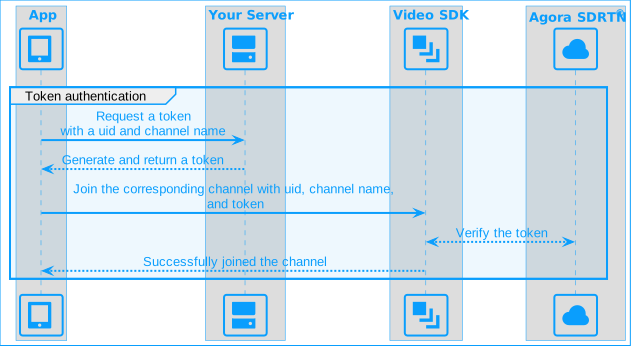
When a user attempts to connect to an Agora channel, your app retrieves a token from the token server in your security infrastructure. Your app then sends this token to Agora SDRTN® for authentication. Agora SDRTN® reads the information stored in the token to validate the request.
The following figure shows the call flow you implement to create step-up-authentication with Agora Video Calling:
## Prerequisites
Before starting, ensure that you have:
* Implemented the [Quickstart](/en/realtime-media/rtc/get-started-sdk) in your project.
* Deployed a token server using either of the following guides:
* [Deploy a token server](/en/realtime-media/rtc/build/authenticate-users/deploy-token-server)
* [Deploy a middleware server](/en/realtime-media/rtc/build/authenticate-users/middleware-token-server)
## Implement basic authentication
This section shows you how to implement basic authentication by acquiring a token and using it to join a channel.
### Use a token to join a channel
This section shows you how to integrate token authentication in your app.
1. Add the following to the `pubspec.yaml` file, under `dependencies`:
```yaml
dependencies:
# Agora Flutter SDK, use the latest version of agora_rtc_engine
agora_rtc_engine: ^6.3.0
# For making http requests
http: ^0.13.5
```
2. Replace the contents in `/lib/main.dart` with the following code.
**Sample code for basic authentication**
```dart
import 'dart:convert';
import 'package:agora_rtc_engine/agora_rtc_engine.dart';
import 'package:flutter/material.dart';
import 'package:http/http.dart' as http;
void main() => runApp(const MyApp());
/// This widget is the root of your application.
class MyApp extends StatefulWidget {
/// Construct the [MyApp]
const MyApp({Key? key}) : super(key: key);
@override
State createState() => _MyAppState();
}
class _MyAppState extends State {
@override
Widget build(BuildContext context) {
return MaterialApp(
theme: ThemeData(
primarySwatch: Colors.blue,
),
home: Scaffold(
appBar: AppBar(
title: const Text('APIExample'),
),
body: const JoinChannelVideoToken()),
);
}
}
class JoinChannelVideoToken extends StatefulWidget {
const JoinChannelVideoToken({Key? key}) : super(key: key);
@override
State createState() => _State();
}
class _State extends State {
late final RtcEngine _engine;
bool _isReadyPreview = false;
bool isJoined = false, switchCamera = true, switchRender = true;
Set remoteUid = {};
static const String appId = ''; // Fill in the information from Agora console
static const String channelId = ''; // Fill in the channel name
static const String hostUrl = ''; // Fill in the server URL and port
@override
void initState() {
super.initState();
_initEngine();
}
@override
void dispose() {
super.dispose();
_dispose();
}
Future _dispose() async {
await _engine.leaveChannel();
await _engine.release();
}
Future _initEngine() async {
_engine = createAgoraRtcEngine();
await _engine.initialize(const RtcEngineContext(
appId: appId,
));
_engine.registerEventHandler(RtcEngineEventHandler(
onJoinChannelSuccess: (RtcConnection connection, int elapsed) {
setState(() {
isJoined = true;
});
},
onUserJoined: (RtcConnection connection, int rUid, int elapsed) {
setState(() {
remoteUid.add(rUid);
});
},
onUserOffline:
(RtcConnection connection, int rUid, UserOfflineReasonType reason) {
setState(() {
remoteUid.removeWhere((element) => element == rUid);
});
},
onLeaveChannel: (RtcConnection connection, RtcStats stats) {
setState(() {
isJoined = false;
remoteUid.clear();
});
},
onTokenPrivilegeWillExpire: (RtcConnection connection, String token) {
_fetchToken(1234, channelId, 1, false);
},
onRequestToken: (RtcConnection connection) {
_fetchToken(1234, channelId, 1, true);
},
));
await _engine.enableVideo();
await _engine.startPreview();
await _fetchToken(1234, channelId, 1, true);
setState(() {
_isReadyPreview = true;
});
}
Future _fetchToken(
int uid,
String channelName,
int toeknRole,
bool needJoinChannel,
) async {
var client = http.Client();
try {
Map headers = {
'Content-type': 'application/json',
'Accept': 'application/json',
};
var response = await client.post(Uri.parse(hostUrl),
headers: headers,
body: jsonEncode(
{'uid': uid, 'ChannelName': channelName, 'role': toeknRole}));
var decodedResponse = jsonDecode(utf8.decode(response.bodyBytes)) as Map;
final token = decodedResponse['token'];
if (needJoinChannel) {
await _engine.joinChannel(
token: token,
channelId: channelName,
uid: uid,
options: const ChannelMediaOptions(
channelProfile: ChannelProfileType.channelProfileLiveBroadcasting,
clientRoleType: ClientRoleType.clientRoleBroadcaster,
),
);
} else {
await _engine.renewToken(token);
}
} finally {
client.close();
}
}
@override
Widget build(BuildContext context) {
if (!_isReadyPreview) return Container();
return Stack(
children: [
AgoraVideoView(
controller: VideoViewController(
rtcEngine: _engine,
canvas: const VideoCanvas(uid: 0),
),
),
Align(
alignment: Alignment.topLeft,
child: SingleChildScrollView(
scrollDirection: Axis.horizontal,
child: Row(
children: List.of(remoteUid.map(
(e) => SizedBox(
width: 120,
height: 120,
child: AgoraVideoView(
controller: VideoViewController.remote(
rtcEngine: _engine,
canvas: VideoCanvas(uid: e),
connection: const RtcConnection(channelId: channelId),
),
),
),
)),
),
),
)
],
);
}
}
```
Replace `` with your app ID, which must be consistent with the app ID you specified in the server configuration. Update `` with the host URL and port of the local Golang server you have deployed. For example `99.9.9.99:8082`.
The sample code implements the following logic:
* Calls `joinChannel` to join a channel using the user ID, the channel name, and a token you obtain from the server. The user ID and channel name you specify must be consistent with the values you used to generate the token.
* The SDK triggers an `onTokenPrivilegeWillExpire` callback 30 seconds before the token expires. After receiving the callback, you obtain a new token from the server and call `renewToken` to pass the newly generated token to the SDK.
* If the token expires, the SDK triggers an `onRequestToken` callback. After receiving the callback, obtain a new token from the server and call `joinChannel` with the new token to rejoin the channel.
Build and run the project on the local device, the app performs the following operations:
* Obtains a token from your token server.
* Joins the channel.
* Automatically renews the token when it is about to expire.
Note
The user ID and channel name used to join a channel must be consistent with the values used to generate the token.
## Reference
This section contains content that completes the information on this page, or points you to documentation that explains other aspects to this product.
### API reference
* [renewToken](https://api-ref.agora.io/en/video-sdk/flutter/6.x/API/class_irtcengine.html#api_irtcengine_renewtoken)
* [onTokenPrivilegeWillExpire](https://api-ref.agora.io/en/video-sdk/flutter/6.x/API/class_irtcengineeventhandler.html#callback_irtcengineeventhandler_ontokenprivilegewillexpire)
* [onConnectionStateChanged](https://api-ref.agora.io/en/video-sdk/flutter/6.x/API/class_irtcengineeventhandler.html#callback_irtcengineeventhandler_onconnectionstatechanged)