# Use tokens (/en/realtime-media/rtc/build/authenticate-users/authentication-workflow/blueprint)
> For AI agents: see the complete documentation index at [llms.txt](/llms.txt).
To protect your business, it is best practice to authenticate every client that joins a channel. This guide explains how to fetch an authentication token from your token server, use it to join a channel, and renew the token when it expires.
## Understand the tech
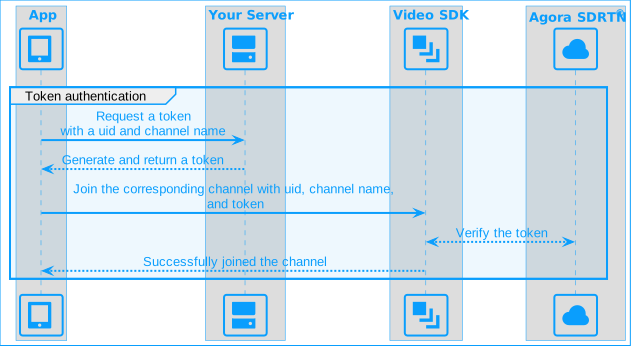
When a user attempts to connect to an Agora channel, your app retrieves a token from the token server in your security infrastructure. Your app then sends this token to Agora SDRTN® for authentication. Agora SDRTN® reads the information stored in the token to validate the request.
The following figure shows the call flow you implement to create step-up-authentication with Agora Video Calling:
## Prerequisites
Before starting, ensure that you have:
* Implemented the [Quickstart](/en/realtime-media/rtc/get-started-sdk) in your project.
* Deployed a token server using either of the following guides:
* [Deploy a token server](/en/realtime-media/rtc/build/authenticate-users/deploy-token-server)
* [Deploy a middleware server](/en/realtime-media/rtc/build/authenticate-users/middleware-token-server)
## Implement basic authentication
This section shows you how to implement basic authentication by acquiring a token and using it to join a channel.
### Use a token to join a channel
The client requests a token from your authentication server corresponding to the user ID and the channel name. You use the received token to join a channel.
```cpp
// Channel name
const char* channelId;
// User ID
int uid = 0
// Request a token from the server corresponding to channelId and uid
const char* token = getToken();
// Set channel media options
ChannelMediaOptions options;
// Set the user role as host
options.clientRoleType = CLIENT_ROLE_TYPE::CLIENT_ROLE_BROADCASTER;
// Join the channel
m_rtcEngine->joinChannel(token, channelId, uid, options);
```
### Token expiration
After you join a channel using a token, the SDK triggers an `onTokenPrivilegeWillExpire` callback, 30 seconds before the token is set to expire.
When the token expires, the SDK triggers an `onRequestToken` callback. After receiving the callback, you regenerate a new token on the server side, and then update the token in one of the following ways:
#### Single channel use-case
* Call `renewToken` to pass in the newly generated Token (Recommended).
* Call `updateChannelMediaOptions` to update the token.
* Call `leaveChannel` \[2/2] to leave the current channel, and then pass in a new token when calling `joinChannel` \[2/2] to rejoin the channel.
#### Multi-channel use-case
If you call `joinChannelEx` to join multiple channels, call the `updateChannelMediaOptionsEx` method to update the token.
The following sample code demonstrates how to call `renewToken` to update the token upon receiving an `onTokenPrivilegeWillExpire` callback notification.
```cpp
class CJoinChannelVideoByTokenRtcEngineEventHandler
: public IRtcEngineEventHandler
{
public:
// Triggered when a token is about to expire
virtual void onTokenPrivilegeWillExpire(const char* token) {
// Request to generate a fresh token
const char* token = getToken();
// Renew token
m_rtcEngine->renewToken(token);
}
}
```
Note
The user ID and channel name used to join a channel must be consistent with the values used to generate the token.
## Reference
This section contains content that completes the information on this page, or points you to documentation that explains other aspects to this product.