# Composite recording (/en/realtime-media/on-premise-recording/build/record-audio-and-video/composite-mode)
> For AI agents: see the complete documentation index at [llms.txt](/llms.txt).
<_PlatformTabsGroup groupMode="structured" canonicalPlatform="linux-cpp" platforms="["linux-cpp","linux-java"]" showTabs="true">
<_PlatformPanel platform="linux-cpp">
<_PlatformProcessedMarker groupMode="structured" canonicalPlatform="linux-cpp" platform="linux-cpp" />
The On-Premise Recording SDK supports two recording modes:
* Individual recording mode: This is the default recording mode. The SDK generates one audio and/or video file for each UID.
* Composite recording mode: Generates a single mixed audio and video file for all UIDs in a channel, or mixes the audio of all UIDs in the channel into an audio file and the video of all UIDs into a video file.
See [Differences between individual recording mode and composite recording mode](https://docs.agora.io/en/help/integration-issues/recording_mode) to decide which mode you should use.
## Prerequisites [#prerequisites]
Before continuing, follow the [Quickstart](/en/realtime-media/on-premise-recording/quickstart) guide to integrate the Recording SDK and implement the basic recording functionality.
## Implement composite recording [#implement-composite-recording]
The implementation of composite recording is largely similar to the steps in the [Quickstart](/en/realtime-media/on-premise-recording/quickstart) guide. The main differences are in the configuration parameters and the APIs used.
Refer to the following call sequence diagram to understand the recording workflow.
Sequence diagram
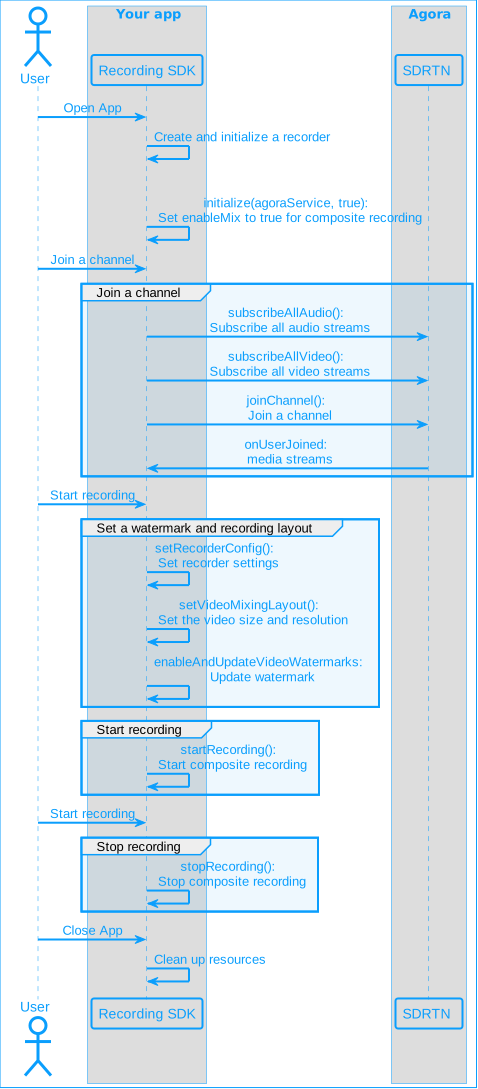
To implement composite recording in your app, follow these steps:
To implement composite recording mode in your C++ app, follow these steps:
1. Initialize the recorder with [`enableMix`](/en/api-reference/api-ref/on-premise-recording#initialize) set to `true`.
2. Subscribe to the audio and video streams of the users you want to record.
3. Join the channel with [`joinChannel`](/en/api-reference/api-ref/on-premise-recording#joinchannel).
4. After joining the channel, configure the recording:
* Use [`setRecorderConfig`](/en/api-reference/api-ref/on-premise-recording#setrecorderconfig) to set video resolution, bitrate, and storage path.
* Optionally, apply watermarks with [`enableAndUpdateVideoWatermarks`](/en/api-reference/api-ref/on-premise-recording#enableandupdatevideowatermarks).
* Define the video layout with [`setVideoMixingLayout`](/en/api-reference/api-ref/on-premise-recording#setvideomixinglayout).
5. Start and stop recording by calling:
* [`startRecording`](/en/api-reference/api-ref/on-premise-recording#startrecording)
* [`stopRecording`](/en/api-reference/api-ref/on-premise-recording#stoprecording)
Refer to the following code to implement these steps:
```cpp
// Initialize the recorder in composite recording mode
recorder->initialize(service, true);
// Subscribe to all audio and video streams
recorder->subscribeAllAudio();
recorder->subscribeAllVideo();
// Join the channel
recorder->joinChannel(config.token.c_str(), config.ChannelName.c_str(), config.UserId.c_str());
// Set recording configuration
recorder->setRecorderConfig(recorder_config);
// Apply watermarks (optional)
recorder->enableAndUpdateVideoWatermarks(watermarks, config.waterMarks.size());
// Set the video mixing layout
recorder->setVideoMixingLayout(layout);
// Start recording
recorder->startRecording();
// ...
// Stop recording
recorder->stopRecording();
```
## Reference [#reference]
This section contains content that completes the information on this page, or points you to documentation that explains other aspects to this product.
### Considerations [#considerations]
The composite recording mode supports a specific set of APIs. Calling unsupported methods in the wrong mode has no effect. When using the composite recording mode, the following methods do not work:
* [`setRecorderConfigByUid`](/en/api-reference/api-ref/on-premise-recording#setrecorderconfigbyuid)
* [`enableAndUpdateVideoWatermarksByUid`](/en/api-reference/api-ref/on-premise-recording#enableandupdatevideowatermarksbyuid)
* [`startSingleRecordingByUid`](/en/api-reference/api-ref/on-premise-recording#startsinglerecordingbyuid)
* [`stopSingleRecordingByUid`](/en/api-reference/api-ref/on-premise-recording#stopsinglerecordingbyuid)
<_PlatformProcessedMarker close="true" />
<_PlatformPanel platform="linux-java">
<_PlatformProcessedMarker groupMode="structured" canonicalPlatform="linux-cpp" platform="linux-java" />
The On-Premise Recording SDK supports two recording modes:
* Individual recording mode: This is the default recording mode. The SDK generates one audio and/or video file for each UID.
* Composite recording mode: Generates a single mixed audio and video file for all UIDs in a channel, or mixes the audio of all UIDs in the channel into an audio file and the video of all UIDs into a video file.
See [Differences between individual recording mode and composite recording mode](https://docs.agora.io/en/help/integration-issues/recording_mode) to decide which mode you should use.
## Prerequisites [#prerequisites-1]
Before continuing, follow the [Quickstart](/en/realtime-media/on-premise-recording/quickstart) guide to integrate the Recording SDK and implement the basic recording functionality.
## Implement composite recording [#implement-composite-recording-1]
The implementation of composite recording is largely similar to the steps in the [Quickstart](/en/realtime-media/on-premise-recording/quickstart) guide. The main differences are in the configuration parameters and the APIs used.
Refer to the following call sequence diagram to understand the recording workflow.
Sequence diagram

To implement composite recording in your app, follow these steps:
1. Initialize the recorder with [`enableMix`](/en/api-reference/api-ref/on-premise-recording#initialize) set to `true`.
2. Subscribe to the audio and video streams of the users you want to record.
3. Join the channel using [`joinChannel`](/en/api-reference/api-ref/on-premise-recording#joinchannel).
4. After joining the channel:
* Use [`setRecorderConfig`](/en/api-reference/api-ref/on-premise-recording#setrecorderconfig) to set video resolution, frame rate, duration, and output path.
* Optionally, use [`enableAndUpdateVideoWatermarks`](/en/api-reference/api-ref/on-premise-recording#enableandupdatevideowatermarks) to apply video watermarks.
* Use [`setVideoMixingLayout`](/en/api-reference/api-ref/on-premise-recording#setvideomixinglayout) to configure the layout of multiple video streams.
5. Start and stop recording using:
* [`startRecording`](/en/api-reference/api-ref/on-premise-recording#startrecording)
* [`stopRecording`](/en/api-reference/api-ref/on-premise-recording#stoprecording)
Refer to the following code to implement these steps:
```java
// Initialize the recorder in composite recording mode
agoraMediaRtcRecorder.initialize(agoraService, true);
// Subscribe to all audio and video streams
agoraMediaRtcRecorder.subscribeAllAudio();
VideoSubscriptionOptions options = new VideoSubscriptionOptions();
options.setEncodedFrameOnly(false);
options.setType(Constants.VideoStreamType.VIDEO_STREAM_HIGH);
agoraMediaRtcRecorder.subscribeAllVideo(options);
// Join the channel
agoraMediaRtcRecorder.joinChannel(
recorderConfig.getToken(),
recorderConfig.getChannelName(),
recorderConfig.getUserId()
);
// Configure the recorder
agoraMediaRtcRecorder.setRecorderConfig(recorderConfig);
agoraMediaRtcRecorder.enableAndUpdateVideoWatermarks(watermarks); // Optional
agoraMediaRtcRecorder.setVideoMixingLayout(layout);
// Start recording
agoraMediaRtcRecorder.startRecording();
// ...
// Stop recording
agoraMediaRtcRecorder.stopRecording();
```
## Reference [#reference-1]
This section contains content that completes the information on this page, or points you to documentation that explains other aspects to this product.
### Considerations [#considerations-1]
The composite recording mode supports a specific set of APIs. Calling unsupported methods in the wrong mode has no effect. When using the composite recording mode, the following methods do not work:
* [`setRecorderConfigByUid`](/en/api-reference/api-ref/on-premise-recording#setrecorderconfigbyuid)
* [`enableAndUpdateVideoWatermarksByUid`](/en/api-reference/api-ref/on-premise-recording#enableandupdatevideowatermarksbyuid)
* [`startSingleRecordingByUid`](/en/api-reference/api-ref/on-premise-recording#startsinglerecordingbyuid)
* [`stopSingleRecordingByUid`](/en/api-reference/api-ref/on-premise-recording#stopsinglerecordingbyuid)
<_PlatformProcessedMarker close="true" />