# Embed a custom plugin (/en/realtime-media/flexible-classroom/build/customize-the-ui-and-plugins/embed-custom-plugin/web)
> For AI agents: see the complete documentation index at [llms.txt](/llms.txt).
In online classroom applications, some customization is often necessary to meet the needs of a particular use case. Agora provides Widgets to help users develop plugins according to their specific needs and embed them into Flexible Classroom.
## Web [#web]
In online classroom applications, some customization is often necessary to meet the needs of a particular use-case. Agora provides Widgets to help users develop plug-ins according to their specific needs and embed them into Flexible Classroom.
Widgets are stand-alone plugins that contain interface and functionality. Developers can implement a widget based on customization of the base class, and then register the widget in the Agora Classroom SDK. Agora Classroom SDK supports registering multiple widgets. Widgets can communicate with other widgets, as well as with other plugins in the UI layer.
This document applies to Flexible Classroom version `2.8.0` or later.
## Understand the tech [#understand-the-tech]
Flexible Classroom provides a plugin mechanism to help developers expand classroom capabilities under various use-cases. This mechanism also reduces the degree of code coupling between the custom application and the classroom, thereby reducing the difficulty of subsequent upgrading of the integrated source code. See [Plugin technology principles](../../reference/plugin-technology-principles.mdx).
## Built-in plugins [#built-in-plugins]
This section introduces the built-in plugins of Flexible Classroom. They extend classroom capabilities and fall into two main categories:
* Common class plugins, for example:
* Interactive whiteboard
* Agora Chat
* Embedded browser
* Video sync player (currently supports Youtube videos only)
* Teaching-aid plugins, for example:
* Clicker
* Voter
* Timer
The [source codes of the built-in plugins](https://github.com/AgoraIO-Community/apaas-widgets-web/tree/70b0e20d6824533ed36882351629e46da7798ba4/src/gallery) is located in the **apaas-widgets-web** repository.
| Plugin name | Source code folder |
| :---------------------------------------------------- | :----------------------- |
| Interactive Whiteboard (adapted to AgoraEduSDK) | `classroom/whiteboard` |
| IM module (adapted to AgoraEduSDK) | `classroom/im` |
| Embedded browser (adapted to AgoraEduSDK) | `classroom/webview` |
| Video synchronization player (adapted to AgoraEduSDK) | `classroom/stream-media` |
| Clicker (adapted to AgoraEduSDK) | `classroom/answer` |
| Voting device (adapted to AgoraEduSDK) | `classroom/vote` |
| Timer (Adapted to AgoraEduSDK) | `classroom/counter` |
| Watermark plug-in (adapted to AgoraEduSDK) | `classroom/watermark` |
| Embedded browser (adapted to AgoraProctorSDK) | `proctor/webview` |
| Chat room (adapted to FcrUIScene) | `scene/chatroom` |
| Timer (adapted to FcrUIScene) | `scene/countdown` |
| Voter (adapted to FcrUIScene) | `scene/polling` |
| Clicker (adapted to FcrUIScene) | `scene/quiz` |
| Video sync player (adapted to FcrUIScene) | `scene/stream-media` |
| Embedded browser (adapted to FcrUIScene) | `scene/webview` |
| Interactive whiteboard (adapted to FcrUIScene) | `scene/whiteboard` |
## Custom plugins [#custom-plugins]
If you need to add a custom plugin or a widget, you can inherit the class provided by Flexible Classroom `AgoraWidgetBase` and implement its abstract methods.
### The `AgoraWidgetBase` class [#the-agorawidgetbase-class]
The `AgoraWidgetBase` class provides the widget-related operation API. It is defined as follows:
```javascript
export declare abstract class AgoraWidgetBase implements AgoraWidgetRenderable, AgoraMultiInstanceWidget, AgoraWidgetLifecycle {
constructor(_widgetController: AgoraWidgetController, _classroomStore: EduClassroomStore);
onInstall(controller: AgoraWidgetController): void {}
onCreate(properties: any, userProperties: any): void {}
onPropertiesUpdate(properties: any): void {}
onUserPropertiesUpdate(userProperties: any): void {}
onDestroy(): void {}
onUninstall(controller: AgoraWidgetController): void {}
locate(): HTMLElement | undefined | null;
render(dom: HTMLElement): void;
unload(): void;
setInstanceId(instId: string): void;
get instanceId(): string;
// Widget Name
abstract get widgetName(): string;
// Unique widget ID
get widgetId(): string;
// Container level
get zContainer(): 0 | 10;
// Track synchronization controller
get trackController(): AgoraWidgetTrackController | undefined;
// Widget Controller
get widgetController(): AgoraWidgetController;
// Classroom Store
get classroomStore(): EduClassroomStore;
// Share UIStore
get shareUIStore(): EduShareUIStore;
// Classroom configuration
get classroomConfig(): import("agora-edu-core").EduClassroomConfig;
// UI configuration
get uiConfig(): FcrUIConfig;
// Theme
get theme(): FcrTheme;
// Broadcast message
broadcast(messageType: string, message: unknown): void;
// Add a broadcast listener
addBroadcastListener(listener: Omit): void;
// Remove broadcast listener
removeBroadcastListener(listener: Omit): void;
// Update widget properties
updateWidgetProperties(properties: any): Promise<{
data: any;
}>;
// Update widget User Properties
updateWidgetUserProperties(userProperties: any): void;
// Delete the widget
deleteWidget(): Promise<{
data: any;
}>;
// Delete widget User Properties
removeWidgetUserProperties(keys: string[]): Promise<{
data: any;
}>;
// Remove widget Extended Properties
removeWidgetExtraProperties(keys: string[]): Promise<{
data: any;
}>;
// Set widget as active
setActive(props?: any): void;
// Set the widget to the inactive state
setInactive(props?: any): void;
// Get the latest component Z-index level
get latestZIndex(): number;
}
```
### Using the `AgoraWidgetBase` class [#using-the-agorawidgetbase-class]
The following code shows the definition of an `ExampleWidget` to implement a basic widget:
```javascript
import { AgoraWidgetBase } from "agora-common-libs";
export class ExampleWidget extends AgoraWidgetBase {
private _dom?: HTMLElement
// Globally unique widget name
get widgetName(): string {
return 'example'
// Mount point
// Rewrite the locate method to return a node, the widget will be rendered inside this node
// ExampleWidget is mounted to the whiteboard area
locate(): HTMLElement | null | undefined {
return document.querySelector(".widget-slot-board") as HTMLElement;
// Widget node is mounted
// At this point, custom rendering can be performed on the DOM node
render(dom: HTMLElement): void {
dom.innerHTML = 'This is a custom widget';
dom.style.height = '100%';
dom.style.display = "flex";
dom.style.alignItems = "center";
dom.style.justifyContent = "center";
this._dom = dom;
// Uninstall components
// Relevant resources can be released here
unload(): void {
this._dom = undefined;
}
}
```
### Pass in the custom widget in `launch` [#pass-in-the-custom-widget-in-launch]
Use the following code to pass in your custom widget through the `widgets` parameter in `launch`:
```javascript
const widgets = {
// Need to import the ExampleWidget class defined above
'example': ExampleWidget
};
AgoraEduSDK.launch(dom, {
...
widgets: widgets
...
});
```
### Create the custom widget on install [#create-the-custom-widget-on-install]
Since `ExampleWidget` is a custom widget, you need to manually call the `createWidget` method to create a widget:
```javascript
// Modify the WidgetUIStore code file path packages/agora-classroom-sdk/src/infra/stores/common/widget/index.ts to add code
onInstall() {
...
// Add this code at the end of the onInstall method to open the specified widget after the room is successfully added
this._disposers.push(
reaction(
() => this.classroomStore.widgetStore.widgetController,
() => {
// Open our new widget, pass in widgetName here
this.createWidget('example');
},
),
);
}
```
### Test your implementation [#test-your-implementation]
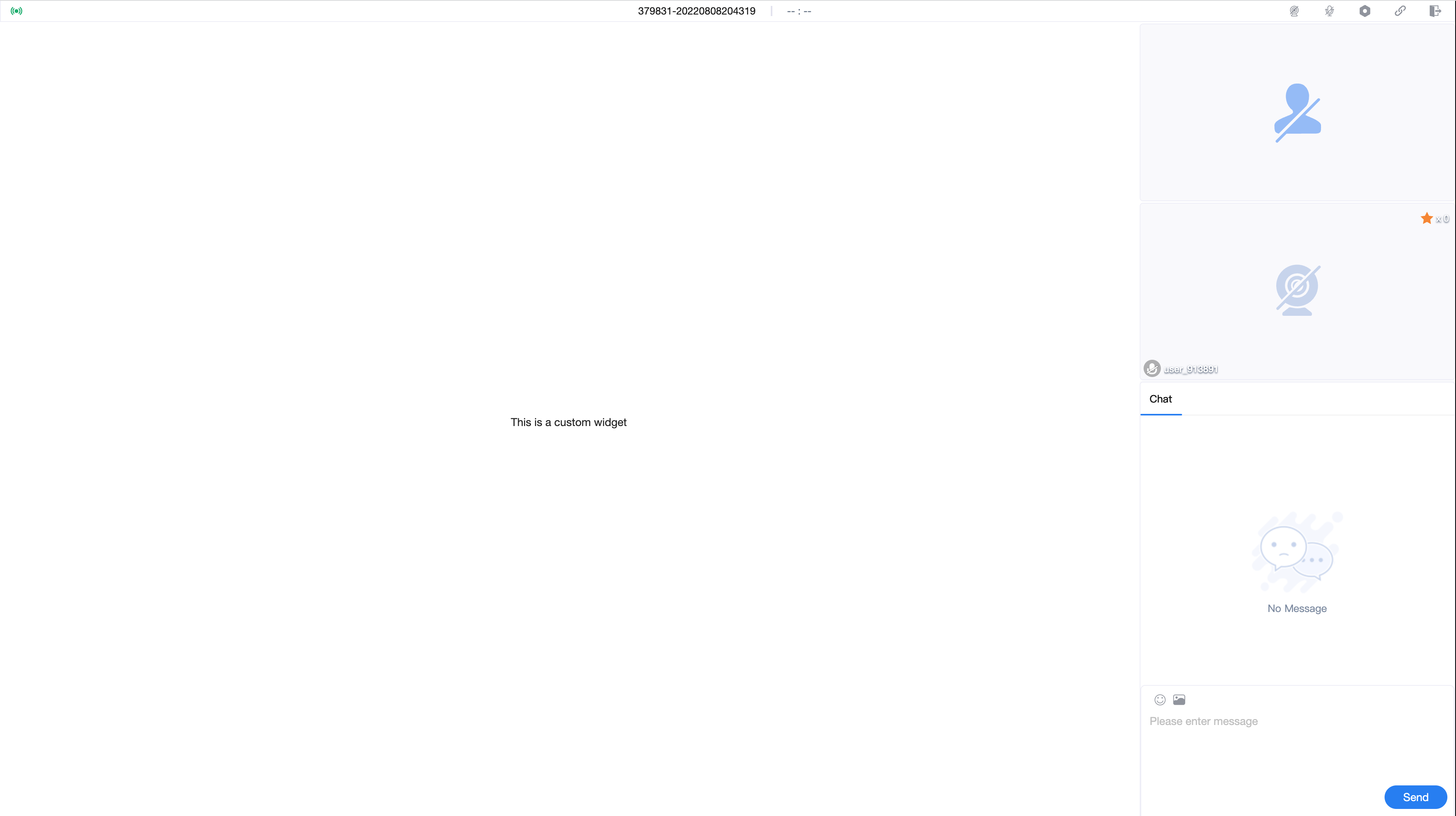
Start the classroom, the effect after the plug-in is mounted is as follows:
## Create a teaching-aid plugin [#create-a-teaching-aid-plugin]
Flexible Classroom provides developers with an abstract class called `AgoraEduToolWidget`. The class implements the encapsulation of the general capabilities of teaching-aid plugins. Inheriting this class gives the plugin track synchronization, hierarchical control capabilities, and control logic for the display of UI windows.
With the `ControlledModal` component, you can also quickly implement the outer window of the built-in teaching-aid plugin, reducing a lot of general logic code development. For specific implementation, please refer to the `answer`, `vote` and `counter` folders in the [Github repository](https://github.com/AgoraIO-Community/apaas-widgets-web/tree/70b0e20d6824533ed36882351629e46da7798ba4/src/gallery), which provide the source code of the built-in teaching-aid plugins in Flexible Classroom.
The following code shows the `AgoraEduToolWidget` class definition:
```javascript
// Use the AgoraEduToolWidget abstract class as the base class to implement draggable and track-synchronized widgets
export abstract class AgoraEduToolWidget
extends AgoraWidgetBase
implements AgoraWidgetLifecycle, AgoraTrackSyncedWidget
{
private _controlStateCallbacks: CallableFunction[] = [];
onUninstall(controller: AgoraWidgetController) {}
onInstall(controller: AgoraWidgetController) {}
onCreate(properties: any, userProperties: any): void {}
onPropertiesUpdate(properties: any): void {}
onUserPropertiesUpdate(userProperties: any): void {}
onDestroy(): void {}
get track(): Track {
return this.trackController?.track!;
}
get zIndex(): number {
return this.trackController?.zIndex || 0;
}
@bound
updateZIndexToRemote(zIndex: number) {
this.trackController?.updateRemoteZIndex(zIndex);
this.widgetController.zIndexController.setZIndex(zIndex);
}
@bound
updateZIndexToLocal(zIndex: number) {
this.trackController?.updateLocalZIndex(zIndex);
this.widgetController.zIndexController.setZIndex(zIndex);
}
get draggable(): boolean {
return true;
}
get resizable(): boolean {
return false;
}
get dragHandleClassName(): string {
return 'modal-title';
}
get dragCancelClassName(): string {
return 'modal-title-close';
}
get boundaryClassName(): string {
return 'widget-slot-board';
}
get minWidth(): number {
return 0;
}
get minHeight(): number {
return 0;
}
get trackMode(): AgoraWidgetTrackMode {
return AgoraWidgetTrackMode.TrackPositionOnly;
}
@bound
updateToRemote(
end: boolean,
pos: Point,
dimensions?: Dimensions | undefined,
options?: TrackOptions | undefined,
): void {
this.trackController?.updateRemoteTrack(end, pos, dimensions, options);
}
@bound
updateToLocal(trackProps: AgoraWidgetTrack): void {
this.trackController?.updateLocalTrack(trackProps);
}
@bound
handleResize({ width, height }: { width: number; height: number }) {
this.track.setRealDimensions({ width, height });
this.track.reposition(false);
}
@bound
handleClose() {
this.widgetController.broadcast(AgoraExtensionWidgetEvent.WidgetBecomeInactive, this.widgetId);
this.deleteWidget();
}
@bound
setVisibility(visible: boolean) {
this.track.setVisibility(visible);
}
get controlled() {
return this.hasPrivilege;
}
addControlStateListener(cb: (controlled: boolean) => void) {
this._controlStateCallbacks.push(cb);
}
removeControlStateListener(cb: (controlled: boolean) => void) {
this._controlStateCallbacks = this._controlStateCallbacks.filter((c) => c !== cb);
}
fireControlStateChanged() {
const controled = this.controlled;
this._controlStateCallbacks.forEach((cb) => {
cb(controled);
});
}
}
```
### Using AgoraEduToolWidget [#using-agoraedutoolwidget]
The following code shows how to create a teaching-aid plugin for pre-class roll calls based on the existing widget capabilities of Flexible Classroom. See the full source code in [rollbook-widget](https://github.com/AgoraIO-Community/flexible-classroom-desktop/).
```javascript
// Create the RollbookWidget class based on the AgoraEduToolWidget class
// packages/agora-plugin-gallery/src/gallery/rollbook/index.tsx
import { render, unmountComponentAtNode } from 'react-dom';
import { App } from './app';
import { AgoraEduToolWidget } from '../../common/edu-tool-widget';
import { observable, action, computed } from 'mobx';
import type { AgoraWidgetController } from 'agora-edu-core';
import { bound } from 'agora-common-libs';
import { AgoraExtensionWidgetEvent } from '../../events';
import { SvgIconEnum } from '../../components/svg-img';
// Roll call:
// Teachers can use this plugin to know the participation of students in the classroom
export class RollbookWidget extends AgoraEduToolWidget {
private _dom?: HTMLElement;
@observable
started = false;
@observable
checkInList: string[] = [];
// Have you checked in?
@computed
get isCheckedIn() {
const { userUuid } = this.classroomConfig.sessionInfo;
return this.checkInList.includes(userUuid);
}
// Check-in username list
@computed
get checkInUserNames() {
return this.checkInList.map((userUuid) => {
// Get the username corresponding to the user ID from the UserStore (this method does not apply to large classes)
const user = this.classroomStore.userStore.studentList.get(userUuid);
return user?.userName || 'Unknown';
});
}
// Initial window width
get minWidth(): number {
return 400;
}
// Initial window height
get minHeight(): number {
return 200;
}
// Globally unique widget name
get widgetName(): string {
return 'rollbook';
}
// Control whether the Widget is controllable
get hasPrivilege(): boolean {
return [1, 3].includes(this.classroomConfig.sessionInfo.role);
}
get checkInPropKey() {
const { userUuid } = this.classroomConfig.sessionInfo;
const key = `checkIn-${userUuid}`;
return key;
}
// The widget node has been mounted, and you can now perform custom rendering on the DOM node.
render(dom: HTMLElement): void {
this._dom = dom;
dom.style.width = '100%';
dom.style.height = '100%';
// Rendering UI components using React
render(, dom);
}
// Uninstall the component and release related resources at this time
unload(): void {
if (this._dom) {
// Uninstall React components
unmountComponentAtNode(this._dom);
}
this._dom = undefined;
}
onCreate(properties: any, userProperties: any): void {
this._handlePropertiesChange(properties);
}
onPropertiesUpdate(properties: any): void {
this._handlePropertiesChange(properties);
}
onInstall(controller: AgoraWidgetController) {
// Register the plug-in entry to the toolbox
controller.broadcast(AgoraExtensionWidgetEvent.RegisterCabinetTool, {
id: this.widgetName,
name: 'Rollbook',
iconType: SvgIconEnum.ANSWER,
});
}
onUninstall(controller: AgoraWidgetController) {
// Remove the plugin entry from the toolbox
controller.broadcast(AgoraExtensionWidgetEvent.UnregisterCabinetTool, this.widgetName);
}
@action
private _handlePropertiesChange(properties: any) {
const list: string[] = [];
Object.keys(properties.extra || {}).forEach((k) => {
if (k.startsWith('checkIn-')) {
const userUuid = k.replace('checkIn-', '');
list.push(userUuid);
}
});
this.checkInList = list;
this.started = !!properties.extra?.started;
}
// Students click to sign in to update the sign-in list
@bound
checkIn() {
this.updateWidgetProperties({
extra: {
// Widgets can be updated incrementally using the Key-Value method
[this.checkInPropKey]: true,
},
});
}
// The teacher clicks to start signing in and updates the Widget status
@bound
startCheckIn() {
this.setActive({ extra: { started: 1 } });
}
}
```
### Add rendering components [#add-rendering-components]
Add an `App` component for rendering in the plugin window:
```javascript
// packages/agora-plugin-gallery/src/gallery/rollbook/app.tsx
import React, { FC } from 'react';
import { observer } from 'mobx-react';
import { ControlledModal } from '../../common/edu-tool-modal';
import { EduRoleTypeEnum } from 'agora-edu-core';
import { RollbookWidget } from '.';
import { Button } from '../../components/button';
// Roll roster component
const view = () =>
[EduRoleTypeEnum.teacher, EduRoleTypeEnum.assistant].includes(
widget.classroomConfig.sessionInfo.role,
) ? (
) : (
);
return (
{}}
canRefresh={false}
widget={widget}
title="Rollbook"
onCancel={widget.handleClose}>
{view()}
);
};
// The teacher interface shows the actual check-in list
const started = widget.started;
return (
);
});
```
### Pass in the custom widget in `launch` [#pass-in-the-custom-widget-in-launch-1]
Use the following code to pass in your custom widget through the `widgets` parameter in `launch`:
```javascript
const widgets = {
// Need to import the RollbookWidget class defined above
'rollbook': RollbookWidget
};
AgoraEduSDK.launch(dom, {
...
widgets: widgets
...
});
```
### Test your implementation [#test-your-implementation-1]
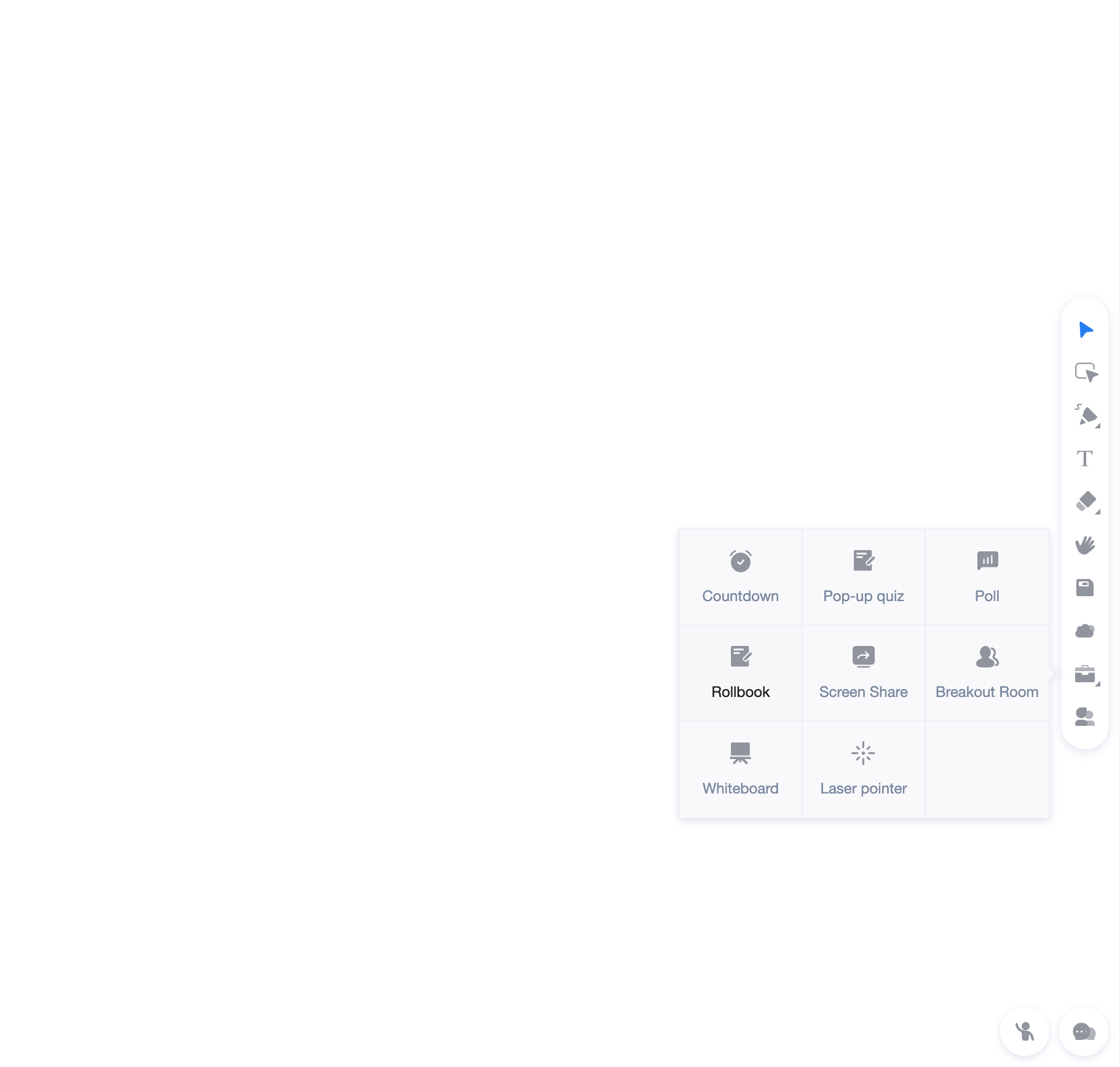
Start the classroom, you see this plugin in the toolbox as shown in the figure:
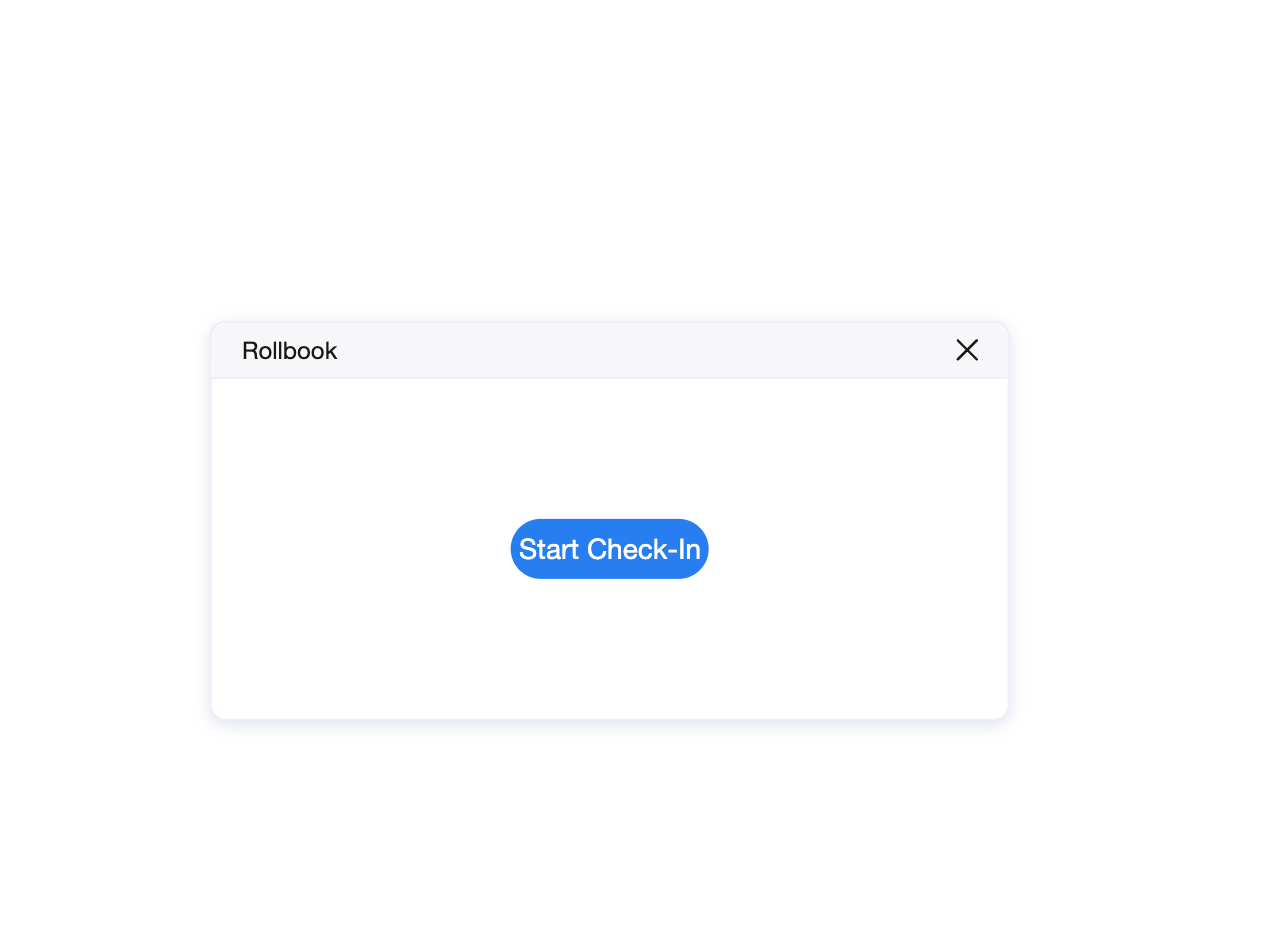
The teacher clicks and opens the interface effect of the plugin:
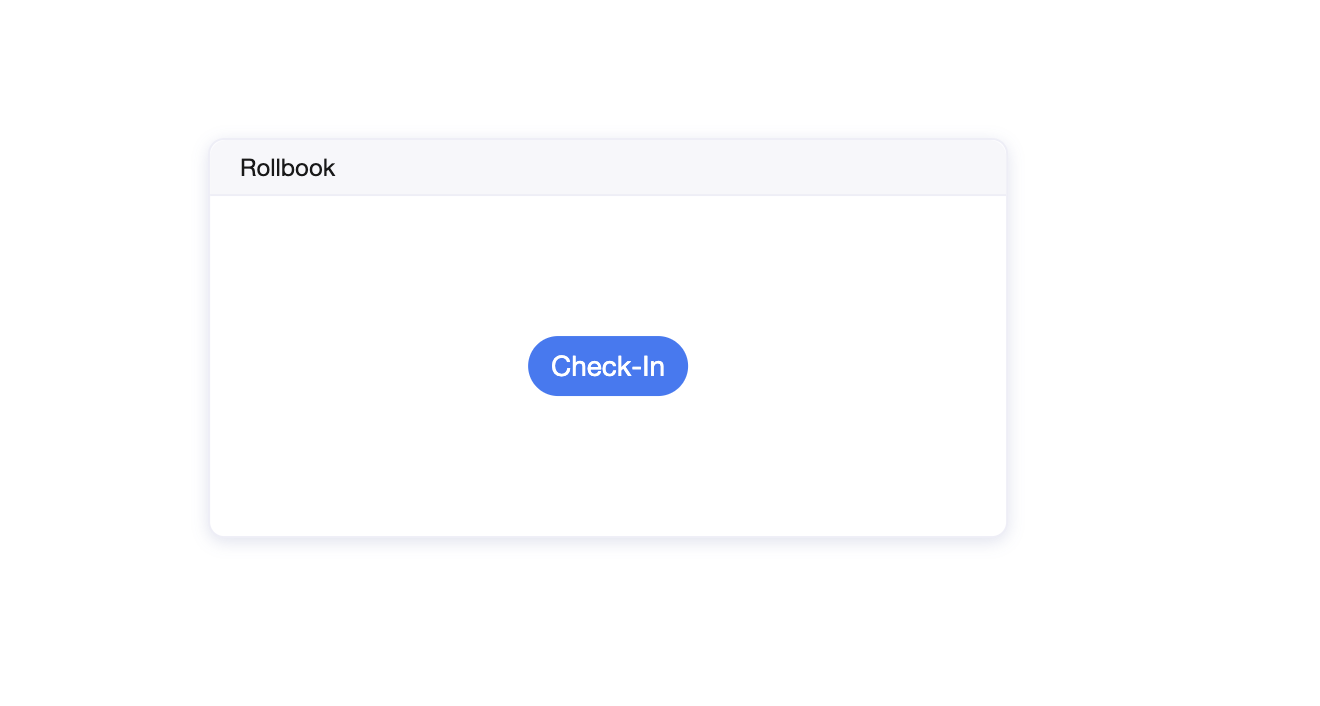
After the teacher clicks Start Check-In, the effect of the plugin is displayed on the student side:
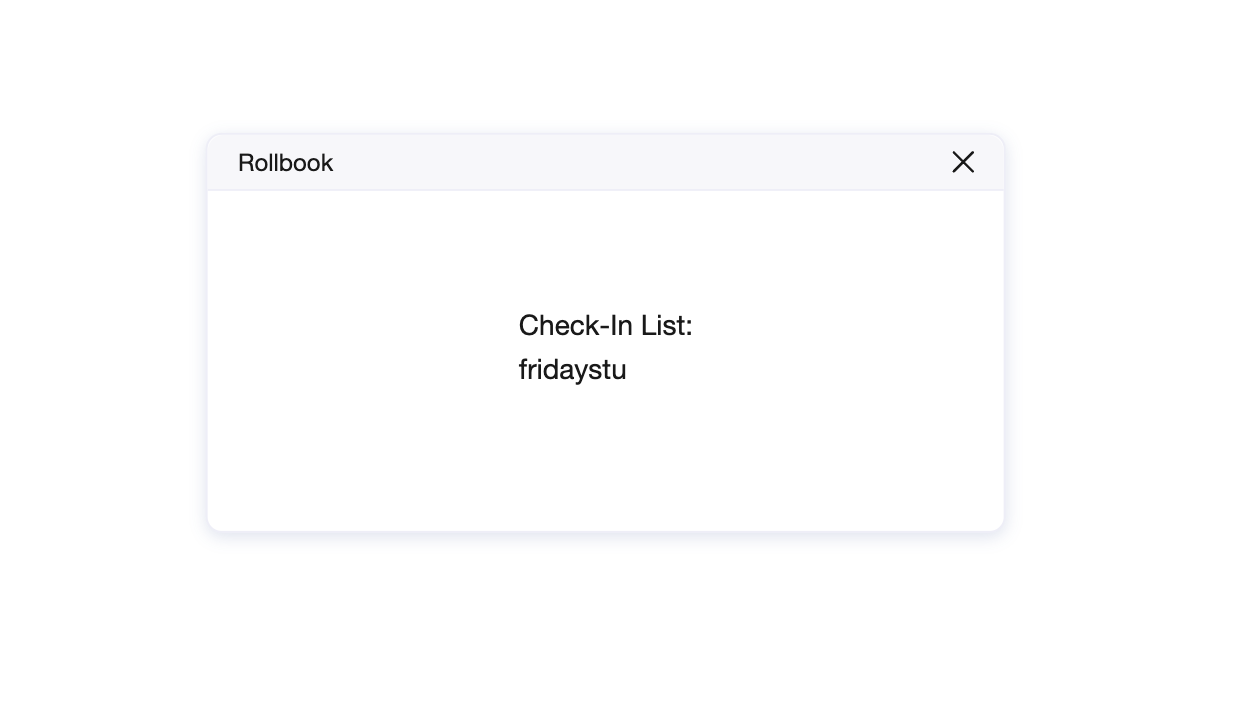
After the student clicks Check-In, the teacher's check-in list displays the student's effect: