# Deploy a token server (/en/realtime-media/cloud-recording/build/set-up-authentication/authentication-workflow)
> For AI agents: see the complete documentation index at [llms.txt](/llms.txt).
To ensure the security of your business, best practice is to authenticate every client that joins a channel. Agora uses digital tokens to authenticate users and their privileges. When a user attempts to connect to Agora, they provide a token obtained from a token server. The Agora SDRTN® validates the user's identity and permissions based on the information in the token.
To generate authentication tokens, deploy a token server within your security infrastructure. This guide explains how to set up a token server using Agora's open source code repository.
## Understand the tech [#understand-the-tech]
An authentication token is a dynamic key that is valid for a maximum of 24 hours. On request, your token server returns an authentication token that is valid to join a specific channel or a set of wildcard channels.
The following figure shows the call flow you implement to create step-up-authentication with Agora Cloud Recording:
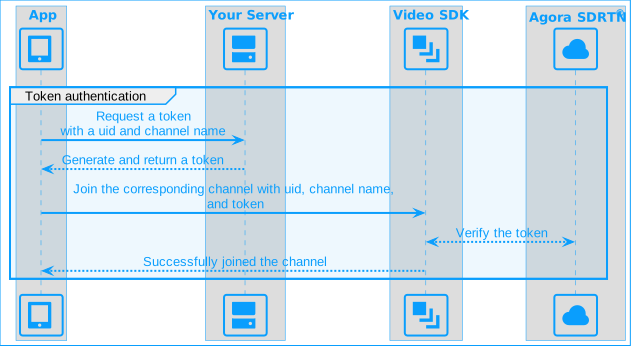
Your app retrieves a token from the token server when a user attempts to connect to an Agora channel. The app then sends this token to Agora SDRTN® for authentication. Agora SDRTN® reads the information stored in the token to validate the request.
Agora enables you to implement permissions with the following strategies. Select the one that best suits your use-case:
* **Uniform permissions**
Uniformly set permissions for joining channels and concurrent streams. This is applicable to most use-cases. For details, see [Basic authentication](#basic-authentication).
* **Finely control permissions for publishing different streams**
Manage permissions to publish different types of streams, such as audio, video, and data. If you have higher requirements for business security, use these permissions to finely control the validity period of permissions to publish different streams. For details, see [Co-host token authentication](#co-host-token-authentication).
Information
The information on this page only applies to `AccessToken2`. If you are still using `AccessToken`, refer to the [AccessToken upgrade guide](./integrate-token-generation#upgrade-to-accesstoken2) to upgrade from `AccessToken` to `AccessToken2`.
## Token generation code [#token-generation-code]
Agora provides an open source token generator code repository on [GitHub](https://github.com/AgoraIO/Tools/tree/master/DynamicKey/AgoraDynamicKey). The repository provides code in the following languages to generate tokens on your own server using the `HMAC-SHA256` algorithm:
| Language | Core Method | Sample Code |
| :------- | :------------------------------------------------------------------------------------------------------------------------------------------------------- | :-------------------------------------------------------------------------------------------------------------------------------------------------------------------- |
| Golang | [BuildTokenWithUid](https://github.com/AgoraIO/Tools/blob/master/DynamicKey/AgoraDynamicKey/go/src/rtctokenbuilder2/rtctokenbuilder.go#L24) | [sample.go](https://github.com/AgoraIO/Tools/tree/master/DynamicKey/AgoraDynamicKey/go/sample/rtctokenbuilder2/sample.go) |
| Node.js | [buildTokenWithUid](https://github.com/AgoraIO/Tools/blob/master/DynamicKey/AgoraDynamicKey/nodejs/src/RtcTokenBuilder2.js#L43) | [RtcTokenBuilder2Sample.js](https://github.com/AgoraIO/Tools/tree/master/DynamicKey/AgoraDynamicKey/nodejs/sample/RtcTokenBuilder2Sample.js) |
| PHP | [buildTokenWithUid](https://github.com/AgoraIO/Tools/blob/master/DynamicKey/AgoraDynamicKey/php/src/RtcTokenBuilder2.php#L40) | [RtcTokenBuilder2Sample.php](https://github.com/AgoraIO/Tools/tree/master/DynamicKey/AgoraDynamicKey/php/sample/RtcTokenBuilder2Sample.php) |
| Python | [build\_token\_with\_uid](https://github.com/AgoraIO/Tools/blob/master/DynamicKey/AgoraDynamicKey/python/src/RtcTokenBuilder2.py#L21) | [RtcTokenBuilder2Sample.py](https://github.com/AgoraIO/Tools/tree/master/DynamicKey/AgoraDynamicKey/python/sample/RtcTokenBuilder2Sample.py) |
| Python3 | [build\_token\_with\_uid](https://github.com/AgoraIO/Tools/blob/master/DynamicKey/AgoraDynamicKey/python3/src/RtcTokenBuilder2.py#L22) | [RtcTokenBuilder2Sample.py](https://github.com/AgoraIO/Tools/tree/master/DynamicKey/AgoraDynamicKey/python3/sample/RtcTokenBuilder2Sample.py) |
| Java | [buildTokenWithUid](https://github.com/AgoraIO/Tools/blob/master/DynamicKey/AgoraDynamicKey/java/src/main/java/io/agora/media/RtcTokenBuilder2.java#L47) | [RtcTokenBuilder2Sample.java](https://github.com/AgoraIO/Tools/tree/master/DynamicKey/AgoraDynamicKey/java/src/main/java/io/agora/sample/RtcTokenBuilder2Sample.java) |
| C++ | [buildTokenWithUid](https://github.com/AgoraIO/Tools/blob/master/DynamicKey/AgoraDynamicKey/cpp/src/RtcTokenBuilder2.h#L70) | [RtcTokenBuilder2Sample.cpp](https://github.com/AgoraIO/Tools/tree/master/DynamicKey/AgoraDynamicKey/cpp/sample/RtcTokenBuilder2Sample.cpp) |
### Basic authentication [#basic-authentication]
Refer to the following code samples to generate a token with basic permissions:
Golang
Node.js
PHP
Python/Python3
Java
C++
```go
package main
"fmt"
"os"
rtctokenbuilder "github.com/AgoraIO/Tools/DynamicKey/AgoraDynamicKey/go/src/rtctokenbuilder2"
)
func main() {
// Get the value of the environment variable AGORA_APP_ID. Make sure you set this variable to the App ID you obtained from Agora console.
appId := os.Getenv("AGORA_APP_ID")
// Get the value of the environment variable AGORA_APP_CERTIFICATE. Make sure you set this variable to the App certificate you obtained from Agora console
appCertificate := os.Getenv("AGORA_APP_CERTIFICATE")
// Replace channelName with the name of the channel you want to join
channelName := "channelName"
// Fill in your actual user ID
uid := uint32(2882341273)
// Token validity time in seconds
tokenExpirationInSeconds := uint32(3600)
// The validity time of all permissions in seconds
privilegeExpirationInSeconds := uint32(3600)
fmt.Println("App Id:", appId)
fmt.Println("App Certificate:", appCertificate)
if appId == "" || appCertificate == "" {
fmt.Println("Need to set environment variable AGORA_APP_ID and AGORA_APP_CERTIFICATE")
return
}
// Generate Token
result, err := rtctokenbuilder.BuildTokenWithUid(appId, appCertificate, channelName, uid, rtctokenbuilder.RoleSubscriber, tokenExpirationInSeconds, privilegeExpirationInSeconds)
if err != nil {
fmt.Println(err)
} else {
fmt.Printf("Token with int uid: %s\\n", result)
}
}
```
```js
const RtcTokenBuilder = require("../src/RtcTokenBuilder2").RtcTokenBuilder;
const RtcRole = require("../src/RtcTokenBuilder2").Role;
// Get the value of the environment variable AGORA_APP_ID. Make sure you set this variable to the App ID you obtained from Agora console.
const appId = process.env.AGORA_APP_ID;
// Get the value of the environment variable AGORA_APP_CERTIFICATE. Make sure you set this variable to the App certificate you obtained from Agora console
const appCertificate = process.env.AGORA_APP_CERTIFICATE;
// Replace channelName with the name of the channel you want to join
const channelName = "channelName";
// Fill in your actual user ID
const uid = 2882341273;
// Set streaming permissions
const role = RtcRole.PUBLISHER;
// Token validity time in seconds
const tokenExpirationInSecond = 3600;
// The validity time of all permissions in seconds
const privilegeExpirationInSecond = 3600;
console.log("App Id:", appId);
console.log("App Certificate:", appCertificate);
if (appId == undefined || appId == "" || appCertificate == undefined || appCertificate == "") {
console.log("Need to set environment variable AGORA_APP_ID and AGORA_APP_CERTIFICATE");
process.exit(1);
}
// Generate Token
const tokenWithUid = RtcTokenBuilder.buildTokenWithUid(appId, appCertificate, channelName, uid, role, tokenExpirationInSecond, privilegeExpirationInSecond);
console.log("Token with int uid:", tokenWithUid);
```
```js
```python
import os
sys.path.insert(0, os.path.abspath(os.path.join(os.path.dirname(__file__), '..')))
from src.RtcTokenBuilder2 import *
def main():
# Get the value of the environment variable AGORA_APP_ID. Make sure you set this variable to the App ID you obtained from Agora console.
app_id = os.environ.get("AGORA_APP_ID")
# Get the value of the environment variable AGORA_APP_CERTIFICATE. Make sure you set this variable to the App certificate you obtained from Agora console
app_certificate = os.environ.get("AGORA_APP_CERTIFICATE")
# Replace channelName with the name of the channel you want to join
channel_name = "channel_name"
# Fill in your actual user ID
uid = 2882341273
# Token validity time in seconds
token_expiration_in_seconds = 3600
# The validity time of all permissions in seconds
privilege_expiration_in_seconds = 3600
print("App Id: %s" % app_id)
print("App Certificate: %s" % app_certificate)
if not app_id or not app_certificate:
print("Need to set environment variable AGORA_APP_ID and AGORA_APP_CERTIFICATE")
return
# Generate Token
token = RtcTokenBuilder.build_token_with_uid(app_id, app_certificate, channel_name, uid, Role_Subscriber,
token_expiration_in_seconds, privilege_expiration_in_seconds)
print("Token with int uid: {}".format(token))
if __name__ == "__main__":
main()
```
```java
package io.agora.sample;
public class RtcTokenBuilder2Sample {
// Get the value of the environment variable AGORA_APP_ID. Make sure you set this variable to the App ID you obtained from Agora console.
static String appId = System.getenv("AGORA_APP_ID");
// Get the value of the environment variable AGORA_APP_CERTIFICATE. Make sure you set this variable to the App certificate you obtained from Agora console
static String appCertificate = System.getenv("AGORA_APP_CERTIFICATE");
// Replace channelName with the name of the channel you want to join
static String channelName = "channelName";
// Fill in your actual user ID
static int uid = 2082341273;
// Token validity time in seconds
static int tokenExpirationInSeconds = 3600;
// The validity time of all permissions in seconds
static int privilegeExpirationInSeconds = 3600;
public static void main(String[] args) {
System.out.printf("App Id: %s\\n", appId);
System.out.printf("App Certificate: %s\\n", appCertificate);
if (appId == null || appId.isEmpty() || appCertificate == null || appCertificate.isEmpty()) {
System.out.printf("Need to set environment variable AGORA_APP_ID and AGORA_APP_CERTIFICATE\\n");
return;
}
// Generate Token
RtcTokenBuilder2 token = new RtcTokenBuilder2();
String result = token.buildTokenWithUid(appId, appCertificate, channelName, uid, Role.ROLE_SUBSCRIBER,
tokenExpirationInSeconds, privilegeExpirationInSeconds);
System.out.printf("Token with uid: %s\\n", result);
}
}
```
```cpp
#include
#include
#include "../src/RtcTokenBuilder2.h"
using namespace agora::tools;
int main(int argc, char const *argv[]) {
(void)argc;
(void)argv;
// Get the value of the environment variable AGORA_APP_ID. Make sure you set this variable to the value you obtained from Agora console
const char *env_app_id = getenv("AGORA_APP_ID");
std::string app_id = env_app_id ? env_app_id : "";
// Get the value of the environment variable AGORA_APP_CERTIFICATE. Make sure you set this variable to the App certificate you obtained from Agora console
const char *env_app_certificate = getenv("AGORA_APP_CERTIFICATE");
std::string app_certificate = env_app_certificate ? env_app_certificate : "";
// Replace channelName with the name of the channel you want to join
std::string channel_name = "channelName";
// Fill in your actual user ID
uint32_t uid = 2882341273
// Token validity time in seconds
uint32_t token_expiration_in_seconds = 3600;
// The validity time of all permissions in seconds
uint32_t privilege_expiration_in_seconds = 3600;
std::string result;
std::cout << "App Id:" << app_id << std::endl;
std::cout << "App Certificate:" << app_certificate << std::endl;
if (app_id == "" || app_certificate == "") {
std::cout << "Need to set environment variable AGORA_APP_ID and "
"AGORA_APP_CERTIFICATE"
<< std::endl;
return -1;
}
// Generate Token
result = RtcTokenBuilder2::BuildTokenWithUid(
app_id, app_certificate, channel_name, uid, UserRole::kRolePublisher,
token_expiration_in_seconds, privilege_expiration_in_seconds);
std::cout << "Token With Int Uid:" << result << std::endl;
return 0;
}
```
Information
The code samples presented on this page use an integer user ID to generate a token. To use a string user ID, refer to the [Token Generator code repository](https://github.com/AgoraIO/Tools/tree/master/DynamicKey/AgoraDynamicKey) to view the corresponding code sample in the desired language.
### Advanced authentication features [#advanced-authentication-features]
This section presents advanced functions related to token authentication.
* [Wildcard tokens](#generate-wildcard-tokens): Allow users to join multiple channels or switch channels without frequently requesting new tokens.
* [Co-host token authentication](#co-host-token-authentication): Enable fine-grained control to ensure only authorized users can publish streams.
#### Generate wildcard tokens [#generate-wildcard-tokens]
In use-cases where users need to join multiple channels, or frequently switch between channels, they need to request a new token from the token server, each time they join a channel. To solve the problem of frequently requesting tokens when switching channels, Agora enables you to generate wildcard tokens that set the user ID or channel name as a wildcard. Users reuse the same wildcard token to join different channels, which speeds up the process of switching and joining channels. It also helps reduce the pressure on your token server.
Information
To generate wildcard tokens, deploy an `AccessToken2` server. If you are still using `AccessToken`, see the [AccessToken upgrade guide](./integrate-token-generation#upgrade-to-accesstoken2) to upgrade to `AccessToken2`.
The `AccessToken2` code provides two `BuildTokenWithUid` methods. Choose the method according to your needs. When generating a wildcard token, fill in the following parameters according to your requirements:
| Token type | `uid` | `channelName` |
| :------------------------------ | :------------------------------------------------------------------------------------------------------------------------------------------------------------------------------------------------------------------------------------------------------------------------------------------------------------------------------------------------ | :------------------------------------------------------------------------------------------------------------------------------------------------------------------------------------------------------------------------------------------------------------------ |
| Token for wildcard user ID | Set the user ID to `0` or a wildcard `*` to match any length of characters for user IDs of int and string types. Agora also supports extended matching, that is, matching multiple combinations of `*` and strings. For example, `1*a*2` means match user IDs starting with *1*, containing the letter *a*, and ending with *2*, such as *1abc2*. | A string of up to 64 bytes. |
| Token for wildcard channel name | The user ID of the user to be authenticated. User IDs of type int and string are supported. | Set the channel name as a wildcard `*` or leave it blank. To employ expanded matching, use multiple combinations of `*` and strings. For example, `1*a*2` matches channel names starting with *1*, containing the letter *a*, and ending with *2*, such as *1abc2*. |
#### Precautions [#precautions]
* If you have generated a token for `uid=0`, consider the following when you use the token:
* If you only need to join a single channel, set the `uid` to `0` when calling `joinChannel`.
* If you need to join multiple channels, set `uid` to a specific user ID instead of `0` when calling `joinChannelEx`.
* In order to prevent unauthorized users from disrupting the order of the channel if the token is leaked, best practice is that users who use wildcard tokens set their client role as audience, and their token privilege `role` to `kRoleSubscriber`.
If viewers using wildcard tokens need to publish streams, Agora recommends the following steps to update the token.
The following API uses C++ as an example:
1. Call `setClientRole` to set the user role as **Broadcaster**.
2. When generating a token using `BuildTokenWithUid`, specify the channel name and user ID in the method, and set the token privilege `role` to `kRolePublisher`, thereby generating a token with the permission to send streams.
3. Call `renewToken` to update the token.
A wildcard token is valid for 24 hours. If the token is about to expire, regenerate a new wildcard token on the server and then call `renewToken` to pass in the new wildcard token.
#### Co-host token authentication [#co-host-token-authentication]
In addition to basic authentication, Agora also provides fine-grained control over the permissions of users in a channel to publish different types of streams. Co-host token authentication helps you ensure that only the streaming users in a channel are authorized to publish streams, thus preventing hackers from stealing tokens or exploiting vulnerabilities to blow up a live broadcast channel.
Note
* Before using advanced authentication features, ensure that you have enabled [Co-host token authentication](/help/integration-issues/token_cohost#enable-co-host-authentication) in Agora Console.
* To send a stream to a channel, ensure that the client role is set to **Broadcaster** either at the time of joining the channel, or after joining a channel by calling `setClientRole`.
Agora provides `BuildTokenWithUidAndPrivilege` methods to set the expiration time of the following privileges:
* Join a channel
* Publish audio stream in a channel
* Publish video stream in a channel
* Publish data stream in a channel
See the [API reference](#api-reference) for detailed parameter descriptions.
#### Generate a token with advanced permissions [#generate-a-token-with-advanced-permissions]
Use the following methods from the token generation [Github repository](https://github.com/AgoraIO/Tools/tree/master/DynamicKey/AgoraDynamicKey) to generate tokens with advanced permissions:
| Language | Core Method | Sample Code |
| :------- | :-------------------------------------------------------------------------------------------------------------------------------------------------------- | :-------------------------------------------------------------------------------------------------------------------------------------------------------------------- |
| Golang | [BuildTokenWithUidAndPrivilege](https://github.com/AgoraIO/Tools/blob/master/DynamicKey/AgoraDynamicKey/go/src/rtctokenbuilder2/rtctokenbuilder.go#L122) | [sample.go](https://github.com/AgoraIO/Tools/tree/master/DynamicKey/AgoraDynamicKey/go/sample/rtctokenbuilder2/sample.go) |
| Node.js | [BuildTokenWithUidAndPrivilege](https://github.com/AgoraIO/Tools/blob/master/DynamicKey/AgoraDynamicKey/nodejs/src/RtcTokenBuilder2.js#L142) | [RtcTokenBuilder2Sample.js](https://github.com/AgoraIO/Tools/tree/master/DynamicKey/AgoraDynamicKey/nodejs/sample/RtcTokenBuilder2Sample.js) |
| PHP | [BuildTokenWithUidAndPrivilege](https://github.com/AgoraIO/Tools/blob/master/DynamicKey/AgoraDynamicKey/php/src/RtcTokenBuilder2.php#L122) | [RtcTokenBuilder2Sample.php](https://github.com/AgoraIO/Tools/tree/master/DynamicKey/AgoraDynamicKey/php/sample/RtcTokenBuilder2Sample.php) |
| Python | [build\_token\_with\_uid\_and\_privilege](https://github.com/AgoraIO/Tools/blob/master/DynamicKey/AgoraDynamicKey/python/src/RtcTokenBuilder2.py#L76) | [RtcTokenBuilder2Sample.py](https://github.com/AgoraIO/Tools/tree/master/DynamicKey/AgoraDynamicKey/python/sample/RtcTokenBuilder2Sample.py) |
| Python3 | [build\_token\_with\_uid\_and\_privilege](https://github.com/AgoraIO/Tools/blob/master/DynamicKey/AgoraDynamicKey/python3/src/RtcTokenBuilder2.py#L75) | [RtcTokenBuilder2Sample.py](https://github.com/AgoraIO/Tools/tree/master/DynamicKey/AgoraDynamicKey/python3/sample/RtcTokenBuilder2Sample.py) |
| Java | [buildTokenWithUid](https://github.com/AgoraIO/Tools/blob/master/DynamicKey/AgoraDynamicKey/java/src/main/java/io/agora/media/RtcTokenBuilder2.java#L135) | [RtcTokenBuilder2Sample.java](https://github.com/AgoraIO/Tools/tree/master/DynamicKey/AgoraDynamicKey/java/src/main/java/io/agora/sample/RtcTokenBuilder2Sample.java) |
| C++ | [buildTokenWithUid](https://github.com/AgoraIO/Tools/blob/master/DynamicKey/AgoraDynamicKey/cpp/src/RtcTokenBuilder2.h#L172) | [RtcTokenBuilder2Sample.cpp](https://github.com/AgoraIO/Tools/tree/master/DynamicKey/AgoraDynamicKey/cpp/sample/RtcTokenBuilder2Sample.cpp) |
Refer to the following code samples to generate a token with advanced permissions:
Golang
Node.js
PHP
Python/Python3
Java
C++
```go
package main
"fmt"
"os"
rtctokenbuilder "github.com/AgoraIO/Tools/DynamicKey/AgoraDynamicKey/go/src/rtctokenbuilder2"
)
func main() {
// Get the value of the environment variable AGORA_APP_ID. Make sure you set this variable to the value you obtained from Agora console
appId := os.Getenv("AGORA_APP_ID")
// Get the value of the environment variable AGORA_APP_CERTIFICATE. Make sure you set this variable to the App certificate you obtained from Agora console
appCertificate := os.Getenv("AGORA_APP_CERTIFICATE")
// Replace channelName with the name of the channel you want to join
channelName := "channelName"
// Fill in your actual user ID
uid := uint32(2882341273)
// Token validity time in seconds
tokenExpirationInSeconds := uint32(3600)
// Validity time for permission to join a channel (seconds)
joinChannelPrivilegeExpireInSeconds := uint32(3600)
// Validity in seconds for the permission to publish audio streams in the channel
pubAudioPrivilegeExpireInSeconds := uint32(3600)
// Validity in seconds for the permission to publish video streams in the channel
pubVideoPrivilegeExpireInSeconds := uint32(3600)
// Validity in seconds for the permission to publish data streams in the channel
pubDataStreamPrivilegeExpireInSeconds := uint32(3600)
fmt.Println("App Id:", appId)
fmt.Println("App Certificate:", appCertificate)
if appId == "" || appCertificate == "" {
fmt.Println("Need to set environment variable AGORA_APP_ID and AGORA_APP_CERTIFICATE")
return
}
// Generate Token
result, err := rtctokenbuilder.BuildTokenWithUidAndPrivilege(
appId,
appCertificate,
channelName,
uid,
tokenExpirationInSeconds,
joinChannelPrivilegeExpireInSeconds,
pubAudioPrivilegeExpireInSeconds,
pubVideoPrivilegeExpireInSeconds,
pubDataStreamPrivilegeExpireInSeconds,
)
if err != nil {
fmt.Println(err)
} else {
fmt.Printf("Token with int uid and privilege: %s\\n", result)
}
}
```
```js
const RtcTokenBuilder = require("../src/RtcTokenBuilder2").RtcTokenBuilder;
// Get the value of the environment variable AGORA_APP_ID. Make sure you set this variable to the value you obtained from Agora console
const appId = process.env.AGORA_APP_ID;
// Get the value of the environment variable AGORA_APP_CERTIFICATE. Make sure you set this variable to the App certificate you obtained from Agora console
const appCertificate = process.env.AGORA_APP_CERTIFICATE;
// Replace channelName with the name of the channel you want to join
const channelName = "channelName";
// Fill in your actual user ID
const uid = 2082341273;
// Token validity time in seconds
const tokenExpirationInSecond = 3600;
// Validity time for permission to join a channel (seconds)
const joinChannelPrivilegeExpireInSeconds = 3600;
// Validity in seconds for the permission to publish audio streams in the channel
const pubAudioPrivilegeExpireInSeconds = 3600;
// Validity in seconds for the permission to publish video streams in the channel
const pubVideoPrivilegeExpireInSeconds = 3600;
// Validity in seconds for the permission to publish data streams in the channel
const pubDataStreamPrivilegeExpireInSeconds = 3600;
console.log("App Id:", appId);
console.log("App Certificate:", appCertificate);
if (appId == undefined || appId == "" || appCertificate == undefined || appCertificate == "") {
console.log("Need to set environment variable AGORA_APP_ID and AGORA_APP_CERTIFICATE");
process.exit(1);
}
// Generate Token
const tokenWithUidAndPrivilege = RtcTokenBuilder.buildTokenWithUidAndPrivilege(
appId,
appCertificate,
channelName,
uid,
tokenExpirationInSecond,
joinChannelPrivilegeExpireInSeconds,
pubAudioPrivilegeExpireInSeconds,
pubVideoPrivilegeExpireInSeconds,
pubDataStreamPrivilegeExpireInSeconds
);
console.log("Token with int uid and privilege:", tokenWithUidAndPrivilege);
```
```js
```python
import os
sys.path.insert(0, os.path.abspath(os.path.join(os.path.dirname(__file__), '..')))
from src.RtcTokenBuilder2 import *
def main():
# Get the value of the environment variable AGORA_APP_ID. Make sure you set this variable to the value you obtained from Agora console
app_id = os.environ.get("AGORA_APP_ID")
# Get the value of the environment variable AGORA_APP_CERTIFICATE. Make sure you set this variable to the App certificate you obtained from Agora console
app_certificate = os.environ.get("AGORA_APP_CERTIFICATE")
# Replace channel_name with the name of the channel to join
channel_name = "channel_name"
# Fill in your actual user ID
uid = 2882341273
# Token validity time in seconds
token_expiration_in_seconds = 3600
# Validity time for permission to join a channel (seconds)
join_channel_privilege_expiration_in_seconds = 3600
# Validity in seconds for the permission to publish audio streams in the channel
pub_audio_privilege_expiration_in_seconds = 3600
# Validity in seconds for the permission to publish video streams in the channel
pub_video_privilege_expiration_in_seconds = 3600
# Validity in seconds for the permission to publish data streams in the channel
pub_data_stream_privilege_expiration_in_seconds = 3600
print("App Id: %s" % app_id)
print("App Certificate: %s" % app_certificate)
if not app_id or not app_certificate:
print("Need to set environment variable AGORA_APP_ID and AGORA_APP_CERTIFICATE")
return
# Generate Token
token = RtcTokenBuilder.build_token_with_uid_and_privilege(
app_id, app_certificate, channel_name, uid, token_expiration_in_seconds,
join_channel_privilege_expiration_in_seconds, pub_audio_privilege_expiration_in_seconds, pub_video_privilege_expiration_in_seconds, pub_data_stream_privilege_expiration_in_seconds)
print("Token with int uid and privilege: {}".format(token))
if __name__ == "__main__":
main()
```
```java
package io.agora.sample;
public class RtcTokenBuilder2Sample {
// Get the value of the environment variable AGORA_APP_ID. Make sure you set this variable to the value you obtained from Agora console
static String appId = System.getenv("AGORA_APP_ID");
// Get the value of the environment variable AGORA_APP_CERTIFICATE. Make sure you set this variable to the App certificate you obtained from Agora console
static String appCertificate = System.getenv("AGORA_APP_CERTIFICATE");
// Replace channelName with the name of the channel you want to join
static String channelName = "channelName";
// Fill in your actual user ID
static int uid = 2082341273;
// Token validity time in seconds
static int tokenExpirationInSeconds = 3600;
// Validity time for permission to join a channel (seconds)
static int joinChannelPrivilegeExpireInSeconds = 3600;
// Validity in seconds for the permission to publish audio streams in the channel
static int pubAudioPrivilegeExpireInSeconds = 3600;
// Validity in seconds for the permission to publish video streams in the channel
static int pubVideoPrivilegeExpireInSeconds = 3600;
// Validity in seconds for the permission to publish data streams in the channel
static int pubDataStreamPrivilegeExpireInSeconds = 3600;
public static void main(String[] args) {
System.out.printf("App Id: %s\\n", appId);
System.out.printf("App Certificate: %s\\n", appCertificate);
if (appId == null || appId.isEmpty() || appCertificate == null || appCertificate.isEmpty()) {
System.out.printf("Need to set environment variable AGORA_APP_ID and AGORA_APP_CERTIFICATE\\n");
return;
}
// Generate Token
result = token.buildTokenWithUid(appId, appCertificate, channelName, uid, tokenExpirationInSeconds,
joinChannelPrivilegeExpireInSeconds, pubAudioPrivilegeExpireInSeconds,
pubVideoPrivilegeExpireInSeconds,
pubDataStreamPrivilegeExpireInSeconds);
System.out.printf("Token with uid and privilege: %s\\n", result);
}
}
```
```cpp
#include
#include
#include "../src/RtcTokenBuilder2.h"
using namespace agora::tools;
int main(int argc, char const *argv[]) {
(void)argc;
(void)argv;
// Get the value of the environment variable AGORA_APP_ID. Make sure you set this variable to the value you obtained from Agora console
const char *env_app_id = getenv("AGORA_APP_ID");
std::string app_id = env_app_id ? env_app_id : "";
// Get the value of the environment variable AGORA_APP_CERTIFICATE. Make sure you set this variable to the App certificate you obtained from Agora console
const char *env_app_certificate = getenv("AGORA_APP_CERTIFICATE");
std::string app_certificate = env_app_certificate ? env_app_certificate : "";
// Replace channelName with the name of the channel you want to join
std::string channel_name = "channelName";
// Fill in your actual user ID
uint32_t uid = 2882341273;
// Token validity period (seconds)
uint32_t token_expiration_in_seconds = 3600;
// Validity time of permission to join channel (seconds)
uint32_t join_channel_privilege_expiration_in_seconds = 3600;
// The validity period of the permission to publish audio streams in the channel (seconds)
uint32_t pub_audio_privilege_expiration_in_seconds = 3600;
// The validity period of the permission to publish video streams in the channel (seconds)
uint32_t pub_video_privilege_expiration_in_seconds = 3600;
// The validity period of the permission to publish data streams in the channel (seconds)
uint32_t pub_data_stream_privilege_expiration_in_seconds = 3600;
std::string result;
std::cout << "App Id:" << app_id << std::endl;
std::cout << "App Certificate:" << app_certificate << std::endl;
if (app_id == "" || app_certificate == "") {
std::cout << "Need to set environment variable AGORA_APP_ID and "
"AGORA_APP_CERTIFICATE"
<< std::endl;
return -1;
}
// Generate Token
result = RtcTokenBuilder2::BuildTokenWithUid(
app_id, app_certificate, channel_name, uid, token_expiration_in_seconds,
join_channel_privilege_expiration_in_seconds,
pub_audio_privilege_expiration_in_seconds,
pub_video_privilege_expiration_in_seconds,
pub_data_stream_privilege_expiration_in_seconds);
std::cout << "Token With Int Uid:" << result << std::endl;
return 0;
}
```
## Deploy a token server [#deploy-a-token-server]
This section presents multiple methods of deploying a token generator locally. After successful deployment, you can use the generated tokens to test and debug your Cloud Recording project.
### Use the NPM package [#use-the-npm-package]
The [`agora-token`](https://www.npmjs.com/package/agora-token) NPM package provides a library for generating tokens and includes code for a demo server that handles token generation requests. Follow these steps to install the package and run the demo server:
1. Install the NPM package
```bash
npm install agora-token
```
2. Add your App ID and App certificate
Open the file `node_modules/agora-token/server/DemoServer.js` and update the following variables:
```js
// Replace with your Agora credentials
var appID = "";
var appCertificate = "";
```
3. Install the dependencies and run the server
Navigate to the `server` directory and run the following commands:
```bash
npm i
node DemoServer.js
```
4. Test your server
Use a `curl` request to generate a sample token:
```bash
curl http://localhost:8080/rtcToken?channelName=test
```
You receive a response like the following:
```json
{
"key": "YOUR_GENERATED_TOKEN"
}
```
### Deploy with Docker [#deploy-with-docker]
Refer to the following steps to deploy a Docker-based token generator locally:
1. Install [Docker](https://www.docker.com/).
2. Open a terminal and run the following command to start the token generator. Replace `[YOUR_APP_ID]` and `[YOUR_APP_CERTIFICATE]` with the App ID and App certificate you obtained from Agora Console.
```bash
docker run -d -it -p 8080:8080 -e APP_ID=[YOUR_APP_ID] -e APP_CERTIFICATE=[YOUR_APP_CERTIFICATE] --name agora-token-service agoracn/token:0.1.2023053011
```
3. Run the following command to request a token from the token generator you just deployed:
```bash
curl --location 'http://localhost:8080/token/generate' \
--header 'Content-Type: application/json' \
--data '{
"channelName": "channel_name_test",
"uid": "12345678",
"tokenExpireTs": 3600,
"privilegeExpireTs": 3600,
"serviceRtc": {
"enable": true,
"role": 1
}
}'
```
After the request is successful, your terminal displays the generated token.
### Manual local deployment [#manual-local-deployment]
This section demonstrates how to deploy a token server locally using Golang as an example. Before you begin, ensure that you have [Golang](https://golang.org/dl/) version 1.14 or later installed.
Refer to the following steps to build and run a token generator:
1. Create a new `token-server` folder. Add a `server.go` file inside the folder and paste the following Golang sample code into the file. Replace the values for `appID` and `appCertificate` with your App ID and App certificate.
```go
package main
import (
rtctokenbuilder "github.com/AgoraIO/Tools/DynamicKey/AgoraDynamicKey/go/src/rtctokenbuilder2"
"fmt"
"log"
"net/http"
"encoding/json"
"errors"
"strconv"
)
type rtc_int_token_struct struct{
Uid_rtc_int uint32 \`json:"uid"\`
Channel_name string \`json:"ChannelName"\`
Role uint32 \`json:"role"\`
}
var rtc_token string
var int_uid uint32
var channel_name string
var role_num uint32
var role rtctokenbuilder.Role
// Use RtcTokenBuilder to generate RTC Token
func generateRtcToken(int_uid uint32, channelName string, role rtctokenbuilder.Role){
appID := ""
appCertificate := ""
// Ensure that the expiration time of the token is later than the permission expiration time. Permission expiration time, unit is seconds
tokenExpireTimeInSeconds := uint32(40)
// The token-privilege-will-expire callback is triggered 30 seconds before the permission expires.
// For demonstration purposes, set the expiration time to 40 seconds. You can see the process of the client automatically updating the Token
privilegeExpireTimeInSeconds := uint32(40)
result, err := rtctokenbuilder.BuildTokenWithUid(appID, appCertificate, channelName, int_uid, role, tokenExpireTimeInSeconds, privilegeExpireTimeInSeconds)
if err != nil {
fmt.Println(err)
} else {
fmt.Printf("Token with uid: %s\\n", result)
fmt.Printf("uid is %d\\n", int_uid )
fmt.Printf("ChannelName is %s\\n", channelName)
fmt.Printf("Role is %d\\n", role)
}
rtc_token = result
}
func rtcTokenHandler(w http.ResponseWriter, r *http.Request){
w.Header().Set("Content-Type", "application/json; charset=UTF-8")
w.Header().Set("Access-Control-Allow-Origin", "*")
w.Header().Set("Access-Control-Allow-Methods", "POST, OPTIONS");
w.Header().Set("Access-Control-Allow-Headers", "*");
if r.Method == "OPTIONS" {
w.WriteHeader(http.StatusOK)
return
}
if r.Method != "POST" && r.Method != "OPTIONS" {
http.Error(w, "Unsupported method. Please check.", http.StatusNotFound)
return
}
var t_int rtc_int_token_struct
var unmarshalErr *json.UnmarshalTypeError
int_decoder := json.NewDecoder(r.Body)
int_err := int_decoder.Decode(&t_int)
if (int_err == nil) {
int_uid = t_int.Uid_rtc_int
channel_name = t_int.Channel_name
role_num = t_int.Role
switch role_num {
case 1:
role = rtctokenbuilder.RolePublisher
case 2:
role = rtctokenbuilder.RoleSubscriber
}
}
if (int_err != nil) {
if errors.As(int_err, &unmarshalErr){
errorResponse(w, "Bad request. Wrong type provided for field " + unmarshalErr.Value + unmarshalErr.Field + unmarshalErr.Struct, http.StatusBadRequest)
} else {
errorResponse(w, "Bad request.", http.StatusBadRequest)
}
return
}
generateRtcToken(int_uid, channel_name, role)
errorResponse(w, rtc_token, http.StatusOK)
log.Println(w, r)
}
func errorResponse(w http.ResponseWriter, message string, httpStatusCode int){
w.Header().Set("Content-Type", "application/json")
w.Header().Set("Access-Control-Allow-Origin", "*")
w.WriteHeader(httpStatusCode)
resp := make(map[string]string)
resp["token"] = message
resp["code"] = strconv.Itoa(httpStatusCode)
jsonResp, _ := json.Marshal(resp)
w.Write(jsonResp)
}
func main(){
// Use int type uid to generate RTC Token
http.HandleFunc("/fetch_rtc_token", rtcTokenHandler)
fmt.Printf("Starting server at port 8082\n")
if err := http.ListenAndServe(":8082", nil); err != nil {
log.Fatal(err)
}
}
```
2. Open the terminal, go to the `token-server` folder path, and run the following command line to create a `go.mod` file for your token generator. This file defines the import path and dependencies:
```go
go mod init sampleServer
```
3. Run the following command to install dependencies.
```go
go get github.com/AgoraIO/Tools/DynamicKey/AgoraDynamicKey/go/src/rtctokenbuilder2
```
4. Run the following command to start the token generator:
```go
go run server.go
```
After the token generator is deployed successfully, your terminal returns the token generated based on the App ID and App certificate you filled in.
## Reference [#reference]
This section contains content that completes the information on this page, or points you to documentation that explains other aspects to this product.
### API Reference [#api-reference]
This section documents the core methods you use to generate tokens, using the Golang code as an example.
#### `BuildTokenWithUid` [#buildtokenwithuid]
Generate a token, set the expiration time, and define all permissions.
```go
func BuildTokenWithUid(
appId string, appCertificate string,
channelName string, uid uint32,
role Role,
tokenExpire uint32, privilegeExpire uint32,
)
```
**Parameters**
* `appId`: The App ID generated when you create a project in Agora Console.
* `appCertificate`: The App certificate of your project.
* `channelName`: Channel name, length should be less than 64 bytes.
* `uid`: The unique user ID of the user to be authenticated. It is a 32-bit signed integer with a value range from -231 to 231 - 1.
* `role`: User permissions, which determine whether the user can send streams in the channel.
* `kRolePublisher` (1): (Default) The user has the permission to send streams in the channel.
* `kRoleSubscriber` (2): The user has receiving permission only. The user can receive streams in the channel, but cannot send streams. This parameter only takes effect after Co-host authentication is enabled.
* `tokenExpire`: The token validity period (seconds). The maximum validity period is 24 hours.
* `privilegeExpire`: Validity time of all permissions (seconds). If set to 0 (default value), it means that the permission will never expire.
Note
If the token expires but the permissions have not expired, the user remains in the channel and can continue to send streams. Any callbacks related to the token in the SDK are not triggered. Once disconnected from the channel, the user is not able to use the expired token to join the same channel. Best practice is to use consistent settings for the token expiration time and the permission expiration time.
#### `BuildTokenWithUidAndPrivilege` [#buildtokenwithuidandprivilege]
Generate a token with fine control over streaming permissions. Set the validity period of the token and the expiration time of permissions to join channels, publish audio, video, and data streams.
```go
func BuildTokenWithUidAndPrivilege(
appId string, appCertificate string,
channelName string, uid uint32,
tokenExpire uint32, joinChannelPrivilegeExpire uint32,
pubAudioPrivilegeExpire uint32, pubVideoPrivilegeExpire uint32, pubDataStreamPrivilegeExpire uint32
)
```
**Parameters**
* `appId`: The App ID generated when you create a project in Agora Console.
* `appCertificate`: The App certificate of your project.
* `channelName`: Channel name, length should be less than 64 bytes.
* `uid`: The unique user ID of the user to be authenticated. It is a 32-bit signed integer with a value range from -231 to 231 - 1.
* `tokenExpire`: The token validity period (seconds). The maximum validity period is 24 hours.
* `joinChannelPrivilegeExpire`: Validity in seconds for the permission to join the channel (seconds).
* `pubAudioPrivilegeExpire`: Validity in seconds for the permission to publish audio streams in the channel.
* `pubVideoPrivilegeExpire`: Validity in seconds for the permission to publish video streams in the channel.
* `pubDataStreamPrivilegeExpire`: Validity in seconds for the permission to publish data streams in the channel.
Note
* The expiration time of the different permissions is calculated from the time the token is generated.
* Agora recommends that the token expiration time be consistent with the expiration time of other permissions.
* The permission to publish audio, video and data streams in the channel only takes effect after Co-host token authentication service is enabled. If the permission to join the channel expires earlier than the permission to publish an audio stream, the user is kicked out of the channel after the permission to join the channel expires.
### Compatibility [#compatibility]
`AccessToken2` is supported on the following versions of Agora SDK (excluding client side bypass push function):
For RTC 4.x SDK:
* Android, iOS, macOS, Windows, Electron, Unity, React Native, or Unreal SDK version must be greater than or equal to v4.0.0
* Flutter SDK version must be greater than or equal to v6.0.0
* Web SDK version must be greater than or equal to v4.8.0
Information
SDKs using `AccessToken2` can interoperate with SDKs using `AccessToken`. The SDK versions that supports `AccessToken2` also supports `AccessToken`.
### Frequently asked questions [#frequently-asked-questions]
* [How do I use co-host token authentication?](/help/integration-issues/token_cohost)
* [How to deal with token-related error codes?](/help/integration-issues/token_related_issues)