# Preload channels (/en/realtime-media/broadcast-streaming/build/optimize-quality-and-connection/preload-channels/ios)
> For AI agents: see the complete documentation index at [llms.txt](/llms.txt).
In live streaming applications, a key user experience performance metric is how quickly a viewer can join or switch channels and how fast the remote video stream is rendered on their device. This document explores methods and best practices for reducing first-frame rendering time in apps using Video SDK and provides sample code for desktop and mobile devices.
Agora provides an open source [`VideoLoaderAPI`](https://github.com/AgoraIO-Community/VideoLoaderAPI) sample project on GitHub that includes APIs for fast channel loading and switching. To integrate the APIs into your project, take the following steps:
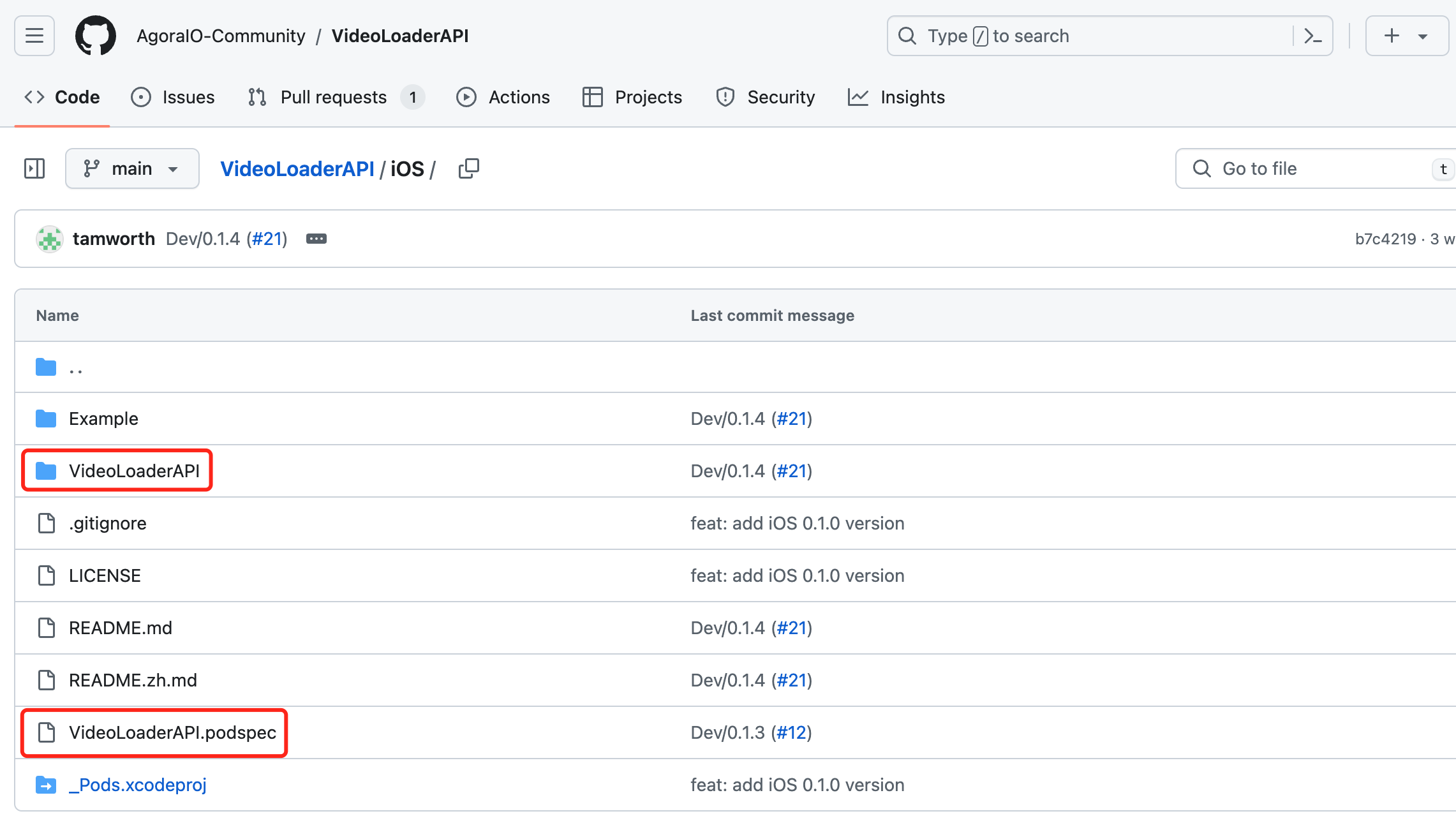
1. Copy the following folders and files from the repository to the same folder as your `*.xcodeproj` file:
* [`VideoLoaderAPI`](https://github.com/AgoraIO-Community/VideoLoaderAPI/tree/main/iOS/VideoLoaderAPI) folder
* [`VideoLoaderAPI.podspec`](https://github.com/AgoraIO-Community/VideoLoaderAPI/blob/main/iOS/VideoLoaderAPI.podspec) file
Note
To facilitate subsequent code upgrades, do not modify the names and paths of the files you add.
\:::
1. In the terminal, go to the directory where the `*.xcodeproj` file is located and run the `pod init` command. A **Podfile** text file is generated in the project folder.
2. Open the **Podfile** file and modify it as follows:
```ruby
source 'https://github.com/CocoaPods/Specs.git'
use_frameworks!
platform :ios, '13.0'
# Change the target to the actual Target name in your project.
target 'VideoLoaderAPI_Example' do
pod 'VideoLoaderAPI', :path => 'VideoLoaderAPI.podspec'
target 'VideoLoaderAPI_Tests' do
inherit! :search_paths
end
end
```
3. In the terminal, go to the directory where the `*.xcodeproj` file is located and execute `pod install` to install the dependencies.
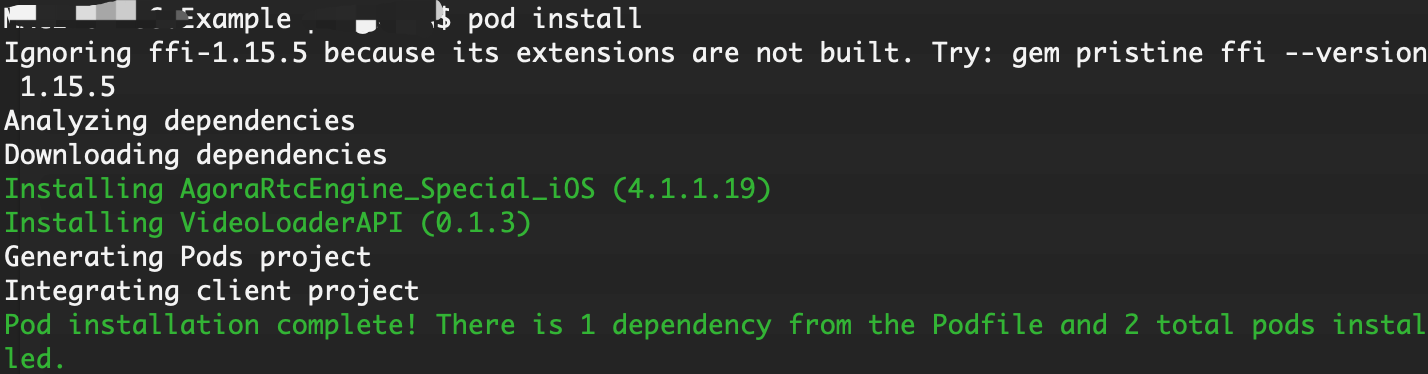
After successful installation of the dependency library, you see a `*.xcworkspace` file.
4. (Optional) If you have previously integrated a Video SDK dependency in your project, open the `VideoLoaderAPI.podspec` file and modify the dependency version as needed.
```bash
# 4.1.1.19 is the default version installed in step 4, if you are using a different version, change it to the current one.
s.dependency 'AgoraRtcEngine_Special_iOS', '4.1.1.19'
```
Follow these steps to implement fast channel joining and switching:
### Prepare to use the VideoLoader API [#prepare-to-use-the-videoloader-api-1]
Take the following steps before using the fast joining and fast switching features:
1. Initialize `AgoraRtcEngineKit` and `VideoLoader` instances.
In the default `ViewController` of the project file, call the `sharedEngine(with:)` method of Video SDK to create and initialize an `AgoraRtcEngineKit` instance. Then, initialize the `VideoLoader`.
```swift
func prepareEngine() {
// Create an Instance of AgoraRtcEngineKit
let engine = _createRtcEngine()
// Obtain a shared instance of VideoLoaderApiImpl
let loader = VideoLoaderApiImpl.shared
loader.addListener(listener: self)
// Creating a VideoLoaderConfig instance
let config = VideoLoaderConfig()
// Setting up an AgoraRtcEngineKit instance
config.rtcEngine = engine
// Initialize VideoLoader
loader.setup(config: config)
}
// Initializing AgoraRtcEngineKit
private func _createRtcEngine() -> AgoraRtcEngineKit {
let config = AgoraRtcEngineConfig()
// Use the App Id of your project from the console
config.appId = KeyCenter.AppId
config.channelProfile = .liveBroadcasting
config.audioScenario = .gameStreaming
config.areaCode = .global
let engine = AgoraRtcEngineKit.sharedEngine(with: config,
delegate: nil)
return engine
}
```
2. Use a wildcard token.
To speed up the process of users joining a channel, use a [wildcard token](/en/realtime-media/broadcast-streaming/build/authenticate-users/deploy-token-server#generate-wildcard-tokens). Generate the token on your server and pass it to the client for authentication.
Note
Using wildcard tokens carries security risks, such as room bombing. Evaluate whether wildcard tokens are appropriate for your use case before implementation.
\:::
### Fast channel joining [#fast-channel-joining-1]
This section explains how to create a seamless, instant-opening experience in live broadcast scenarios.
1. Add a UI component for the live broadcast room list.
Implement a UI component to display a list of live broadcast rooms. The following example uses a `UICollectionView`:
```swift
private lazy var listView: UICollectionView = {
let layout = UICollectionViewFlowLayout()
layout.minimumLineSpacing = 5
layout.minimumInteritemSpacing = 5
layout.sectionInset = .zero
let w = view.bounds.width / 2 - 5
layout.itemSize = CGSize(width: w, height: w * 1.5)
let collectionView = UICollectionView(frame: self.view.bounds, collectionViewLayout: layout)
collectionView.backgroundColor = .white
collectionView.register(UICollectionViewCell.self, forCellWithReuseIdentifier: "videoloader_listcell")
collectionView.scrollsToTop = false
collectionView.delegate = self.delegateHandler
collectionView.dataSource = self
collectionView.contentInsetAdjustmentBehavior = .never
collectionView.showsVerticalScrollIndicator = false
return collectionView
}()
```
2. Listen for scrolling events.
Create an instance of `AGCollectionLoadingDelegateHandler` and assign it as the delegate for the live room list UI to handle scrolling events. When initializing the `AGCollectionLoadingDelegateHandler` instance, pass the local user's `uid` in the `localUid` parameter of the constructor.
The `AGCollectionLoadingDelegateHandler` listens for scrolling events in the live broadcast room list and automatically preloads the live room channels that come into view (`preloadChannel`). This improves loading speed and enhances the user experience.
```swift
// The following code is from the ViewController for the live room list.
class ShowRoomListVC: UIViewController {
// Create an instance of AGCollectionLoadingDelegateHandler.
private lazy var delegateHandler: AGCollectionLoadingDelegateHandler = {
let handler = AGCollectionLoadingDelegateHandler(localUid: localUid)
return handler
}()
// Business service module for managing room data.
private lazy var service: ShowServiceProtocol = AppContext.showServiceImp("")
// List of live rooms
private var roomList = [ShowRoomListModel]() {
didSet {
// Update delegateHandler with the latest room list
delegateHandler.roomList = AGRoomArray(roomList: roomList)
collectionView.reloadData()
}
}
override func viewDidLoad() {
super.viewDidLoad()
// Perform any additional setup after loading the view.
// ...
prepareEngine()
// Set delegate and data source for the room list UI.
listView.delegate = self.delegateHandler
listView.dataSource = self
// Fetch the live room list from the service.
service.getRoomList(page: 1) { [weak self] error, roomList in
self?.roomList = roomList ?? []
}
}
}
```
3. Listen for touch events.
In the `DataSource` protocol of the native `listView`, create a Cell inside the `cellForItemAt` method. When initializing the Cell, use the `ag_addPreloadTap` method to listen for touch events on a specific live broadcast room.
When calling `ag_addPreloadTap`, provide the following parameters:
* `roomInfo`: A `VideoLoader.RoomInfo` instance containing details of the live room.
* `localUid`: The uid of the local user.
* `enableProcess`: A callback function triggered when the user taps the Cell. Use this function to implement business logic, such as verifying whether the token has been successfully obtained.
* `onRequireRenderVideo`: A callback function that handles rendering the host's video feed. It is recommended to create the video container in advance and assign the returned object to it when the `onRequireRenderVideo` event is triggered. This ensures that `ag_addPreloadTap` automatically attaches and renders the host’s video on the designated container.
* `completion`: A callback function executed when the user enters the live broadcast page.
When a user taps a live broadcast room, `ag_addPreloadTap` automatically follows best practices, including joining the selected live broadcast channel. Consequently, you do not need to manually call `joinChannelByToken` or similar methods to handle channel joining within your business logic.
```swift
// The code snippet comes from the ViewController for the list of live streams.
extension ShowRoomListVC: UICollectionViewDataSource {
func collectionView(_ collectionView: UICollectionView, numberOfItemsInSection section: Int) -> Int {
// Return the total number of rooms in the room list
return roomList.count
}
func collectionView(_ collectionView: UICollectionView, cellForItemAt indexPath: IndexPath) -> UICollectionViewCell {
let cell: ShowRoomListCell = collectionView.dequeueReusableCell(withReuseIdentifier: NSStringFromClass(ShowRoomListCell.self), for: indexPath) as! ShowRoomListCell
// Get the room data corresponding to the current index
let room = roomList[indexPath.item]
// Configure the Cell with room details
// ...
// Add a touch event to handle user interaction
cell.ag_addPreloadTap(roomInfo: room, localUid: delegateHandler.localUid) { [weak self] state in
if AppContext.shared.rtcToken?.count ?? 0 == 0 {
// If no token has been obtained
if state == .began {
// If the touch event starts (pressing down), retrieve a new token
self?.preGenerateToken()
} else if state == .ended {
// If the touch event completes but the token is still unavailable, prevent the user from entering the live room
ToastView.show(text: "Token does not exist, try again!")
}
return false
}
return true
} onRequireRenderVideo: { _ in
// Provide a container for rendering the host's video feed (if available)
return nil
} completion: { [weak self] in
// Enter the live stream
self?.joinRoom(room)
}
return cell
}
}
```
### Fast channel switching [#fast-channel-switching-1]
This section explains how to enable viewers to switch live broadcast channels quickly.
1. Implement a UI component for sliding between live broadcast rooms.
The following example uses a `UICollectionView`:
```swift
private lazy var collectionView: UICollectionView = {
let layout = UICollectionViewFlowLayout()
layout.minimumLineSpacing = 0
layout.minimumInteritemSpacing = 0
layout.sectionInset = .zero
layout.itemSize = self.view.bounds.size
let collectionView = UICollectionView(frame: self.view.bounds, collectionViewLayout: layout)
collectionView.register(UICollectionViewCell.self, forCellWithReuseIdentifier: NSStringFromClass(UICollectionViewCell.self))
collectionView.scrollsToTop = false
collectionView.isPagingEnabled = true
collectionView.contentInsetAdjustmentBehavior = .never
collectionView.bounces = false
collectionView.showsVerticalScrollIndicator = false
return collectionView
}()
```
2. Listen for live room switching events.
Create an `AGCollectionSlicingDelegateHandler` instance and register it as the slide event delegate for the `CollectionView` live broadcast room. To create the `AGCollectionSlicingDelegateHandler` instance, pass the following parameters to the constructor:
* `localUid`: `uid` of the local user.
* `needPreJoin`: Determines whether to prejoin the adjacent live broadcast rooms (above and below the current one). Setting this to `true` improves instant switching but increases resource consumption.
* `videoType`: Switch the timing of live broadcast room video display.
* `audioType`: Switch the timing of the live broadcast room audio display.
* `onRequireRenderVideo`: The callback function to render the host view of the corresponding live broadcast room. At this time, pass in the container for the host screen of the corresponding live broadcast room. The `AGCollectionSlicingDelegateHandler` instance adds and renders the host screen on that container.
The `AGCollectionSlicingDelegateHandler` instance listens to the `CollectionView` slide event of the live broadcast room. It implements the best practices encapsulated in the `AGCollectionSlicingDelegateHandler` class and switches the audio/video subscription behavior of different live broadcast rooms at the best time.
When creating the `ViewController`, call the `roomList` method to pass the initial live broadcast room list information to the `AGCollectionSlicingDelegateHandler` instance.
```swift
// The code snippet comes from the ViewController for the room list
class ShowLivePagesViewController: ViewController {
// Creating an AGCollectionSlicingDelegateHandler instance
private lazy var delegateHandler = {
let handler = AGCollectionSlicingDelegateHandler(localUid: localUid, needPrejoin: needPrejoin)
handler.videoSlicingType = videoType
handler.audioSlicingType = audioType
handler.onRequireRenderVideo = { [weak self] info, cell, indexPath in
// Perform the appropriate action at the optimal time to render the host screen
return ...
}
return handler
}()
// Pass the initial live room list information to the AGCollectionSlicingDelegateHandler instance
var roomList: [ShowRoomListModel]? {
didSet {
delegateHandler.roomList = AGRoomArray(roomList: roomList)
}
}
// Register the delegateHandler instance as the slide event proxy for the CollectionView in the live streaming room
override func viewDidLoad() {
super.viewDidLoad()
// Setting up a proxy
collectionView.delegate = delegateHandler
collectionView.dataSource = self
...
}
}
```
### Release resources [#release-resources-1]
After using the `VideoLoaderAPI`, you do not need to call `leaveChannel` in the business layer to leave the live broadcast. To release resources, refer to the following sample code:
```swift
VideoLoaderApiImpl.shared.cleanCache()
AgoraRtcEngineKit.destroy()
```