# Stream media to a channel (/en/realtime-media/broadcast-streaming/build/manage-video-and-streaming/play-media/unity)
> For AI agents: see the complete documentation index at [llms.txt](/llms.txt).
Playing media files during online business presentations, educational sessions, or casual meetups heightens user engagement. Video SDK enables you to add media playing functionality to your game.
This page shows you how to use media player-related APIs to play local or online media resources with remote users in Broadcast Streaming channels.
## Understand the tech [#understand-the-tech-6]
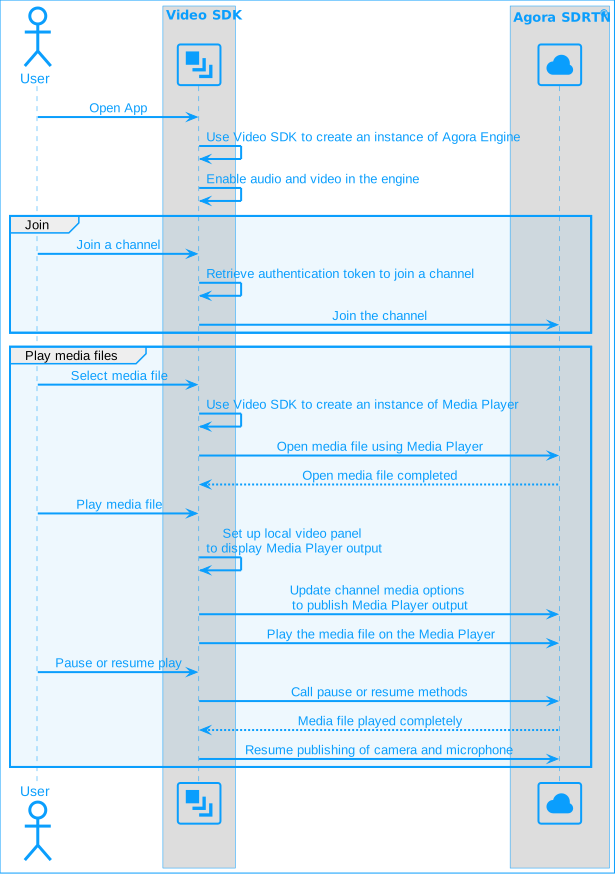
To play a media file in a channel, you open the file using a media player instance. When the file is ready to be played, you set up the local video container to display the media player output. You update channel media options to start publishing the media player stream, and stop publishing the camera and microphone streams. The remote user sees the camera and microphone streams of the media publishing user replaced by media streams.
**Media player flow**
## Prerequisites [#prerequisites-6]
Ensure that you have implemented the [SDK quickstart](../../index) in your project.
## Implement the logic [#implement-the-logic-6]
To implement a media player in your game, follow these steps:
### Create a media player object [#create-a-media-player-object]
After initializing an `IRtcEngine` instance, call `createMediaPlayer` to create an `IMediaPlayer` object.
```csharp
MediaPlayer = RtcEngine.CreateMediaPlayer();
if (MediaPlayer == null)
{
this.Log.UpdateLog("Failed to create media player.");
return;
}
```
If you need multiple media player objects, call `createMediaPlayer` multiple times.
### Register callback events and implement callbacks [#register-callback-events-and-implement-callbacks]
Call `InitEventHandler` from the `IMediaPlayer` class to register media player callback events.
```csharp
MpkEventHandler handler = new MpkEventHandler(this);
MediaPlayer.InitEventHandler(handler);
this.Log.UpdateLog("Player ID: " + MediaPlayer.GetId());
```
Implement `IMediaPlayerSourceObserver` callbacks as needed.
```csharp
class MpkEventHandler : IMediaPlayerSourceObserver
{
// Report player status changes
public override void OnPlayerSourceStateChanged(MEDIA_PLAYER_STATE state, MEDIA_PLAYER_REASON reason)
{
}
// Report player events
public override void OnPlayerEvent(MEDIA_PLAYER_EVENT @event, Int64 elapsedTime, string message)
{
Debug.Log($"OnPlayerEvent state: {@event}");
}
// Report preload events
public override void OnPreloadEvent(string src, PLAYER_PRELOAD_EVENT @event)
{
Debug.Log($"OnPreloadEvent src: {src}, event: {@event}");
}
// Report media resource playback progress
public override void OnPositionChanged(long positionMs, long timestampMs)
{
}
}
```
### Set the video rendering window [#set-the-video-rendering-window]
To play a video, set the video renderer after opening the media resource. Destroy the video view when playback stops. Use `GetId` to retrieve the player ID and set `VIDEO_SOURCE_TYPE` to `VIDEO_SOURCE_MEDIA_PLAYER`.
```csharp
// Handle player status changes
public override void OnPlayerSourceStateChanged(MEDIA_PLAYER_STATE state, MEDIA_PLAYER_REASON reason)
{
Debug.Log($"State: {state}, Reason: {reason}, Player ID: {_sample.MediaPlayer.GetId()}");
if (state == MEDIA_PLAYER_STATE.PLAYER_STATE_OPEN_COMPLETED)
{
// Create a view to display the video stream when the media resource opens
MakeVideoView((uint)_sample.MediaPlayer.GetId(), "", VIDEO_SOURCE_TYPE.VIDEO_SOURCE_MEDIA_PLAYER);
}
else if (state == MEDIA_PLAYER_STATE.PLAYER_STATE_STOPPED)
{
// Destroy the video view after playback stops
DestroyVideoView((uint)_sample.MediaPlayer.GetId());
}
}
```
To set the video display, call `SetForUser`, and start rendering with `SetEnable`.
```csharp
// Create a video view
static void MakeVideoView(uint uid, string channelId = "", VIDEO_SOURCE_TYPE videoSourceType = VIDEO_SOURCE_TYPE.VIDEO_SOURCE_CAMERA)
{
var go = GameObject.Find(uid.ToString());
if (go != null) return;
// Create a GameObject for rendering video
var videoSurface = MakeImageSurface(uid.ToString());
if (videoSurface == null) return;
// Set up video display
videoSurface.SetForUser(uid, channelId, videoSourceType);
videoSurface.SetEnable(true);
// Adjust video surface size
videoSurface.OnTextureSizeModify += (int width, int height) =>
{
var transform = videoSurface.GetComponent();
if (transform != null)
{
transform.sizeDelta = new Vector2(width / 2, height / 2);
transform.localScale = Vector3.one;
}
else
{
float scale = (float)height / (float)width;
videoSurface.transform.localScale = new Vector3(-1, 1, scale);
}
Debug.Log($"Texture size modified: {width} x {height}");
};
}
// Destroy the video view
static void DestroyVideoView(uint uid)
{
var go = GameObject.Find(uid.ToString());
if (go != null)
{
Destroy(go);
}
}
// Create a video view with a RawImage component
private static VideoSurface MakeImageSurface(string goName)
{
GameObject go = new GameObject(goName);
go.AddComponent();
go.AddComponent();
var canvas = GameObject.Find("VideoCanvas");
if (canvas != null)
{
go.transform.SetParent(canvas.transform);
Debug.Log("Added video view");
}
else
{
Debug.Log("Canvas not found for video view");
}
go.transform.Rotate(0f, 0f, 180f);
go.transform.localPosition = Vector3.zero;
go.transform.localScale = new Vector3(4.5f, 3f, 1f);
return go.AddComponent();
}
```
### Open media resources [#open-media-resources]
Call `Open` to load a local or online media file. You can also set the playback start position. For supported formats, see [Supported Formats](#supported-formats-and-protocols).
```csharp
public void OnOpenButtonPress()
{
var ret = MediaPlayer.Open("Your File Path", 0);
Debug.Log("Open returns: " + ret);
}
```
Alternatively, use `OpenWithMediaSource` to open media resources and configure playback settings, like automatic playback and real-time caching.
### Publish the audio and video streams [#publish-the-audio-and-video-streams]
When joining a channel, set the `ChannelMediaOptions` as follows:
```csharp
ChannelMediaOptions options = new ChannelMediaOptions();
// Enable automatic subscription to audio and video streams
options.autoSubscribeAudio.SetValue(true);
options.autoSubscribeVideo.SetValue(true);
options.publishCustomAudioTrack.SetValue(false);
options.publishCameraTrack.SetValue(false);
// Enable publishing audio and video streams from the media player
options.publishMediaPlayerAudioTrack.SetValue(true);
options.publishMediaPlayerVideoTrack.SetValue(true);
// Provide the media player ID
options.publishMediaPlayerId.SetValue(MediaPlayer.GetId());
// Enable audio playback
options.enableAudioRecordingOrPlayout.SetValue(true);
// Set the user role to broadcaster
options.clientRoleType.SetValue(CLIENT_ROLE_TYPE.CLIENT_ROLE_BROADCASTER);
var ret = RtcEngine.JoinChannel(_token, _channelName, 0, options);
this.Log.UpdateLog($"JoinChannel returns: {ret}");
```
### Playback control [#playback-control]
1. Call `Play` to start playing a local or online media resource.
```csharp
public void OnPlayButtonPress()
{
var ret = MediaPlayer.Play();
Debug.Log($"Play return: {ret}");
}
```
If you use `Open` to load a media resource, wait for the `OnPlayerSourceStateChanged` callback to report the state as `PLAYER_STATE_OPEN_COMPLETED` before calling `Play`. If you use `OpenWithMediaSource` with `autoPlay` enabled, playback starts automatically.
1. To loop playback, call `SetLoopCount`. Set the value to `-1` for infinite looping. The default value of `0` means no loop playback.
```csharp
public void OnPlayButtonPress()
{
MediaPlayer.SetLoopCount(this.IsLoop() ? -1 : 0);
var ret = MediaPlayer.Play();
this.Log.UpdateLog($"Play return: {ret}");
}
```
2. To play from a specific position, use `Seek`. Ensure `Seek` is called after receiving the `PLAYER_STATE_OPEN_COMPLETED` state in the `OnPlayerSourceStateChanged` callback.
If you call `Seek` while playback is paused, the media remains paused after the call. Call `Resume` or `Play` to continue playback.
3. Call `SetPlaybackSpeed` to control the playback speed.
```csharp
public void OnSetPlaybackSpeedButtonPress()
{
var ret = MediaPlayer.SetPlaybackSpeed(2);
this.Log.UpdateLog($"SetPlaybackSpeed return: {ret}");
}
```
#### Pause, resume, and stop [#pause-resume-and-stop]
To control playback, use the following methods:
* `Pause`: Pauses playback.
```csharp
public void OnPauseButtonPress()
{
var ret = MediaPlayer.Pause();
this.Log.UpdateLog($"Pause return: {ret}");
}
```
* `Resume`: Resumes playback after pausing.
```csharp
public void OnResumeButtonPress()
{
var ret = MediaPlayer.Resume();
this.Log.UpdateLog($"Resume returns: {ret}");
}
```
* `Stop`: Stops playback. Reopen the media resource to play again.
```csharp
public void OnStopButtonPress()
{
var ret = MediaPlayer.Stop();
this.Log.UpdateLog($"Stop return: {ret}");
}
```
### Adjust the volume [#adjust-the-volume]
To adjust the local playback volume, call `AdjustPlayoutVolume`. To adjust the volume of the audio stream sent to the remote end, call `AdjustPublishSignalVolume`.
```csharp
var ret = MediaPlayer.AdjustPlayoutVolume(30);
this.Log.UpdateLog($"AdjustPlayoutVolume return: {ret}");
ret = MediaPlayer.AdjustPublishSignalVolume(50);
this.Log.UpdateLog($"AdjustPublishSignalVolume return: {ret}");
```
### Preload media resources [#preload-media-resources]
To play multiple media resources continuously, preload the media resources to ensure optimal audience experience when switching resources.
1. Call `PreloadSrc` to preload media resources. To load multiple resources, call this method multiple times. Listen to the `OnPreloadEvent` callbacks to receive preload related events.
```csharp
public void OnPreloadSrcButtonClick()
{
var nRet = MediaPlayer.PreloadSrc(PRELOAD_URL, 0);
this.Log.UpdateLog("PreloadSrc: " + nRet);
}
```
2. Call `PlayPreloadedSrc` to play the preloaded media resource. After you call this method successfully, you receive a `OnPlayerStateChanged` callback reporting status `PLAYER_STATE_PLAYING`.
```csharp
public void OnPlayPreloadButtonClick()
{
var nRet = MediaPlayer.PlayPreloadedSrc(PRELOAD_URL);
this.Log.UpdateLog("PlayPreloadedSrc: " + nRet);
}
```
3. When you no longer need the loaded media resources, call `UnloadSrc` to release the preloaded resources.
```csharp
var nRet = MediaPlayer.UnloadSrc(PRELOAD_URL);
this.Log.UpdateLog("UnloadSrc: " + nRet);
```
### Leave channel [#leave-channel]
Follow these steps to leave a channel:
1. Call `DestroyMediaPlayer` to destroy the media player object.
2. Call `InitEventHandler` to unregister the player event observer.
3. Call `LeaveChannel` to leave the channel.
4. Call `Dispose` to destroy `IRtcEngine` object and releases resources used by the SDK.
```csharp
public void OnLeaveChannelButtonPress()
{
if (RtcEngine == null) return;
// Destroy the media player object
if (MediaPlayer != null) RtcEngine.DestroyMediaPlayer(MediaPlayer);
// Unregister the media player event handler
RtcEngine.InitEventHandler(null);
// Leave the channel
RtcEngine.LeaveChannel();
// Destroy the engine and release resources
RtcEngine.Dispose();
RtcEngine = null;
MediaPlayer = null;
}
```
## Reference [#reference-6]
This section contains content that completes the information on this page, or points you to documentation that explains other aspects to this product.
### Supported formats and protocols [#supported-formats-and-protocols-4]
The media player supports the following media formats and protocols:
#### Video encoding formats [#video-encoding-formats-4]
* H.263, H.264, H.265, MPEG-4, MPEG-2, RMVB, Theora, VP3, VP8, AVS, WMV
#### Audio coding formats [#audio-coding-formats-4]
* WAV, MP2, MP3, AAC, OPUS, FLAC, Vorbis, AMR-NB, AMR-WB, WMA v1, WMA v2
#### Container formats [#container-formats-4]
* WAV, FLAC, OGG, MOV, ASF, FLV, MP3, MP4, MPEG-TS, Matroska (MKV), AVI, ASS, CONCAT, DTS, AVS
#### Supported protocols [#supported-protocols-4]
* HTTP, HTTPS, RTMP, HLS, RTP, RTSP
### Sample project [#sample-project-6]
Agora provides an open source sample project [MediaPlayer](https://github.com/AgoraIO-Extensions/Agora-Unity-Quickstart/blob/main/API-Example-Unity/Assets/API-Example/Examples/Advanced/MediaPlayer/MediaPlayerExample.cs) on GitHub. Download it or view the source code for a more detailed example.
### API reference [#api-reference-6]
* [`CreateMediaPlayer`](https://api-ref.agora.io/en/video-sdk/unity/4.x/API/class_irtcengine.html#api_irtcengine_createmediaplayer)
* [`InitEventHandler`](https://api-ref.agora.io/en/video-sdk/unity/4.x/API/class_imediaplayer.html#api_imediaplayer_initeventhandler)
* [`OnPlayerStateChanged`](https://api-ref.agora.io/en/video-sdk/unity/4.x/API/class_imediaplayersourceobserver.html#callback_imediaplayersourceobserver_onplayersourcestatechanged)
* [`OnPositionChanged`](https://api-ref.agora.io/en/video-sdk/unity/4.x/API/class_imediaplayersourceobserver.html#callback_imediaplayersourceobserver_onpositionchanged)
* [`GetMediaPlayerId`](https://api-ref.agora.io/en/video-sdk/unity/4.x/API/class_imediaplayer.html#api_imediaplayer_registeraudioframeobserver2__parameters)
* [`Open`](https://api-ref.agora.io/en/video-sdk/unity/4.x/API/class_imediaplayer.html#api_imediaplayer_open)
* [`Play`](https://api-ref.agora.io/en/video-sdk/unity/4.x/API/class_imediaplayer.html#api_imediaplayer_play)
* [`Pause`](https://api-ref.agora.io/en/video-sdk/unity/4.x/API/class_imediaplayer.html#api_imediaplayer_pause)
* [`Stop`](https://api-ref.agora.io/en/video-sdk/unity/4.x/API/class_imediaplayer.html#api_imediaplayer_stop)