# Virtual Background (/en/realtime-media/broadcast-streaming/build/apply-effects-and-enhancements/virtual-background/windows)
> For AI agents: see the complete documentation index at [llms.txt](/llms.txt).
Virtual Background enables users to blur their background, or replace it with a solid color or an image. This feature is applicable to use-cases such as online conferences, online classes, and live streaming. It helps protect personal privacy and reduces audience distraction.
## Understand the tech [#understand-the-tech-3]
Virtual Background offers the following options:
| Feature | Example |
| --------------------------------------- | --------------------------------------------------------------------------------------------------------------------------------------------------------------------------------------------------------------------------------------------------------------------------------------------------------------------- |
| Blurred background and image background | 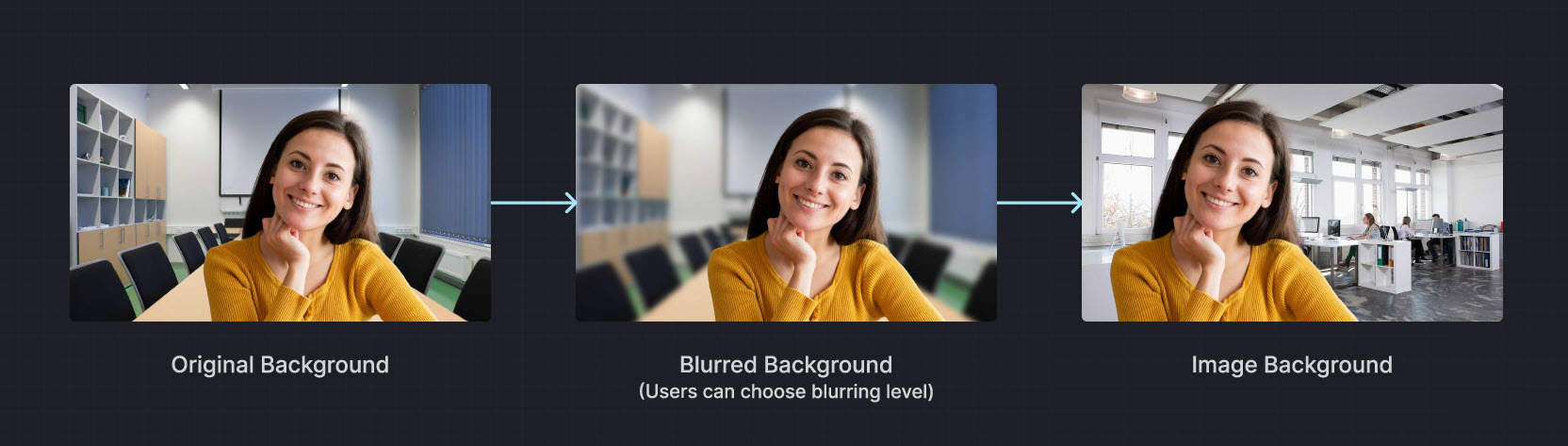 |
| Video/Animated background | |
| Portrait-in-picture |  Allows the presenter to use slides as the virtual background while superimposing their video. The effect is similar to a weather news cast on television, preventing interruptions during a layout toggle. |
Want to test Virtual Background? Try the online demo.
## Prerequisites [#prerequisites-3]
Ensure that you have implemented the [SDK quickstart](../../index) in your project.
## Implement virtual background [#implement-virtual-background-3]
This section shows you how to add a virtual background to the local video.
### Check device compatibility [#check-device-compatibility-2]
To avoid performance degradation or unavailable features when enabling Virtual Background on low-end devices, check whether the device supports the feature.
```cpp
if (!(m_rtcEngine->isFeatureAvailableOnDevice(FeatureType::VIDEO_VIRTUAL_BACKGROUND)))
{
AfxMessageBox(L"Device doesn't support virtual background");
return;
}
```
### Set a blurred background [#set-a-blurred-background-2]
To blur the video background, use the following code:
```cpp
void SetBackgroundBlur(VirtualBackgroundSource& virtualBackgroundSource) {
VirtualBackgroundSource virtualBackgroundSource;
SegmentationProperty segmentationProperty;
// Set background blur
virtualBackgroundSource.background_source_type = VirtualBackgroundSource:BACKGROUND_BLUR;
virtualBackgroundSource.blur_degree = VirtualBackgroundSource::BLUR_DEGREE_HIGH;
// Set processing properties for background
segmentationProperty.modelType = SegmentationProperty::SEG_MODEL_AI;
segmentationProperty.greenCapacity = 0.5F;
// Enable or disable virtual background
m_rtcEngine->enableVirtualBackground(true, virtualBackgroundSource, segmentationProperty);
}
```
### Set a color background [#set-a-color-background-2]
To apply a solid color as the virtual background, use a hexadecimal color code. For example, `0x0000FF` for blue:
```cpp
void SetBackgroundColor(VirtualBackgroundSource& virtualBackgroundSource) {
VirtualBackgroundSource virtualBackgroundSource;
SegmentationProperty segmentationProperty;
// Set a solid background color
virtualBackgroundSource.background_source_type = VirtualBackgroundSource::BACKGROUND_COLOR;
virtualBackgroundSource.color = 0x0000FF;
// Set processing properties for background
segmentationProperty.modelType = SegmentationProperty::SEG_MODEL_AI;
segmentationProperty.greenCapacity = 0.5F;
// Enable or disable virtual background
m_rtcEngine->enableVirtualBackground(true, virtualBackgroundSource, segmentationProperty);
}
```
### Set an image background [#set-an-image-background-2]
To set a custom image as the virtual background, specify the absolute path to the image file.
```cpp
void SetBackgroundImage(VirtualBackgroundSource& virtualBackgroundSource) {
VirtualBackgroundSource virtualBackgroundSource;
SegmentationProperty segmentationProperty;
// Set a background image
virtualBackgroundSource.background_source_type = VirtualBackgroundSource::BACKGROUND_IMG;
virtualBackgroundSource.source = "";
// Set processing properties for background
segmentationProperty.modelType = SegmentationProperty::SEG_MODEL_AI;
segmentationProperty.greenCapacity = 0.5F;
// Enable or disable virtual background
m_rtcEngine->enableVirtualBackground(true, virtualBackgroundSource, segmentationProperty);
}
```
### Reset the background [#reset-the-background-2]
To disable the virtual background and revert to the original video state, use the following code:
```cpp
void ResetVirtualBackground() {
// Set a default or reset state for the virtual background
VirtualBackgroundSource virtualBackgroundSource;
SegmentationProperty segmentationProperty;
// For example, setting a default background color
virtualBackgroundSource.background_source_type = VirtualBackgroundSource::BACKGROUND_COLOR;
virtualBackgroundSource.color = 0xFFFFFF;
// Set processing properties for background
segmentationProperty.modelType = SegmentationProperty::SEG_MODEL_AI;
segmentationProperty.greenCapacity = 0.5F;
// Disable virtual background
m_rtcEngine->enableVirtualBackground(false, virtualBackgroundSource, segmentationProperty);
}
```
## Reference [#reference-3]
This section contains content that completes the information in this page, or points you to documentation that explains other aspects to this product.
### API reference [#api-reference-3]
* [`isFeatureAvailableOnDevice`](https://api-ref.agora.io/en/video-sdk/cpp/4.x/API/class_irtcengine.html#api_irtcengine_isfeatureavailableondevice)
* [`enableVirtualBackground`](https://api-ref.agora.io/en/video-sdk/cpp/4.x/API/class_irtcengine.html#api_irtcengine_enablevirtualbackground)
* [`VirtualBackgroundSource`](https://api-ref.agora.io/en/video-sdk/cpp/4.x/API/class_virtualbackgroundsource.html)
* [`SegmentationProperty`](https://api-ref.agora.io/en/video-sdk/cpp/4.x/API/class_segmentationproperty.html)